Historical record

A demonstration record, compiled from public archives. Scott Joplin did not write it; the institutions cited here did. Sources and clearance →

PortfolioSource ofYOU

c. 1868 to 1917

Scott Joplin

Scott Joplin published a rag that made his name and an opera he never saw staged in full, a distance the record keeps rather than resolves.

01About

The record gives his birth only as sometime between the summer of 1867 and mid-January 1868, on the Texas-Arkansas border; no more precise date survives in the institutional record consulted here. He trained in Sedalia, Missouri, studying music at George R. Smith College and playing in local ensembles, including the Queen City Cornet Band, before opening his own piano studio and teaching younger composers. Engagements at Sedalia's Maple Leaf Club inspired the tune he published in 1899 as Maple Leaf Rag, through John Stark, his major publisher. In 1908 he self-published School of Ragtime, a treatise instructing pianists to give each note its proper value and never play ragtime fast. In 1911, at his own expense, he published the vocal score of Treemonisha, an opera in three acts with his own libretto, which the Library of Congress catalogs at 230 pages. The opera reached him twice while he lived: a full cast read it through once, without orchestra, scenery, or costumes, for an audience of seventeen in 1911, and a student orchestra played its Act II ballet alone in May 1915. He died in 1917; the opera was not given a fully staged, orchestrated production until January 1972, in Atlanta, fifty-five years later.
02Selected work/ 04
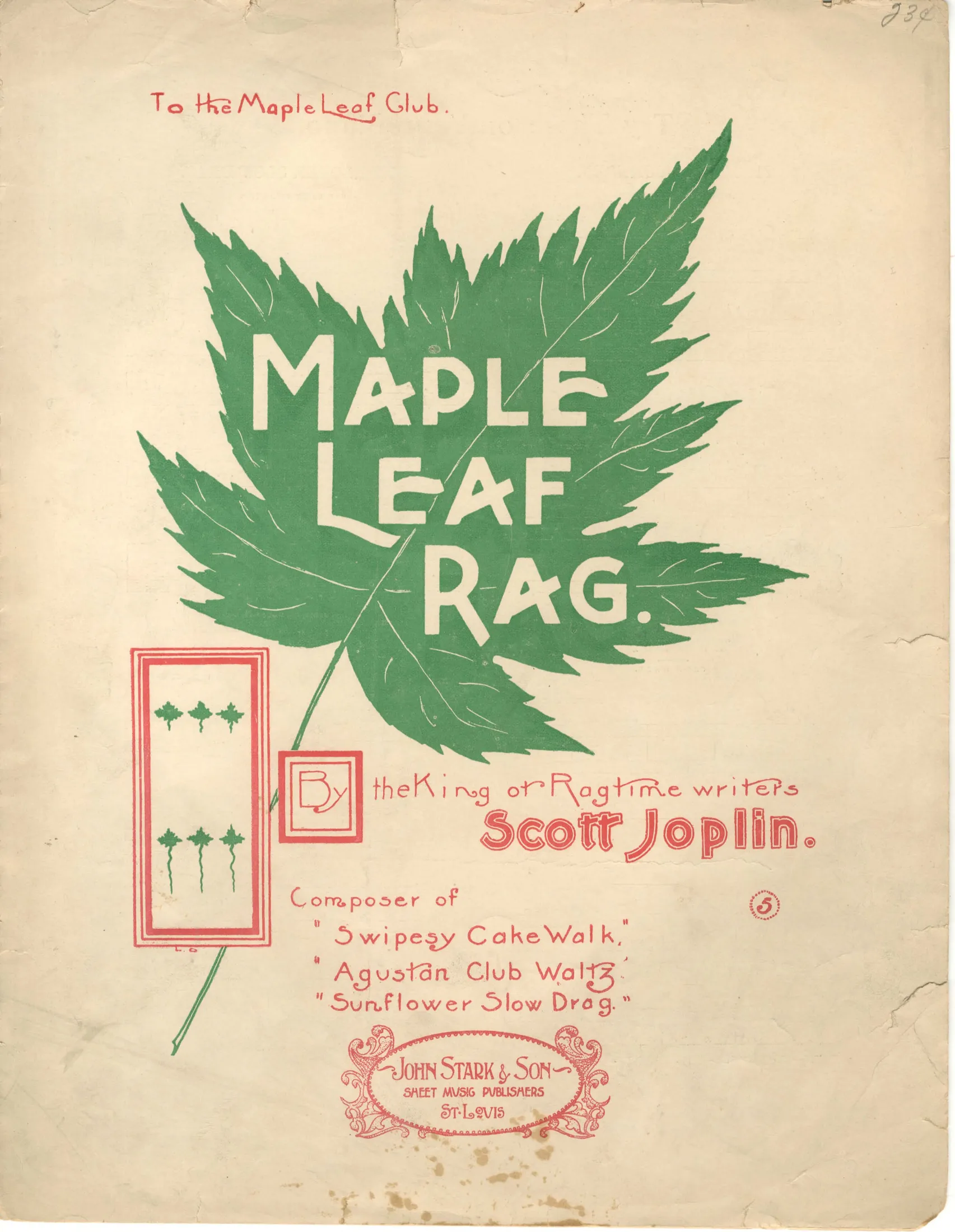
The illustrated title plate of the sheet music for Maple Leaf Rag, issued in St. Louis by John Stark and Son, with the title set large over an ornamented panel.
011899

Maple Leaf Rag

Published by Stark Music Co. The Gaylord Music Library's copy carries the publisher's own cover credit, "king of ragtime writers Scott Joplin," and is dated by the library to a printing of 1910 or later.

Gaylord Music Library, Washington University in St. Louis. Public Domain Mark 1.0

  1. 021908

    School of Ragtime

    A self-published treatise instructing pianists to give each note its proper value and never play ragtime fast.

  2. 031911

    Treemonisha

    Opera in three acts, words and music by Joplin, published at his own expense; the Library of Congress catalogs the vocal score at 230 pages.

  3. 041902

    The Entertainer

    A rag that became, decades later, the musical cornerstone of the film The Sting, helping drive a 1970s ragtime revival.

03Career
  1. 1899

    Maple Leaf Rag published

    Published by John Stark; the Library of Congress catalog record does not identify a place of publication.

  2. 1908

    School of Ragtime published

    Joplin self-published this treatise on playing ragtime correctly, warning against playing it fast.

  3. 1911

    Treemonisha published

    Joplin self-published the 230-page vocal score of his opera in three acts, words and music his own.

  4. 1911

    Treemonisha read through, unstaged

    A full cast read the opera through once, without orchestra, scenery, or costumes, for an audience of seventeen; a student orchestra played its Act II ballet alone in May 1915.

  5. 1917

    Joplin dies

    He died in April 1917.

  6. 1972

    Treemonisha fully staged

    First full, orchestrated production, in Atlanta, fifty-five years after Joplin's death.

  7. 1973

    The Entertainer reaches a wide audience

    The 1902 rag became the musical cornerstone of the film The Sting, driving a ragtime revival.

  8. 1976

    Pulitzer special citation

    The Pulitzer Board bestowed a posthumous special award on Joplin, in the US Bicentennial year, for his contributions to American music.

04Recognition

230 pages

Length of the 1911 Treemonisha vocal score he self-published.

1899

Year the Library of Congress catalog dates Joplin's Maple Leaf Rag, published by John Stark.

17

People in the audience for the one full read-through of Treemonisha in his lifetime, 1911.

55 years

From Joplin's death in 1917 to Treemonisha's first full, orchestrated staging, in Atlanta, in 1972.

1976

Year the Pulitzer Board bestowed a posthumous special citation on Joplin.

05Perspective

School of Ragtime, from the printed remarks, 1908

"What is scurrilously called ragtime is an invention that is here to stay. That is now conceded by all classes of musicians." The opening of the prefatory remarks, printed page 3 of School of Ragtime, six exercises for piano, New York, 1908. Read at the Library of Congress page image.

School of Ragtime, the note under Exercise No. 1, 1908

"The perpendicular dotted lines running from the syncopated note below to the two notes above will show exactly its duration. Play slowly until you catch the swing, and never play ragtime fast at any time." The instruction printed under the first exercise, page 3 of School of Ragtime, New York, 1908. Read at the Library of Congress page image.

06Questions
01

Is Scott Joplin's birth date settled?

No. The Library of Congress's own biographical note places it only within a range, sometime between the summer of 1867 and mid-January 1868, and its catalog authority records the year alone, 1868.

02

Where did Joplin train as a musician?

In Sedalia, Missouri, where he studied at George R. Smith College and played in local ensembles, including the Queen City Cornet Band, before opening his own piano studio.

03

Did Joplin hear Treemonisha performed?

In a limited way, twice: a full cast read the opera through once, without orchestra, scenery, or costumes, in 1911, and a student orchestra played its Act II ballet alone in May 1915.

04

Did Joplin win a Pulitzer Prize?

Not a category Prize. In 1976 the Pulitzer Board bestowed a posthumous special citation on him, for his contributions to American music.

05

What made Joplin's reputation?

Maple Leaf Rag, published in 1899, on the strength of which he was acknowledged in his own time as King of Ragtime.