‹ The Hall of RecordsEntered into the record July 28, 2026
HISTORICAL RECORD · A DEMONSTRATIONMusicc. 1868 to 1917

Filed under

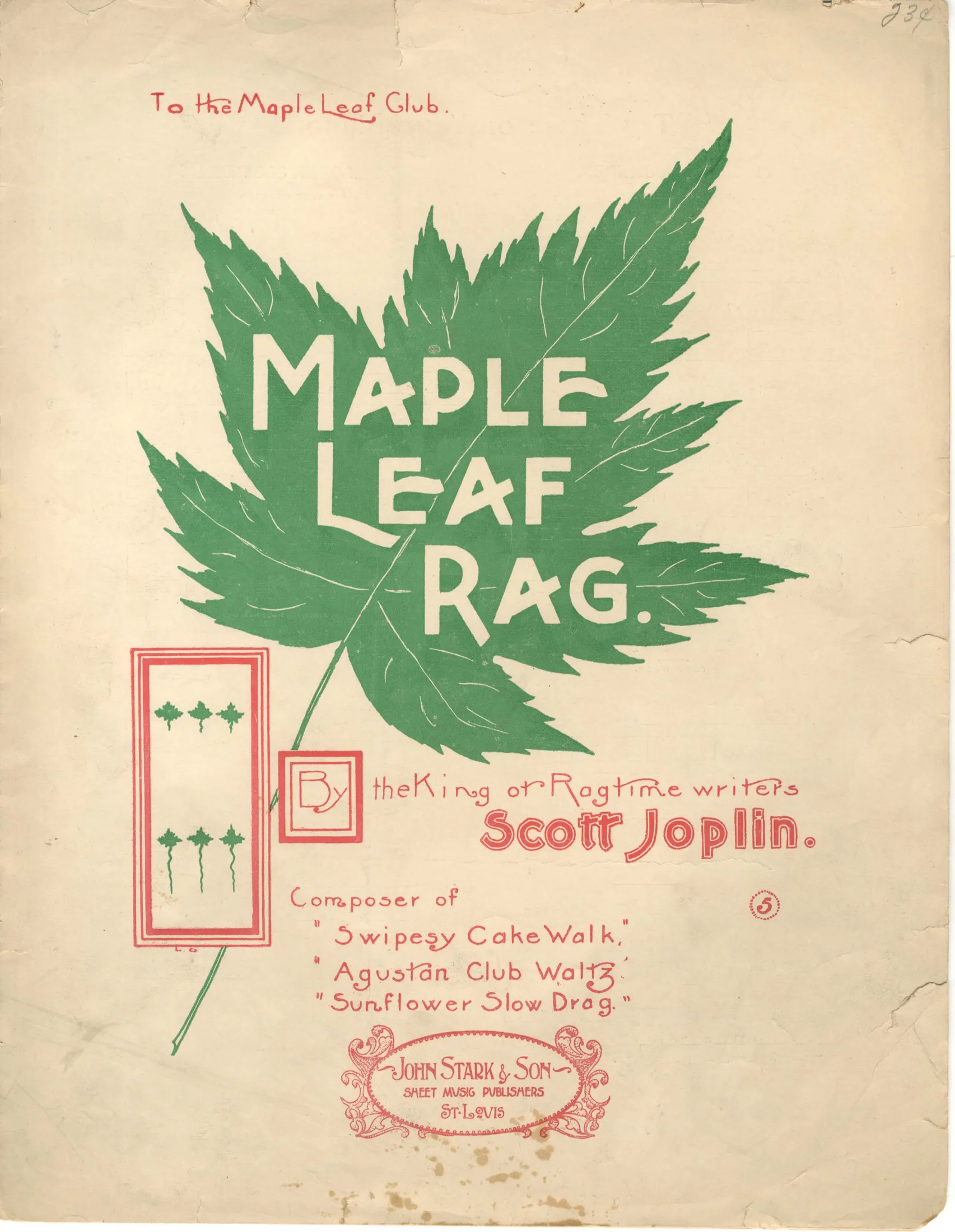
"King of Ragtime writers," printed by his publisher on the cover of Maple Leaf Rag. [A4]Maple Leaf Rag (sheet music, Stark Music Co. printing)Gaylord Music Library, Washington University in St. Louis, via Internet Archiveclass A · read 2026-07-28

Lifted off the plate

Illustrated title plate of the sheet music for Scott Joplin's Maple Leaf Rag, issued in St. Louis by John Stark and Son.

[A7]Gaylord Music Library, Washington University in St. Louis1902Public Domain Mark 1.0read 2026-07-29Downloaded the institution's IIIF page image (leaf 0, title plate) at 3000px wide; resized to 2200px long edge with sharp (fit inside, no enlargement); encoded to WebP quality 80. No crop, rotation, retouching, or color adjustment.

The record

In his own time he was acknowledged as King of Ragtime. He also wrote an opera that went unstaged until fifty-five years after he was gone. [A2]Biography, "Scott Joplin, 1868-1917," from The Library of Congress Celebrates the Songs of AmericaLibrary of Congress, Performing Arts Reading Roomclass A · read 2026-07-28

Scott Joplin

Scott Joplin published a rag that made his name and an opera he never saw staged in full, a distance the record keeps rather than resolves. [A2]Biography, "Scott Joplin, 1868-1917," from The Library of Congress Celebrates the Songs of AmericaLibrary of Congress, Performing Arts Reading Roomclass A · read 2026-07-28

Works

What survives, and who holds it

Works

Works of record

Each work is listed with the institution that holds it and the rights statement that institution publishes, quoted as written.

1899

Maple Leaf Rag [A4]Maple Leaf Rag (sheet music, Stark Music Co. printing)Gaylord Music Library, Washington University in St. Louis, via Internet Archiveclass A · read 2026-07-28

Published by Stark Music Co. The Gaylord Music Library's copy carries the publisher's own cover credit, "king of ragtime writers Scott Joplin," and is dated by the library to a printing of 1910 or later.

Held by
Gaylord Music Library, Washington University in St. Louis, via Internet Archive
Rights, as published
CC Public Domain Mark 1.0 (licenseurl: creativecommons.org/publicdomain/mark/1.0/), as stated on the Internet Archive item record.

1908

School of Ragtime [A2]Biography, "Scott Joplin, 1868-1917," from The Library of Congress Celebrates the Songs of AmericaLibrary of Congress, Performing Arts Reading Roomclass A · read 2026-07-28

A self-published treatise instructing pianists to give each note its proper value and never play ragtime fast.

Held by
Library of Congress, Performing Arts Reading Room
Rights, as published
The page credits its portrait "[Portrait of Scott Joplin], taken from American Musician (June 17, 1907), Performing Arts Reading Room, Library of Congress"; no separate rights statement for the essay text itself was found on the page as read on 2026-07-28.

1911

Treemonisha [A1]Treemonisha: opera in three acts (vocal score)Library of Congress, Music Divisionclass A · read 2026-07-28

Opera in three acts, words and music by Joplin, published at his own expense; the Library of Congress catalogs the vocal score at 230 pages.

Held by
Library of Congress, Music Division
Rights, as published
The item page's Rights & Access panel loads via a client-side expandable widget not retrievable through automated text extraction on 2026-07-28; no explicit rights statement was read from it. The work itself, a 1911 US publication by a composer who died in 1917, is public domain by operation of law as an unrenewed pre-1930 US publication.

1902

The Entertainer [A2]Biography, "Scott Joplin, 1868-1917," from The Library of Congress Celebrates the Songs of AmericaLibrary of Congress, Performing Arts Reading Roomclass A · read 2026-07-28

A rag that became, decades later, the musical cornerstone of the film The Sting, helping drive a 1970s ragtime revival.

Held by
Library of Congress, Performing Arts Reading Room
Rights, as published
The page credits its portrait "[Portrait of Scott Joplin], taken from American Musician (June 17, 1907), Performing Arts Reading Room, Library of Congress"; no separate rights statement for the essay text itself was found on the page as read on 2026-07-28.

Record boundary

What the sources establish

Sources read
8
Primary or institutional
8
Distinct sources cited on this page
6
Works of record
4

Where the sources do not settle a question, this record does not answer it. Nothing above is inferred from anything else on the page.

What the record declines

Maple Leaf Rag sold a million copies of sheet music.

No sales total appears in the institutional record consulted here. The figure is widely repeated but not sourced to an institution. [A2]Biography, "Scott Joplin, 1868-1917," from The Library of Congress Celebrates the Songs of AmericaLibrary of Congress, Performing Arts Reading Roomclass A · read 2026-07-28

Checked: The Library of Congress catalog and biography for Joplin, and the Gaylord Music Library record for the sheet music itself; neither states a sales total.

Treemonisha was never performed in any form during Joplin's lifetime.

The record supports 'not fully staged,' not 'never performed.' A full cast read the opera through once, without orchestra, scenery, or costumes, in 1911, and Joplin heard a student orchestra play its Act II ballet alone in May 1915. [A6]"A Year of Hope for Joplin and Johnson," by Michael Walsh, June 2010Smithsonian Institution (Smithsonian Magazine)class A · read 2026-07-28

Checked: Smithsonian Magazine's account of Edward A. Berlin's King of Ragtime: Scott Joplin and His Era (Oxford University Press, 1994), and the Library of Congress's biographical note, which states the opera went unstaged in his lifetime and premiered fully in Atlanta in 1972.

Scott Joplin won the Pulitzer Prize.

He did not win a category Prize. In 1976 the Pulitzer Board bestowed a posthumous special citation, a separate category from the annual Prizes. [A3]Scott Joplin, Special Citations and Awards, 1976The Pulitzer Prizes, Columbia Universityclass A · read 2026-07-28

Checked: The Pulitzer Prizes' own winner page for Scott Joplin, listed under Special Citations and Awards, not under any 1976 Prize category.

Joplin's birth date is settled as a specific day in 1868.

The institutional record does not fix a day or month. It gives a range for the year of birth, and elsewhere the bare year alone. [A2]Biography, "Scott Joplin, 1868-1917," from The Library of Congress Celebrates the Songs of AmericaLibrary of Congress, Performing Arts Reading Roomclass A · read 2026-07-28

Checked: The Library of Congress biography, which gives "sometime between the summer of 1867 and mid-January 1868," and the Library of Congress catalog record for the Treemonisha vocal score, which names him only as Joplin, Scott, 1868 to 1917.

The record

Scott Joplin has a source page.

The same renderer a customer's published page mounts, drawing the same facts this room holds the sources for. Everything below is its apparatus.

View the record →sourceofyou.com/scott-joplin
One record, two views

The apparatus

What stands behind the record: the works and who holds them, the claims this record refuses, every source read and when, and the gate stack this figure passed before a page was compiled.

Sources

Sources

Class A is primary or institutional archival material. Class B is scholarly secondary work, cited with edition and page, and used only where class A could not be reached. Every source below was read at the URL given, on the date given.

  1. [A1]Class A

    Treemonisha: opera in three acts (vocal score)

    Library of Congress, Music Division

    https://www.loc.gov/item/2019565725/read 2026-07-28

    The item page's Rights & Access panel loads via a client-side expandable widget not retrievable through automated text extraction on 2026-07-28; no explicit rights statement was read from it. The work itself, a 1911 US publication by a composer who died in 1917, is public domain by operation of law as an unrenewed pre-1930 US publication.

  2. [A2]Class A

    Biography, "Scott Joplin, 1868-1917," from The Library of Congress Celebrates the Songs of America

    Library of Congress, Performing Arts Reading Room

    https://www.loc.gov/item/n50039880/scott-joplin-1868-1917/read 2026-07-28

    The page credits its portrait "[Portrait of Scott Joplin], taken from American Musician (June 17, 1907), Performing Arts Reading Room, Library of Congress"; no separate rights statement for the essay text itself was found on the page as read on 2026-07-28.

  3. [A3]Class A

    Scott Joplin, Special Citations and Awards, 1976

    The Pulitzer Prizes, Columbia University

    https://www.pulitzer.org/winners/scott-joplinread 2026-07-28

    No rights or licensing statement appears on the page as read on 2026-07-28; the citation text quoted here is reproduced as the Pulitzer Board's own published wording, for the fact of the award rather than as a licensed work.

  4. [A4]Class A

    Maple Leaf Rag (sheet music, Stark Music Co. printing)

    Gaylord Music Library, Washington University in St. Louis, via Internet Archive

    https://archive.org/details/b89641127read 2026-07-28

    CC Public Domain Mark 1.0 (licenseurl: creativecommons.org/publicdomain/mark/1.0/), as stated on the Internet Archive item record.

  5. [A5]Class A

    Maple Leaf Rag (1899 first edition, sheet music)

    Library of Congress, Music Division

    https://www.loc.gov/item/2023864250/read 2026-07-28

    The item page's Rights & Access panel loads via a client-side expandable widget not retrievable through automated text extraction on 2026-07-28; no explicit rights statement was read from it. The catalog record dates the work to 1899, a pre-1930 US publication, public domain by operation of law.

  6. [A6]Class A

    "A Year of Hope for Joplin and Johnson," by Michael Walsh, June 2010

    Smithsonian Institution (Smithsonian Magazine)

    https://www.smithsonianmag.com/history/a-year-of-hope-for-joplin-and-johnson-123024/read 2026-07-28

    Page footer states "copyright 2026 Smithsonian Magazine"; no open license or public-domain statement was found for this article as read on 2026-07-28. Cited here for the facts it reports, with its own attribution to Edward A. Berlin's King of Ragtime: Scott Joplin and His Era (Oxford University Press, 1994), and for its one directly quoted sentence from that book.

  7. [A7]Class A

    Maple leaf rag

    Gaylord Music Library, Washington University in St. Louis

    https://archive.org/details/b107117903read 2026-07-29

    Public Domain Mark 1.0

  8. [A8]Class A

    School of ragtime: six exercises for piano, by Scott Joplin, New York, 1908, catalogued with the contributor line "Joplin, Scott, 1868-1917, composer". The printed REMARKS and the note under Exercise No. 1, both at printed page 3, were read at the Library's own page image (scan leaf musihas-200033489.0002). The plate carries the imprint "Copyright MCMVIII by Scott Joplin."

    Library of Congress, Music Division

    https://www.loc.gov/item/2023864271/read 2026-07-29

    The item's rights field carries the Library's collection level statement, which opens, verbatim: "The Library of Congress is providing access to these materials for educational and research purposes and makes no warranty with regard to their use for other purposes." It is not an affirmative public domain declaration for this item, and it is recorded here as exactly what it is. The suggested credit line the Library gives is "Library of Congress, Music Division." The 1908 US publication puts the work in the public domain by operation of law independently of that statement.

Clearance

How this record was cleared

Every record in the Hall passes the same gate stack before a page is compiled, and the result is published rather than merely filed.

Died
1917
Public domain basis
Composer died in 1917. Maple Leaf Rag (1899) and Treemonisha (1911) are both pre-1930 US publications, unrenewed, and public domain by operation of law; the Maple Leaf Rag scan used here additionally carries the holding library's own CC Public Domain Mark.
Estate and licensing screen
2026-07-28 screen of the Library of Congress, Pulitzer, Internet Archive/Gaylord Music Library and Smithsonian Magazine source pages found no assertion of an enforcing estate or licensing agent for Joplin's work; the institutions holding the scores used here assert public domain or CC Public Domain Mark status themselves.
Trademark screen
2026-07-28 screen found no live commercial trademark collision. Scott Joplin is in current use as the name of the nonprofit Scott Joplin International Ragtime Foundation (Sedalia, Missouri) and the Scott Joplin House State Historic Site (St. Louis, Missouri), both heritage bodies named in the Library of Congress biography, not a claim against this record.
Dignity screen
The gap between Treemonisha's 1911 publication and its 1972 full staging is treated as the record's own throughline, not a tragedy beat: the gap is the story, not the tragedy. His death is stated as a year, 1917, with no cause given; the birth-year uncertainty is stated as an open fact rather than smoothed into a confident date.
Gate stack run
2026-07-28

The machine record

The structured representation this page is built from, printed field by field.

Every row below is a field of this figure's module, printed with its value and the citation key that settles it. Nothing here is summarised or inferred. It is shown as text for a reader: this page emits no machine-readable metadata, and it is excluded from the sitemap, from llms.txt, and from search indexes.

identity

slugscott-joplin
handlescott-joplin
nameScott Joplin
disciplineMusic
entered2026-07-28
accent#4C2A6B

claims

label"King of Ragtime writers," printed by his publisher on the cover of Maple Leaf Rag. [A4]
turnIn his own time he was acknowledged as King of Ragtime. He also wrote an opera that went unstaged until fifty-five years after he was gone. [A2]
lifespanc. 1868 to 1917 [A2]
statementScott Joplin published a rag that made his name and an opera he never saw staged in full, a distance the record keeps rather than resolves. [A2]

story[7]

story[0]The record gives his birth only as sometime between the summer of 1867 and mid-January 1868, on the Texas-Arkansas border; no more precise date survives in the institutional record consulted here. [A2]
story[1]He trained in Sedalia, Missouri, studying music at George R. Smith College and playing in local ensembles, including the Queen City Cornet Band, before opening his own piano studio and teaching younger composers. [A2]
story[2]Engagements at Sedalia's Maple Leaf Club inspired the tune he published in 1899 as Maple Leaf Rag, through John Stark, his major publisher. [A2]
story[3]In 1908 he self-published School of Ragtime, a treatise instructing pianists to give each note its proper value and never play ragtime fast. [A2]
story[4]In 1911, at his own expense, he published the vocal score of Treemonisha, an opera in three acts with his own libretto, which the Library of Congress catalogs at 230 pages. [A1]
story[5]The opera reached him twice while he lived: a full cast read it through once, without orchestra, scenery, or costumes, for an audience of seventeen in 1911, and a student orchestra played its Act II ballet alone in May 1915. [A6]
story[6]He died in 1917; the opera was not given a fully staged, orchestrated production until January 1972, in Atlanta, fifty-five years later. [A2]
schedule[8]

schedule[0] [A5]

span1899
titleMaple Leaf Rag published
detailPublished by John Stark; the Library of Congress catalog record does not identify a place of publication.

schedule[1] [A2]

span1908
titleSchool of Ragtime published
detailJoplin self-published this treatise on playing ragtime correctly, warning against playing it fast.

schedule[2] [A1]

span1911
titleTreemonisha published
detailJoplin self-published the 230-page vocal score of his opera in three acts, words and music his own.

schedule[3] [A6]

span1911
titleTreemonisha read through, unstaged
detailA full cast read the opera through once, without orchestra, scenery, or costumes, for an audience of seventeen; a student orchestra played its Act II ballet alone in May 1915.

schedule[4] [A2]

span1917
titleJoplin dies
detailHe died in April 1917.

schedule[5] [A2]

span1972
titleTreemonisha fully staged
detailFirst full, orchestrated production, in Atlanta, fifty-five years after Joplin's death.

schedule[6] [A2]

span1973
titleThe Entertainer reaches a wide audience
detailThe 1902 rag became the musical cornerstone of the film The Sting, driving a ragtime revival.

schedule[7] [A3]

span1976
titlePulitzer special citation
detailThe Pulitzer Board bestowed a posthumous special award on Joplin, in the US Bicentennial year, for his contributions to American music.

figures[5]

figures[0] [A1]

label230 pages
detailLength of the 1911 Treemonisha vocal score he self-published.

figures[1] [A5]

label1899
detailYear the Library of Congress catalog dates Joplin's Maple Leaf Rag, published by John Stark.

figures[2] [A6]

label17
detailPeople in the audience for the one full read-through of Treemonisha in his lifetime, 1911.

figures[3] [A2]

label55 years
detailFrom Joplin's death in 1917 to Treemonisha's first full, orchestrated staging, in Atlanta, in 1972.

figures[4] [A3]

label1976
detailYear the Pulitzer Board bestowed a posthumous special citation on Joplin.

works[4]

works[0] [A4]

titleMaple Leaf Rag
year1899
notePublished by Stark Music Co. The Gaylord Music Library's copy carries the publisher's own cover credit, "king of ragtime writers Scott Joplin," and is dated by the library to a printing of 1910 or later.
urlhttps://archive.org/details/b89641127

works[1] [A2]

titleSchool of Ragtime
year1908
noteA self-published treatise instructing pianists to give each note its proper value and never play ragtime fast.

works[2] [A1]

titleTreemonisha
year1911
noteOpera in three acts, words and music by Joplin, published at his own expense; the Library of Congress catalogs the vocal score at 230 pages.
urlhttps://www.loc.gov/item/2019565725/

works[3] [A2]

titleThe Entertainer
year1902
noteA rag that became, decades later, the musical cornerstone of the film The Sting, helping drive a 1970s ragtime revival.

answers[5]

answers[0] [A2]

qIs Scott Joplin's birth date settled?
aNo. The Library of Congress's own biographical note places it only within a range, sometime between the summer of 1867 and mid-January 1868, and its catalog authority records the year alone, 1868.

answers[1] [A2]

qWhere did Joplin train as a musician?
aIn Sedalia, Missouri, where he studied at George R. Smith College and played in local ensembles, including the Queen City Cornet Band, before opening his own piano studio.

answers[2] [A6]

qDid Joplin hear Treemonisha performed?
aIn a limited way, twice: a full cast read the opera through once, without orchestra, scenery, or costumes, in 1911, and a student orchestra played its Act II ballet alone in May 1915.

answers[3] [A3]

qDid Joplin win a Pulitzer Prize?
aNot a category Prize. In 1976 the Pulitzer Board bestowed a posthumous special citation on him, for his contributions to American music.

answers[4] [A2]

qWhat made Joplin's reputation?
aMaple Leaf Rag, published in 1899, on the strength of which he was acknowledged in his own time as King of Ragtime.

declines[4]

declines[0] [A2]

mythMaple Leaf Rag sold a million copies of sheet music.
refusalNo sales total appears in the institutional record consulted here. The figure is widely repeated but not sourced to an institution.
checkedThe Library of Congress catalog and biography for Joplin, and the Gaylord Music Library record for the sheet music itself; neither states a sales total.

declines[1] [A6]

mythTreemonisha was never performed in any form during Joplin's lifetime.
refusalThe record supports 'not fully staged,' not 'never performed.' A full cast read the opera through once, without orchestra, scenery, or costumes, in 1911, and Joplin heard a student orchestra play its Act II ballet alone in May 1915.
checkedSmithsonian Magazine's account of Edward A. Berlin's King of Ragtime: Scott Joplin and His Era (Oxford University Press, 1994), and the Library of Congress's biographical note, which states the opera went unstaged in his lifetime and premiered fully in Atlanta in 1972.

declines[2] [A3]

mythScott Joplin won the Pulitzer Prize.
refusalHe did not win a category Prize. In 1976 the Pulitzer Board bestowed a posthumous special citation, a separate category from the annual Prizes.
checkedThe Pulitzer Prizes' own winner page for Scott Joplin, listed under Special Citations and Awards, not under any 1976 Prize category.

declines[3] [A2]

mythJoplin's birth date is settled as a specific day in 1868.
refusalThe institutional record does not fix a day or month. It gives a range for the year of birth, and elsewhere the bare year alone.
checkedThe Library of Congress biography, which gives "sometime between the summer of 1867 and mid-January 1868," and the Library of Congress catalog record for the Treemonisha vocal score, which names him only as Joplin, Scott, 1868 to 1917.

sources[8]

sources.A1 [A1]

clsA
institutionLibrary of Congress, Music Division
titleTreemonisha: opera in three acts (vocal score)
urlhttps://www.loc.gov/item/2019565725/
accessed2026-07-28
rightsThe item page's Rights & Access panel loads via a client-side expandable widget not retrievable through automated text extraction on 2026-07-28; no explicit rights statement was read from it. The work itself, a 1911 US publication by a composer who died in 1917, is public domain by operation of law as an unrenewed pre-1930 US publication.

sources.A2 [A2]

clsA
institutionLibrary of Congress, Performing Arts Reading Room
titleBiography, "Scott Joplin, 1868-1917," from The Library of Congress Celebrates the Songs of America
urlhttps://www.loc.gov/item/n50039880/scott-joplin-1868-1917/
accessed2026-07-28
rightsThe page credits its portrait "[Portrait of Scott Joplin], taken from American Musician (June 17, 1907), Performing Arts Reading Room, Library of Congress"; no separate rights statement for the essay text itself was found on the page as read on 2026-07-28.

sources.A3 [A3]

clsA
institutionThe Pulitzer Prizes, Columbia University
titleScott Joplin, Special Citations and Awards, 1976
urlhttps://www.pulitzer.org/winners/scott-joplin
accessed2026-07-28
rightsNo rights or licensing statement appears on the page as read on 2026-07-28; the citation text quoted here is reproduced as the Pulitzer Board's own published wording, for the fact of the award rather than as a licensed work.

sources.A4 [A4]

clsA
institutionGaylord Music Library, Washington University in St. Louis, via Internet Archive
titleMaple Leaf Rag (sheet music, Stark Music Co. printing)
urlhttps://archive.org/details/b89641127
accessed2026-07-28
rightsCC Public Domain Mark 1.0 (licenseurl: creativecommons.org/publicdomain/mark/1.0/), as stated on the Internet Archive item record.

sources.A5 [A5]

clsA
institutionLibrary of Congress, Music Division
titleMaple Leaf Rag (1899 first edition, sheet music)
urlhttps://www.loc.gov/item/2023864250/
accessed2026-07-28
rightsThe item page's Rights & Access panel loads via a client-side expandable widget not retrievable through automated text extraction on 2026-07-28; no explicit rights statement was read from it. The catalog record dates the work to 1899, a pre-1930 US publication, public domain by operation of law.

sources.A6 [A6]

clsA
institutionSmithsonian Institution (Smithsonian Magazine)
title"A Year of Hope for Joplin and Johnson," by Michael Walsh, June 2010
urlhttps://www.smithsonianmag.com/history/a-year-of-hope-for-joplin-and-johnson-123024/
accessed2026-07-28
rightsPage footer states "copyright 2026 Smithsonian Magazine"; no open license or public-domain statement was found for this article as read on 2026-07-28. Cited here for the facts it reports, with its own attribution to Edward A. Berlin's King of Ragtime: Scott Joplin and His Era (Oxford University Press, 1994), and for its one directly quoted sentence from that book.

sources.A7 [A7]

clsA
institutionGaylord Music Library, Washington University in St. Louis
titleMaple leaf rag
urlhttps://archive.org/details/b107117903
accessed2026-07-29
rightsPublic Domain Mark 1.0

sources.A8 [A8]

clsA
institutionLibrary of Congress, Music Division
titleSchool of ragtime: six exercises for piano, by Scott Joplin, New York, 1908, catalogued with the contributor line "Joplin, Scott, 1868-1917, composer". The printed REMARKS and the note under Exercise No. 1, both at printed page 3, were read at the Library's own page image (scan leaf musihas-200033489.0002). The plate carries the imprint "Copyright MCMVIII by Scott Joplin."
urlhttps://www.loc.gov/item/2023864271/
accessed2026-07-29
rightsThe item's rights field carries the Library's collection level statement, which opens, verbatim: "The Library of Congress is providing access to these materials for educational and research purposes and makes no warranty with regard to their use for other purposes." It is not an affirmative public domain declaration for this item, and it is recorded here as exactly what it is. The suggested credit line the Library gives is "Library of Congress, Music Division." The 1908 US publication puts the work in the public domain by operation of law independently of that statement.

clearance

died1917
diedSrcA2
pdBasisComposer died in 1917. Maple Leaf Rag (1899) and Treemonisha (1911) are both pre-1930 US publications, unrenewed, and public domain by operation of law; the Maple Leaf Rag scan used here additionally carries the holding library's own CC Public Domain Mark.
estate2026-07-28 screen of the Library of Congress, Pulitzer, Internet Archive/Gaylord Music Library and Smithsonian Magazine source pages found no assertion of an enforcing estate or licensing agent for Joplin's work; the institutions holding the scores used here assert public domain or CC Public Domain Mark status themselves.
trademark2026-07-28 screen found no live commercial trademark collision. Scott Joplin is in current use as the name of the nonprofit Scott Joplin International Ragtime Foundation (Sedalia, Missouri) and the Scott Joplin House State Historic Site (St. Louis, Missouri), both heritage bodies named in the Library of Congress biography, not a claim against this record.
dignityThe gap between Treemonisha's 1911 publication and its 1972 full staging is treated as the record's own throughline, not a tragedy beat: the gap is the story, not the tragedy. His death is stated as a year, 1917, with no cause given; the birth-year uncertainty is stated as an open fact rather than smoothed into a confident date.
checkedAt2026-07-28

HISTORICAL RECORD · A DEMONSTRATION

A demonstration record, compiled from public archives. Every line on this page carries its source. Scott Joplin did not write it; the institutions cited here did.

Corrections are wanted, and they are treated the way a falsehood on any Source of You page is treated: they jump the queue. If a line here is wrong, or a source is misread, write to hello@sourceofyou.com and the page comes down while it is checked.