Historical record

A demonstration record, compiled from public archives. Joshua Slocum did not write it; the institutions cited here did. Sources and clearance →

PortfolioSource ofYOU

1844 to 1909

Joshua Slocum

The record of Joshua Slocum, master mariner, born in Annapolis County, Nova Scotia, in 1844, whose entry in the Library of Congress name authority gives his death as November 1909 and his occupation in a single word: sailors.

01About

Slocum went to sea as a boy, came up through the forecastle rather than the cabin, commanded the ship Northern Light in the eighteen eighties as part owner, and had been nearly twenty years a shipmaster when the bark Aquidneck was wrecked on the coast of Brazil; the passage home to New York was made in a canoe he built from her wreckage, the Liberdade. One midwinter day of 1892 he was out of a command in Boston, in a trade steam had closed behind him: "Nearly all our tall vessels had been cut down for coal-barges, and were being ignominiously towed by the nose from port to port, while many worthy captains addressed themselves to Sailors' Snug Harbor." An old whaling-captain then offered him a ship at Fairhaven, and the offer turned out to be a joke: "The next day I landed at Fairhaven, opposite New Bedford, and found that my friend had something of a joke on me. For seven years the joke had been on him." The ship was the sloop Spray, propped in a field under canvas at the end of her natural life, a vessel that "tradition said, had first served as an oysterman, about a hundred years ago, on the coast of Delaware," and of whose building there was no record in the custom-house. He felled a stout oak near by for a keel, steamed saplings into ribs, and rebuilt her timber by timber and plank by plank, at a cost of five hundred fifty three dollars and sixty two cents in materials and thirteen months of his own labor. The New Bedford Whaling Museum records the voyage as a thirty eight month circumnavigation, begun when Slocum cast off his dock lines in East Boston on April 24, 1895 and ended when he ghosted into Newport, Rhode Island at one in the morning on June 27, 1898. His own closing account of the arrival reads: "At last she reached port in safety, and there at 1 a.m. on June 27, 1898, cast anchor, after the cruise of more than forty-six thousand miles round the world, during an absence of three years and two months, with two days over for coming up." He sailed alone from Vineyard Haven for the West Indies and was not heard from again; a New Bedford dispatch of July 26, 1910 reported that the Spray had last been seen by a passing steamship, which described her as making heavy weather, and that his wife had given him up as lost.
02Selected work/ 03
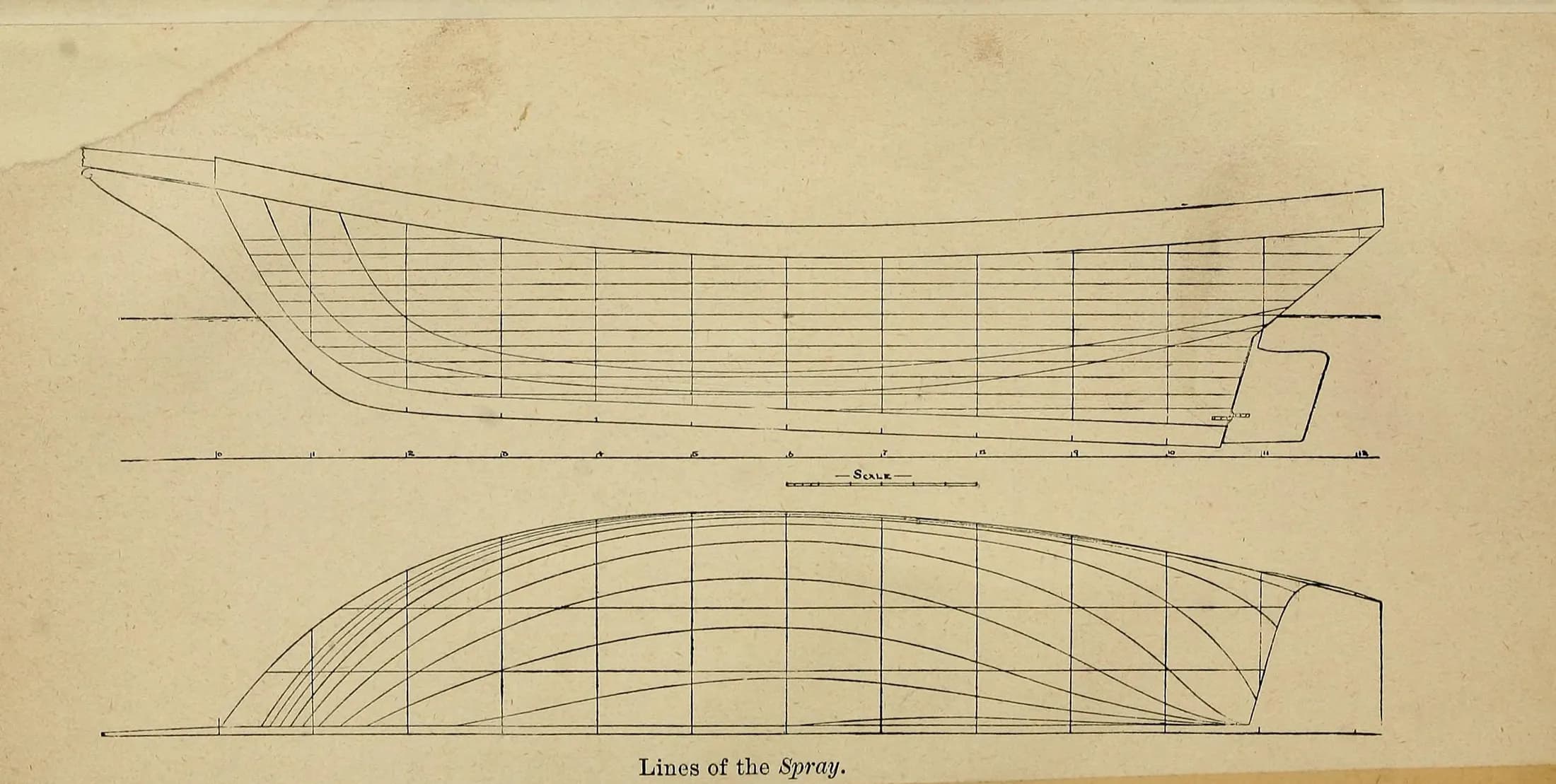
The engraved lines plan of the sloop Spray, sheer above and half-breadth below, printed in the appendix of the 1900 first edition.
011900

Sailing Alone Around the World

The account of the voyage, written in the first person and published in New York by the Century Co. The Century Co. edition digitized from the Robarts Library at the University of Toronto carries copyright evidence recorded by the Internet Archive as a visible notice of copyright with a stated date of 1900.

Library of Congress. The Library of Congress is unaware of any copyright restrictions for this item.

  1. 021890

    Voyage of the Liberdade

    The earlier narrative: the loss of the bark Aquidneck on the coast of Brazil and the passage home with his family in a canoe built from her wreckage. The 1890 Robinson and Stephenson printing digitized from the Harvard University library.

  2. 031892 to 1895

    The sloop Spray

    An object of record rather than a text. Rebuilt timber by timber from a derelict said to have served as an oysterman on the coast of Delaware, with no record of her building in the custom-house; her lines, dimensions and cabin plans are printed in the appendix of the 1900 book.

03Career
  1. 1892 to 1895

    The Spray rebuilt at Fairhaven

    Captain Eben Pierce presented the derelict sloop at Fairhaven, Massachusetts. Rebuilt over thirteen months of labor for five hundred fifty three dollars and sixty two cents in materials, with twelve inches added to the freeboard amidships, eighteen forward and fourteen aft.

  2. April 24, 1895

    Departure from Boston

    Anchor weighed at noon with a fair wind, sailing from Boston where the sloop had been moored all winter. A photographer on the outer pier at East Boston recorded her going.

  3. June 4, 1898

    The single-handed license returned for the last time

    The Spray cleared from the United States consulate and "her license to sail single-handed, even round the world, was returned to her for the last time." The document is recorded as lodged thereafter in the Treasury Department at Washington.

  4. June 27, 1898

    Newport, Rhode Island

    Anchored at one in the morning, closing a thirty eight month circumnavigation, the first solo voyage around the world as the New Bedford Whaling Museum files it.

  5. 1900

    Sailing Alone Around the World published

    Issued in New York by the Century Co. The Library of Congress name authority for Slocum cites the 1900 book as evidence for his heading.

  6. November 1909

    Sailed from Vineyard Haven and did not return

    The Library of Congress name authority records the death date as November 1909 and states nothing further. The record follows it and stops there.

  7. June 1, 1911

    Given up by the mariners of New Bedford and Martha's Vineyard

    A New Bedford dispatch reported that "although the Blue Book of the United States government has not yet taken the sloop Spray from its records of American vessels, there seems to be but little doubt in the minds of the mariners of New Bedford and Martha's Vineyard" that vessel and skipper were lost.

04Recognition

0

Crew. The paper the United States consulate handed back on June 4, 1898 was a license to sail single-handed, even round the world.

46,000+ miles

Sailed round the world. His own closing chapter reckons the cruise at "more than forty-six thousand miles."

3 years, 2 months

Alone at sea between the Boston anchorage and the Newport one, with two days over for coming up.

36 ft 9 in

The Spray's length over all: fourteen feet two inches wide, four feet two inches deep in the hold, nine tons net and twelve and seventy-one hundredths tons gross.

$553.62

Materials for the rebuild, against thirteen months of the rebuilder's own labor.

05Perspective

Sailing Alone Around the World, the first chapter, 1900

"As for myself, the wonderful sea charmed me from the first. At the age of eight I had already been afloat along with other boys on the bay, with chances greatly in favor of being drowned." Read in the Internet Archive scan of the 1900 first edition, the Century Co., New York, digitized from Robarts Library, University of Toronto.

Sailing Alone Around the World, Chapter XXI, 1900

"To face the elements is, to be sure, no light matter when the sea is in its grandest mood. You must then know the sea, and know that you know it, and not forget that it was made to be sailed over." From the last chapter, where the account turns from the voyage to the vessel. Read in the Internet Archive scan of the 1900 first edition, the Century Co., New York, digitized from Robarts Library, University of Toronto.

06Questions
01

What is Joshua Slocum on record for?

Sailing around the world alone in a rebuilt sloop: out of East Boston on April 24, 1895, into Newport, Rhode Island at one in the morning on June 27, 1898, a thirty eight month circumnavigation the New Bedford Whaling Museum files as the first solo voyage around the world.

02

Where did the Spray come from?

Captain Eben Pierce gave her to Slocum at Fairhaven, Massachusetts, at the end of her natural life, propped up in a field under canvas. Tradition held she had served as an oysterman on the coast of Delaware about a hundred years earlier; her lines were supposed to be those of a North Sea fisherman; and the custom-house held no record of where she was built.

03

Could Slocum swim?

No, and the book says so in passing rather than as a boast. Laying out an anchor in surf, his dory rolled: "I grasped her gunwale and held on as she turned bottom up, for I suddenly remembered that I could not swim."

04

How long did the book stay in circulation?

The Library of Congress name authority record for Slocum names, as its own evidence, the 1900 book, a 1981 printing of a 1954 edition, and a 2015 edition. Editions of the same narrative are still being catalogued more than a century after the voyage.

05

Where is the record held, apart from the books?

The New Bedford Whaling Museum Research Library holds MSS 131, the Walter Magnus Teller Papers, three and a half linear feet of correspondence, documents and photographs gathered while researching the life and voyages of Captain Joshua Slocum, whom the finding aid dates 1844 to 1909.