Historical record

A demonstration record, compiled from public archives. Johann Wolfgang von Goethe did not write it; the institutions cited here did. Sources and clearance →

RecordSource ofYOU

1749 to 1832

Johann Wolfgang von Goethe

Kept as the home of a "Dichter und Staatsmann": the house at the Frauenplan, rented from 1782 and lived and worked in for nearly fifty years, held his manuscripts, his books, and his growing art and scientific collections.

I

Didaktischer Teil

What the record sets out

01AccountViolett / Minus

The diary entry for 18 February 1777, written at Weimar in his own hand, reads in full: "Alles in Duft. Conseil. Die Bergwercks Sache. Sehr kalt." Two years later the entry for 5 January 1779 opens "Conseil die Kriegs Commission übertragen." The manuscript is the interleaved 1779 almanac now held as GSA 27/5. The museum that keeps his mining papers records that mining in Saxe-Weimar-Eisenach fell under his offices from 1777, that he struck the first blow with a pick at the shaft opening of 1784, that a gallery collapsed in 1796 and ended the work, and that the shafts were filled in 1814. Writing to Herder on 27 March 1784 he reported a finding in comparative anatomy: "das os intermaxillare am Menschen! Ich verglich mit Lodern Menschen- und Thierschädel". A full text search of the same diary edition on 29 July 2026 returns 268 entries containing the word Farbenlehre, spread over thirty-one separate years from 1797 to 1832, and 113 entries containing Metamorphose, from 1786 to 1832. The colour theory reached print in 1810 at Tübingen, from the J. G. Cotta bookshop, in a copy now scanned from the Getty Research Institute's holdings at 795 images. Even the ennoblement is a document with a shelfmark. The Goethe- und Schiller-Archiv files GSA 30/520 as "Adelsdiplom für Johann Wolfgang von Goethe, ausgestellt von Kaiser Joseph II. Wien, 1782 April 10", among his Akten under honorary memberships and diplomas. The estate is held today by the Goethe- und Schiller-Archiv of the Klassik Stiftung Weimar, in about 500 archive boxes, and its core is the archive he began himself. That archive is the oldest literary archive in Germany, and it left the family in 1885: by the will of the last Goethe grandson the papers passed on 15 April 1885 to Grand Duchess Sophie of Saxe-Weimar-Eisenach.

02WorksBlau / Minus
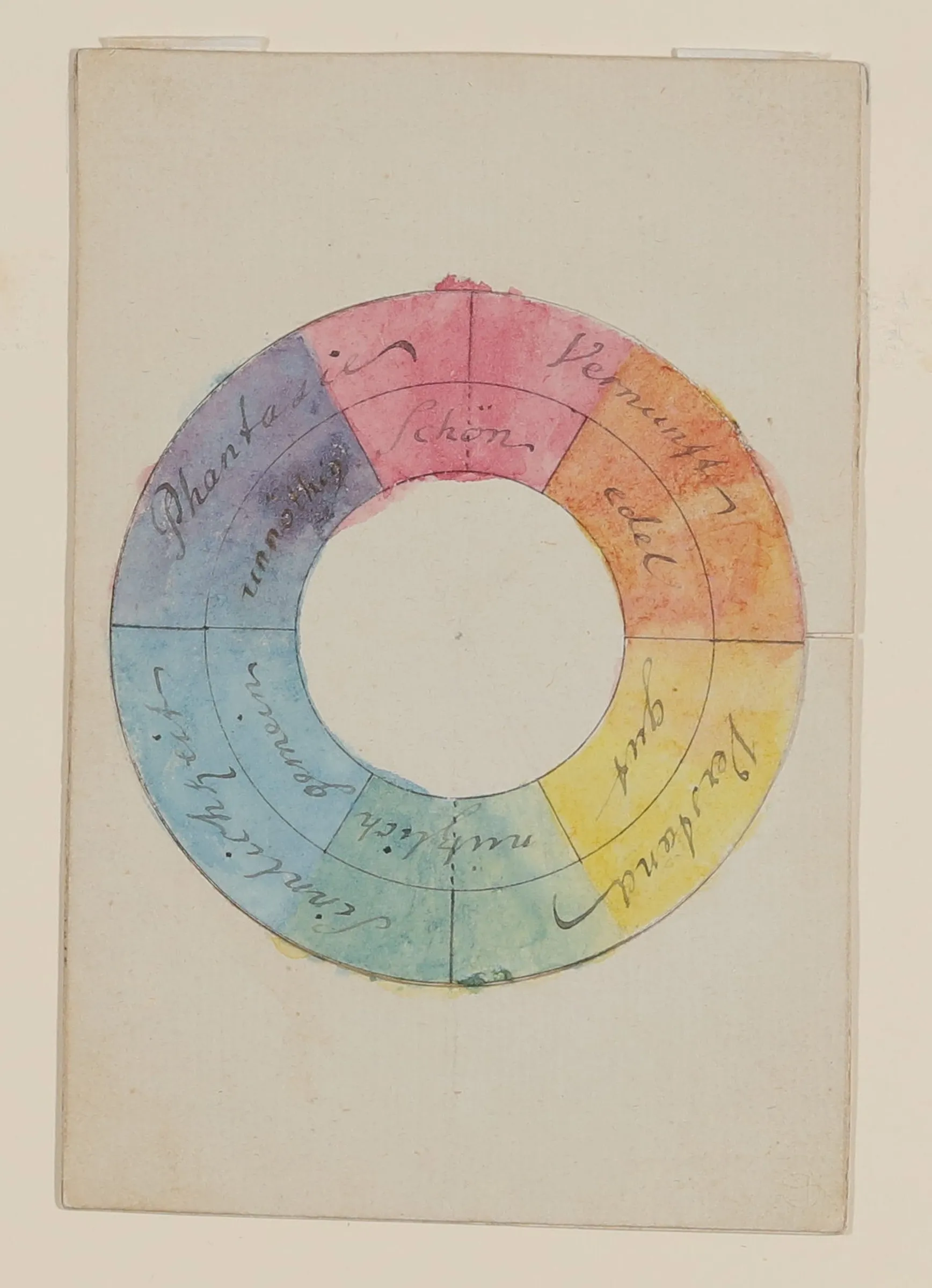
The colour wheel: a small watercoloured disc divided into six segments, mounted in a cut card window on a plain sheet.

Farbenkreis zur Symbolisierung des "menschlichen Geistes- und Seelenlebens"

A disc 69 millimetres across, drawn in pen over erased pencil, mounted on card and then watercoloured in six segments. Held by the Freies Deutsches Hochstift, Frankfurter Goethe-Museum, inventory III-14047, and published by it under the Public Domain Mark. It is the colour wheel a year before Zur Farbenlehre went to press.

Plate 01

November 1809

Freies Deutsches Hochstift / Frankfurter Goethe-Museum, published through museum-digital:hessen. Public Domain Mark

Plate 021774

Die Leiden des jungen Werthers

Leipzig, Weygand. The scanned copy is the Bayerische Staatsbibliothek's, shelfmark Rar. 138, at 235 images. The catalogue notes a title vignette to each part and an errata list at page 224.

Plate 041808

Faust. Eine Tragödie

Tübingen, Cotta. The scanned copy is the Staatsbibliothek Bamberg's, shelfmark MvO.L.g.o.149, at 321 images.

Plate 051810

Zur Farbenlehre

Tübingen, in der J. G. Cotta'schen Buchhandlung. The scanned copy is the Getty Research Institute's, at 795 images.

Plate 061820

Dem Menschen wie den Thieren ist ein Zwischenknochen der obern Kinnlade zuzuschreiben, in Zur Naturwissenschaft überhaupt, besonders zur Morphologie, Band 1, Heft 2

Stuttgart and Tübingen, Cotta. The intermaxillary essay in print, thirty-six years after the finding was written to Herder. It opens by offering "eine kleine Entdeckung vorzulegen die ich glaube gemacht zu haben". The scanned copy is the Staatsbibliothek Bamberg's, shelfmark Physiol.o.70(1, digitized by the Bayerische Staatsbibliothek.

Plate 071819

West-oestlicher Divan

Stuttgard, Cotta. The scanned copy is the Staatliche Bibliothek Regensburg's, shelfmark 999/Germ.3645a, at 567 images, catalogued as the first edition.

II

Historischer Teil

The record over time

03ChronologyGruen / Minus
  1. 1749

    Frankfurt am Main

    The institution that keeps the birth house quotes his own account of the date: "AM 28. AUGUST 1749, MITTAGS MIT DEM GLOCKENSCHLAGE ZWÖLF, KAM ICH IN FRANKFURT AM MAIN AUF DIE WELT."

  2. 1774

    Die Leiden des jungen Werthers

    Printed at Leipzig by Weygand. The scanned copy is the Bayerische Staatsbibliothek's, shelfmark Rar. 138, with a title vignette to each part and an errata list at page 224.

  3. 1777

    The mining business in Conseil

    The diary for 18 February 1777, at Weimar: "Alles in Duft. Conseil. Die Bergwercks Sache. Sehr kalt." The manuscript is GSA 27/3.

  4. 1779

    The war commission

    The diary for 5 January 1779, at Weimar: "5 Conseil die Kriegs Commission übertragen. Aufs Eis essen." The manuscript is GSA 27/5, an interleaved printed almanac for 1779.

  5. 1782

    The house at the Frauenplan

    Moved in as a tenant in 1782 and lived and worked there for nearly fifty years. The house took his manuscripts, his books and his growing art and scientific collections; eighteen rooms of it are still shown.

  6. 1782

    The patent of nobility

    The Goethe- und Schiller-Archiv holds it as GSA 30/520 (ÜF 87): "Adelsdiplom für Johann Wolfgang von Goethe, ausgestellt von Kaiser Joseph II. Wien, 1782 April 10", eight leaves, thirty digitisates.

  7. 1784

    The intermaxillary bone

    Reported to Herder from Jena on 27 March 1784: "das os intermaxillare am Menschen! Ich verglich mit Lodern Menschen- und Thierschädel". Justus Christian Loder was the Jena anatomist.

  8. 1790

    Versuch die Metamorphose der Pflanzen zu erklären

    Printed at Gotha by the Ettingersche Buchhandlung in 1790. The scanned copy is Oxford University's, at 95 images.

  9. 1808

    Faust. Eine Tragödie

    Printed at Tübingen by Cotta. The scanned copy is the Staatsbibliothek Bamberg's, shelfmark MvO.L.g.o.149, at 321 images.

  10. 1809

    The colour wheel

    A disc 69 millimetres across, drawn and watercoloured in November 1809 and lettered in its outer segments Phantasie, Vernunft, Verstand and Sinnlichkeit. Acquired by the institution in 1963.

  11. 1810

    Zur Farbenlehre

    Printed at Tübingen in 1810 by the J. G. Cotta'schen Buchhandlung. The scanned copy is the Getty Research Institute's, at 795 images.

  12. 1817

    The mineral cabinet

    The neighbouring Treuter plot was bought in 1817 and the garden extended eastward. The pavilion at the Ackerwand came with the purchase, and the mineral collection was housed in it.

  13. 1819

    West-oestlicher Divan

    Printed at Stuttgard by Cotta and catalogued as the first edition. The scanned copy is the Staatliche Bibliothek Regensburg's, shelfmark 999/Germ.3645a, at 567 images.

  14. 1820

    The intermaxillary essay reaches print

    Printed at last in the second issue of Zur Naturwissenschaft überhaupt, besonders zur Morphologie, Stuttgart and Tübingen, Cotta, under a dateline giving the year 1786. It offers "eine kleine Entdeckung vorzulegen die ich glaube gemacht zu haben".

  15. 1885

    The papers leave the family

    By the will of the last Goethe grandson, Walther, the estate passed on 15 April 1885 into the possession of Grand Duchess Sophie of Saxe-Weimar-Eisenach. The archive building went up between 1893 and 1896.

  16. 1991

    Into the foundation

    In October 1991 the Goethe- und Schiller-Archiv, by then holding more than 110 personal and institutional estates, was transferred into the Stiftung Weimarer Klassik, today the Klassik Stiftung Weimar.

  17. 2001

    The estate enters the Memory of the World register

    Inscribed as "Goethes literarischer Nachlass", held at the Klassik Stiftung Weimar, Jenaer Str. 1. About 500 archive boxes holding several thousand letters, diaries, writings on scientific subjects and treatises on art theory.

04FiguresGelb / Plus

268 diary entries

A full text search of the PROPYLÄEN diary edition on 29 July 2026 returns 268 diary entries containing the word Farbenlehre, distributed over thirty-one separate years from 1797 to 1832.

113 diary entries

The same search for Metamorphose on 29 July 2026 returns 113 diary entries, from 1786 to 1832. Ilmenau returns 140.

circa 500 boxes

The estate is kept in about 500 archive boxes at the Goethe- und Schiller-Archiv. Its core is the archive he began himself.

1777 to 1814

Mining fell under his offices in Saxe-Weimar-Eisenach from 1777. A gallery collapsed in 1796 and ended the shaft work; the shafts were filled in 1814.

9 hours underground

In October 1784 he spent nine hours at a stretch walking the Ilmenau shafts.

5 million sheets

The Goethe- und Schiller-Archiv, the oldest literary archive in Germany, states a total holding of about 5 million sheets across all its collections.

69 mm across

The colour wheel of November 1809 is a disc 69 millimetres in diameter, mounted on paper and card measuring 117 by 79 millimetres.

III

Polemischer Teil

Where it takes a position

05PositionsOrange / Plus

The opening of the intermaxillary essay, 1820

"Einige Versuche osteologischer Zeichnungen sind hier in der Absicht zusammen geheftet worden, um Kennern und Freunden vergleichender Zergliederungskunde eine kleine Entdeckung vorzulegen die ich glaube gemacht zu haben." The first paragraph of Dem Menschen wie den Thieren ist ein Zwischenknochen der obern Kinnlade zuzuschreiben, printed in Zur Naturwissenschaft überhaupt, besonders zur Morphologie, Band 1, Heft 2, Stuttgart and Tübingen, Cotta, 1820, under a printed dateline giving Jena, 1786. Read at the Bayerische Staatsbibliothek page image of the Staatsbibliothek Bamberg copy.

The second paragraph of the intermaxillary essay, 1820

"Bey Thierschädeln fällt es gar leicht in die Augen, daß die obere Kinnlade aus mehr als einem Paar Knochen bestehet." The observation the whole paper turns on, on the same printed page. Read at the Bayerische Staatsbibliothek page image of the Staatsbibliothek Bamberg copy.

06QuestionsPurpur / Plus
01

What did the Weimar government actually hand him?

The diary records it in his own hand. On 18 February 1777: "Conseil. Die Bergwercks Sache." On 5 January 1779: "Conseil die Kriegs Commission übertragen."

02

How long did the colour work run?

A full text search of the diary edition on 29 July 2026 returns 268 entries containing the word Farbenlehre, spread over thirty-one separate years from 1797 to 1832.

03

What is the object hanging in this room?

A colour wheel of November 1809, pen over erased pencil on round cut paper, mounted and watercoloured, lettered "Phantasie // Vernunft // Verstand // Sinnlichkeit" in the outer segments and "unnöthig // schön // edel // gut // nützlich // gemein" in the inner ones. Inventory III-14047.

04

What is in the estate besides the poems?

The register's own description of the holding lists, in about 500 archive boxes, "mehrere Tausend Briefe, Tagebücher, Schriften über naturwissenschaftliche Themen sowie Abhandlungen zur Kunsttheorie", alongside the fair copy of Faust and the manuscripts of the Italienische Reise and the West-östlicher Divan.

05

Who holds the papers now?

The Goethe- und Schiller-Archiv of the Klassik Stiftung Weimar, in about 500 archive boxes, inscribed in the UNESCO Memory of the World register in 2001.