‹ The Hall of RecordsEntered into the record July 29, 2026
HISTORICAL RECORD · A DEMONSTRATIONGovernment and science1749 to 1832

Filed under

Inscribed in the UNESCO Memory of the World register in 2001 under the heading "Goethes literarischer Nachlass". [A1]Goethes literarischer Nachlass, in the German Commission for UNESCO's register of Memory of the World inscriptions in Germany. Gives the year of inscription, the holding institution and the composition of the holding.Deutsche UNESCO-Kommissionclass A · read 2026-07-29

Lifted off the wheel

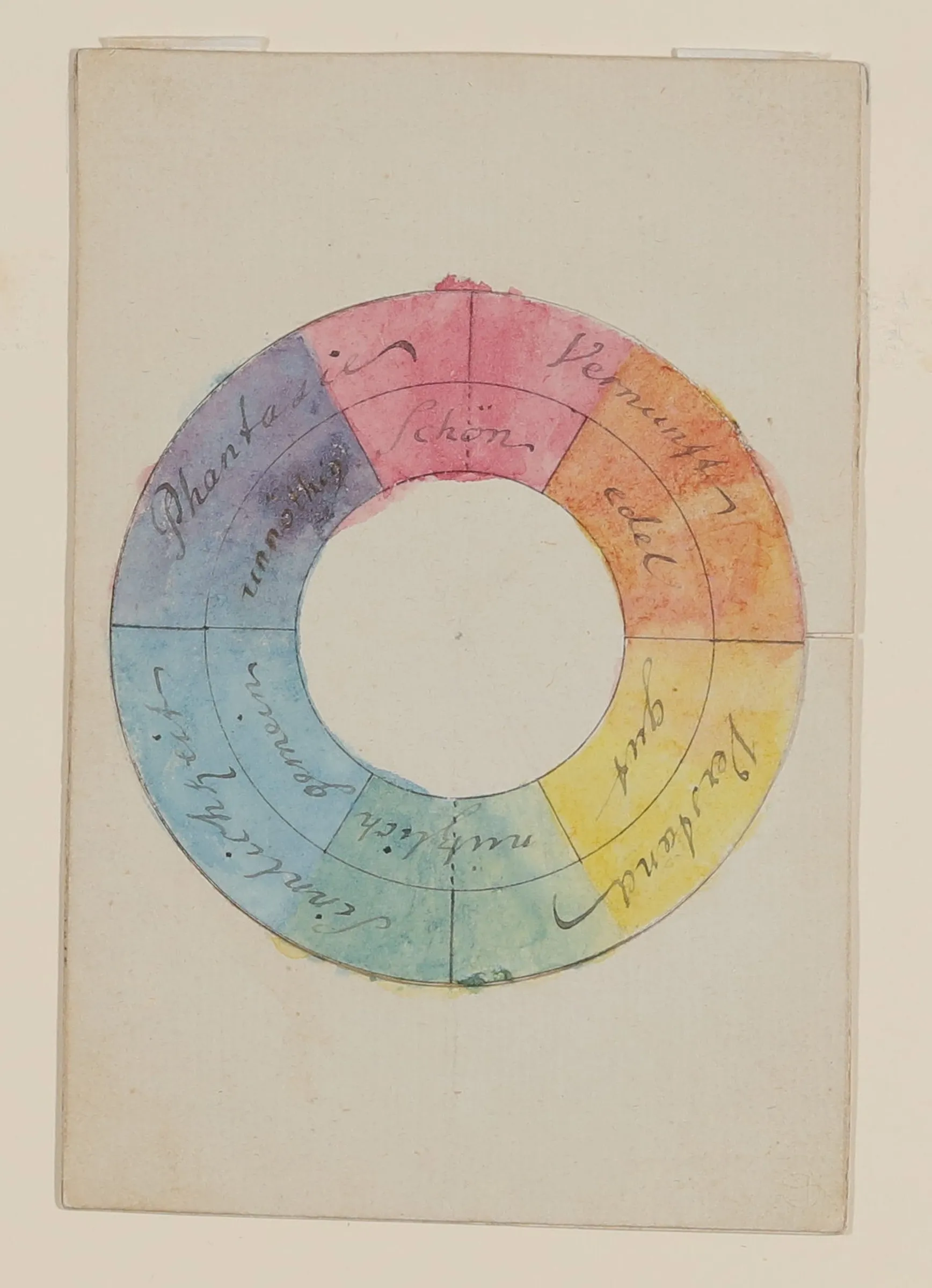
A disc 69 millimetres across, drawn in pen over erased pencil on round cut paper, mounted on card and then watercoloured in six segments.

[A8]Freies Deutsches Hochstift / Frankfurter Goethe-Museum, published through museum-digital:hessenNovember 1809Public Domain Markread 2026-07-29Downloaded the institution's own published image file at its native 2677x3700; resized to 2400px on the long edge with sharp (fit inside, no enlargement); encoded to WebP quality 80. No cropping, rotation, retouching or colour adjustment.

The record

The heading is literature. Inside it the register lists "Schriften über naturwissenschaftliche Themen sowie Abhandlungen zur Kunsttheorie". [A1]Goethes literarischer Nachlass, in the German Commission for UNESCO's register of Memory of the World inscriptions in Germany. Gives the year of inscription, the holding institution and the composition of the holding.Deutsche UNESCO-Kommissionclass A · read 2026-07-29

Johann Wolfgang von Goethe

Kept as the home of a "Dichter und Staatsmann": the house at the Frauenplan, rented from 1782 and lived and worked in for nearly fifty years, held his manuscripts, his books, and his growing art and scientific collections. [A2]Goethes Wohnhaus, the foundation's own page for the house at the Frauenplan: the 1782 tenancy, the nearly fifty years, the collections, the eighteen rooms shown, and the 1817 purchase that brought the pavilion.Klassik Stiftung Weimarclass A · read 2026-07-29

Works

What survives, and who holds it

Works

Works of record

Each work is listed with the institution that holds it and the rights statement that institution publishes, quoted as written.

November 1809

Farbenkreis zur Symbolisierung des "menschlichen Geistes- und Seelenlebens" [A8]Farbenkreis zur Symbolisierung des "menschlichen Geistes- und Seelenlebens", inventory III-14047, Sammlung der Zeichnungen und Aquarelle. Dated November 1809; creator recorded as Johann Wolfgang von Goethe (1749-1832). Material and technique: "Feder in Dunkelgrau über Spuren von Bleistift (ausradiert) auf rund beschnittenem Papier, auf festes Papier montiert, dieses mit dünnem Karton mit mittigem, die runde Zeichnung passgenau rahmenden Ausschnitt beklebt, anschließend aquarelliert". Measurements: "Blatt (Durchmesser): 69 mm; Untersatzpapier und aufgeklebter Karton: 117 x 79 mm". Acquired 1963 from E. Obenaus, Braunschweig.Freies Deutsches Hochstift / Frankfurter Goethe-Museum, published through museum-digital:hessenclass A · read 2026-07-29

A disc 69 millimetres across, drawn in pen over erased pencil, mounted on card and then watercoloured in six segments. Held by the Freies Deutsches Hochstift, Frankfurter Goethe-Museum, inventory III-14047, and published by it under the Public Domain Mark. It is the colour wheel a year before Zur Farbenlehre went to press.

Held by
Freies Deutsches Hochstift / Frankfurter Goethe-Museum, published through museum-digital:hessen
Rights, as published
Object and image rights, quoted from the record: "Herkunft/Rechte: Freies Deutsches Hochstift (Public Domain Mark)". Metadata separately: "Metadaten: CC BY-NC-SA", with the note that the text information is free for non-commercial use when the museum and the text author are named.

1774

Die Leiden des jungen Werthers [A21]Die Leiden des jungen Werthers, by Johann Wolfgang von Goethe, Leipzig: Weygand, 1774. 235 images. The catalogue records a title vignette to part one and part two and an errata list at page 224.Bayerische Staatsbibliothek München (shelfmark Rar. 138), via the Internet Archive mirror of its digitization bsb00070246class A · read 2026-07-29

Leipzig, Weygand. The scanned copy is the Bayerische Staatsbibliothek's, shelfmark Rar. 138, at 235 images. The catalogue notes a title vignette to each part and an errata list at page 224.

Held by
Bayerische Staatsbibliothek München (shelfmark Rar. 138), via the Internet Archive mirror of its digitization bsb00070246
Rights, as published
The item record carries no rights, licence, or copyright-status field. That ABSENCE is recorded here as exactly that. The scanned printing is of 1774.

1790

Versuch die Metamorphose der Pflanzen zu erklären [A14]Versuch die Metamorphose der Pflanzen zu erklären, by Johann Wolfgang von Goethe, Ettingersche Buchhandlung, 1790. 95 images.Oxford University, digitized by Google, via the Internet Archiveclass A · read 2026-07-29

Gotha, Ettingersche Buchhandlung. The plant morphology. The scanned copy is Oxford University's, digitized through Google, at 95 images.

Held by
Oxford University, digitized by Google, via the Internet Archive
Rights, as published
The item record's copyright status field reads, verbatim, "NOT_IN_COPYRIGHT". No further licence statement is attached.

1808

Faust. Eine Tragödie [A22]Faust: eine Tragödie, by Johann Wolfgang von Goethe, Tübingen: Cotta, 1808. 321 images.Staatsbibliothek Bamberg (shelfmark MvO.L.g.o.149), via the Internet Archive mirror of the Bayerische Staatsbibliothek digitization bsb11750682class A · read 2026-07-29

Tübingen, Cotta. The scanned copy is the Staatsbibliothek Bamberg's, shelfmark MvO.L.g.o.149, at 321 images.

Held by
Staatsbibliothek Bamberg (shelfmark MvO.L.g.o.149), via the Internet Archive mirror of the Bayerische Staatsbibliothek digitization bsb11750682
Rights, as published
The item record carries no rights, licence, or copyright-status field. That ABSENCE is recorded here as exactly that. The scanned printing is of 1808.

1810

Zur Farbenlehre [A13]Zur Farbenlehre, by Johann Wolfgang von Goethe, Tübingen: In der J.G. Cotta'schen Buchhandlung, 1810. Call number 9928165500001551, 795 images.Getty Research Institute, via the Internet Archiveclass A · read 2026-07-29

Tübingen, in der J. G. Cotta'schen Buchhandlung. The scanned copy is the Getty Research Institute's, at 795 images.

Held by
Getty Research Institute, via the Internet Archive
Rights, as published
The item record's copyright status field reads, verbatim, "NOT_IN_COPYRIGHT". No further licence statement is attached.

1820

Dem Menschen wie den Thieren ist ein Zwischenknochen der obern Kinnlade zuzuschreiben, in Zur Naturwissenschaft überhaupt, besonders zur Morphologie, Band 1, Heft 2 [A15]Zur Naturwissenschaft überhaupt, besonders zur Morphologie: Erfahrung, Betrachtung, Folgerung, durch Lebensereignisse verbunden. Band 1, Heft 2. Stuttgart and Tübingen, Cotta, 1820. Digitized from the Staatsbibliothek Bamberg copy, shelfmark Physiol.o.70(1. This is the issue in which the intermaxillary essay stands, under the heading "Dem Menschen wie den Thieren ist ein Zwischenknochen der obern Kinnlade zuzuschreiben." and a printed dateline giving the year 1786. Read in the Internet Archive full text export of the same scan, item 11846254bsb.Bayerische Staatsbibliothek, Münchener DigitalisierungsZentrumclass A · read 2026-07-29

Stuttgart and Tübingen, Cotta. The intermaxillary essay in print, thirty-six years after the finding was written to Herder. It opens by offering "eine kleine Entdeckung vorzulegen die ich glaube gemacht zu haben". The scanned copy is the Staatsbibliothek Bamberg's, shelfmark Physiol.o.70(1, digitized by the Bayerische Staatsbibliothek.

Held by
Bayerische Staatsbibliothek, Münchener DigitalisierungsZentrum
Rights, as published
The digitization is published in the library's open digital collections. Its printing is of 1820 and its author died in 1832.

1819

West-oestlicher Divan [A23]West-oestlicher Divan, by Johann Wolfgang von Goethe, Stuttgard: Cotta, 1819. 567 images. Catalogued with the note "Goedeke IV,716,33. - Erstausgabe".Staatliche Bibliothek Regensburg (shelfmark 999/Germ.3645a), via the Internet Archive mirror of the Bayerische Staatsbibliothek digitization bsb11091420class A · read 2026-07-29

Stuttgard, Cotta. The scanned copy is the Staatliche Bibliothek Regensburg's, shelfmark 999/Germ.3645a, at 567 images, catalogued as the first edition.

Held by
Staatliche Bibliothek Regensburg (shelfmark 999/Germ.3645a), via the Internet Archive mirror of the Bayerische Staatsbibliothek digitization bsb11091420
Rights, as published
The item record carries no rights, licence, or copyright-status field. That ABSENCE is recorded here as exactly that. The scanned printing is of 1819.

Record boundary

What the sources establish

Sources read
24
Primary or institutional
23
Distinct sources cited on this page
17
Works of record
7

Where the sources do not settle a question, this record does not answer it. Nothing above is inferred from anything else on the page.

What the record declines

That the Weimar appointments were an honorary literary post.

The diary says otherwise in his own hand. 18 February 1777: "Alles in Duft. Conseil. Die Bergwercks Sache. Sehr kalt." 5 January 1779: "Conseil die Kriegs Commission übertragen." [A5]Tagebucheintrag GT I, 5.1.1779, Weimar, ed. Wolfgang Albrecht and Andreas Döhler. Manuscript GSA 27/5, an interleaved printed almanac for 1779. Printed as GT I 1, Stuttgart 1998.PROPYLÄEN. Goethes Biographica, published by the Klassik Stiftung Weimar with the Sächsische Akademie der Wissenschaften zu Leipzig, the Akademie der Wissenschaften und der Literatur Mainz and the Freies Deutsches Hochstiftclass A · read 2026-07-29

Checked: The two entries at the PROPYLÄEN edition of the diaries, with their manuscript shelfmarks GSA 27/3 and GSA 27/5 at the Goethe- und Schiller-Archiv.

That he said the colour theory was worth more than his poetry.

The printed sentence is not a ranking of works and is not a dated statement. Eckermann introduces it as something Goethe "pflegte er wiederholt zu sagen", and it reads: "Auf Alles was ich als Poet geleistet habe ... bilde ich mir gar nichts ein. Es haben treffliche Dichter mit mir gelebt, es lebten noch Trefflichere vor mir, und es werden ihrer nach mir seyn. Daß ich aber in meinem Jahrhundert in der schwierigen Wissenschaft der Farbenlehre der Einzige bin, der das Rechte weiß, darauf thue ich mir etwas zu gute". The claim is priority in one science, not the value of one shelf against another. The phrase calling the colour theory the greatest and hardest of all his works belongs to Eckermann, in the narration around it. [A16]Johann Peter Eckermann, Gespräche mit Goethe in den letzten Jahren seines Lebens: 1823 bis 1832, second part, Leipzig: Brockhaus, 1836. The first edition. Read in the archive's full text export for the entries of 19 and 20 February 1829. The Fraktur setting is transcribed in modern letterforms where it is quoted on this page, and the wording was cross-checked against the sixth edition of 1885.Staatsbibliothek Bamberg (shelfmark Bg.o.221(2), digitized by the Bayerische Staatsbibliothek), via the Internet Archiveclass A · read 2026-07-29

Checked: The Brockhaus first edition of 1836, second part, under 19 February 1829, read in the Internet Archive full text export of the Bayerische Staatsbibliothek scan of the Staatsbibliothek Bamberg copy. The Fraktur setting is transcribed here in modern letterforms.

That he never gave ground on the colour theory.

The same book records him giving ground the following day. On 19 February 1829 Eckermann told him the derivation of the blue shadows on snow was not confirmed by observation and was called a heretic for it. The entry for 20 February 1829 opens: "Mit Goethe zu Tisch ... In der Farbenlehre tritt er etwas herüber zu meiner Meinung, hinsichtlich der blauen Schatten im Schnee." [A16]Johann Peter Eckermann, Gespräche mit Goethe in den letzten Jahren seines Lebens: 1823 bis 1832, second part, Leipzig: Brockhaus, 1836. The first edition. Read in the archive's full text export for the entries of 19 and 20 February 1829. The Fraktur setting is transcribed in modern letterforms where it is quoted on this page, and the wording was cross-checked against the sixth edition of 1885.Staatsbibliothek Bamberg (shelfmark Bg.o.221(2), digitized by the Bayerische Staatsbibliothek), via the Internet Archiveclass A · read 2026-07-29

Checked: The consecutive entries for 19 and 20 February 1829 in the Brockhaus first edition of 1836, second part.

That his last words were "Mehr Licht".

The record declines to state last words. His attending physician printed the sentence as hearsay and said he was not in the room: "Die Sprache wurde immer mühsamer und undeutlicher. „Mehr Licht“ sollen, während ich das Sterbezimmer auf einen Moment verlassen hatte, die letzten Worte des Mannes gewesen seyn, dem Finsterniss in jeder Beziehung stets verhasst war." Fifteen pages later in the same issue the editor drops the hedge and prints it flat: "Er endete mit den Worten: „Mehr Licht“." [A17]Carl Vogel, Die letzte Krankheit Goethe's, in Journal der practischen Heilkunde, volume LXXVI, second part, February 1833, Berlin: G. Reimer, pages 3 to 32, with a postscript by C. W. Hufeland at pages 30 to 32. Vogel was Goethe's attending physician. The sentence on the last words stands at page 17, Hufeland's at page 32.Boston Medical Library, in the Medical Heritage Library, via the Internet Archiveclass A · read 2026-07-29

Checked: Carl Vogel, Die letzte Krankheit Goethe's, in the Journal der practischen Heilkunde for February 1833, read in the Internet Archive full text of the Boston Medical Library copy, page 17, with C. W. Hufeland's postscript at page 32; the wording and both page numbers confirmed against the Gießen transcription.

That he discovered the intermaxillary bone.

The finding of 27 March 1784 is documented and it was not first. The anatomical literature records that Broussonet in 1779 and Vicq d'Azyr in 1780 had reached the same result by other methods, and that Coiter had already illustrated the sutura incisiva in the human in 1573. What the letter documents is an independent finding made with an anatomist's skulls, not a priority. [B1]K. Barteczko and M. Jacob, A re-evaluation of the premaxillary bone in humans, in Anatomy and Embryology. Cited only for the priority history of the os intermaxillare, which no primary source of the 1780s settles on its own.U.S. National Library of Medicine, National Center for Biotechnology Informationclass B · read 2026-07-29

Checked: The letter to Herder at the PROPYLÄEN critical edition, against the priority history in Barteczko and Jacob, A re-evaluation of the premaxillary bone in humans, Anatomy and Embryology 207(6), 2004, at page 418.

That there is one settled date for the intermaxillary paper.

The record leaves the dates as it finds them. The finding was written to Herder on 27 March 1784. The essay reached print only in 1820, in the second issue of Zur Naturwissenschaft überhaupt, besonders zur Morphologie, and the dateline printed under its heading there gives the year 1786. Both stand; neither is chosen here. [A15]Zur Naturwissenschaft überhaupt, besonders zur Morphologie: Erfahrung, Betrachtung, Folgerung, durch Lebensereignisse verbunden. Band 1, Heft 2. Stuttgart and Tübingen, Cotta, 1820. Digitized from the Staatsbibliothek Bamberg copy, shelfmark Physiol.o.70(1. This is the issue in which the intermaxillary essay stands, under the heading "Dem Menschen wie den Thieren ist ein Zwischenknochen der obern Kinnlade zuzuschreiben." and a printed dateline giving the year 1786. Read in the Internet Archive full text export of the same scan, item 11846254bsb.Bayerische Staatsbibliothek, Münchener DigitalisierungsZentrumclass A · read 2026-07-29

Checked: The heading and dateline of the essay in the Bayerische Staatsbibliothek scan of the Staatsbibliothek Bamberg copy, read in the archive's full text export, against the dated letter at the PROPYLÄEN critical edition.
The record

Johann Wolfgang von Goethe has a source page.

The same renderer a customer's published page mounts, drawing the same facts this room holds the sources for. Everything below is its apparatus.

View the record →sourceofyou.com/johann-wolfgang-von-goethe
One record, two views

The apparatus

What stands behind the record: the works and who holds them, the claims this record refuses, every source read and when, and the gate stack this figure passed before a page was compiled.

Sources

Sources

Class A is primary or institutional archival material. Class B is scholarly secondary work, cited with edition and page, and used only where class A could not be reached. Every source below was read at the URL given, on the date given.

  1. [A1]Class A

    Goethes literarischer Nachlass, in the German Commission for UNESCO's register of Memory of the World inscriptions in Germany. Gives the year of inscription, the holding institution and the composition of the holding.

    Deutsche UNESCO-Kommission

    https://www.unesco.de/kultur-und-natur/weltdokumentenerbe/weltdokumentenerbe-deutschland/goethes-literarischer-nachlassread 2026-07-29

    No reuse licence is published on the page. Its picture credit reads "© Klassik Stiftung Weimar/Goethe- und Schiller-Archiv". That ABSENCE of a licence statement is recorded here as exactly that, and only facts are taken from it.

  2. [A2]Class A

    Goethes Wohnhaus, the foundation's own page for the house at the Frauenplan: the 1782 tenancy, the nearly fifty years, the collections, the eighteen rooms shown, and the 1817 purchase that brought the pavilion.

    Klassik Stiftung Weimar

    https://www.klassik-stiftung.de/goethe-nationalmuseum/goethes-wohnhaus/read 2026-07-29

    No reuse licence is granted. The foundation's imprint states: "Alle Texte, Bilder, Graphiken, Ton-, Video- und Animationsdateien sowie deren Anordnung auf den Websites der Klassik Stiftung Weimar unterliegen dem Urheberrecht und anderen Gesetzen zum Schutz geistigen Eigentums. Sie dürfen weder für kommerzielle Zwecke oder zur Weitergabe kopiert noch verändert und auf anderen Websites verwendet werden." Only facts are taken from it; nothing from it is reproduced here as an image.

  3. [A3]Class A

    Goethes Nachlass im Wandel der Zeiten, in the foundation's own magazine: the estate kept in more than 500 archive boxes at the Goethe- und Schiller-Archiv above the Ilm.

    Klassik Stiftung Weimar

    https://magazin.klassik-stiftung.de/de/themenjahr-offnen-2026-freigegeben/goethes-nachlass-im-wandel-der-zeiten/read 2026-07-29

    No reuse licence is published. The footer states only "© Klassik Stiftung Weimar, 2025". That absence is recorded as exactly that.

  4. [A4]Class A

    Tagebucheintrag GT I, 18.2.1777, Weimar, ed. Wolfgang Albrecht and Andreas Döhler. Manuscript GSA 27/3. Printed as GT I 1, page 38, Stuttgart 1998.

    PROPYLÄEN. Goethes Biographica, published by the Klassik Stiftung Weimar with the Sächsische Akademie der Wissenschaften zu Leipzig, the Akademie der Wissenschaften und der Literatur Mainz and the Freies Deutsches Hochstift

    https://goethe-biographica.de/id/GT01_0291read 2026-07-29

    Quoted from the page: "Die Texte dieser Webseite können unter den Bedingungen der Creative Commons-Lizenz CC BY-NC 4.0 nachgenutzt werden." and "Die Digitalisate können unter den Bedingungen der bestandshaltenden Einrichtung nachgenutzt werden."

  5. [A5]Class A

    Tagebucheintrag GT I, 5.1.1779, Weimar, ed. Wolfgang Albrecht and Andreas Döhler. Manuscript GSA 27/5, an interleaved printed almanac for 1779. Printed as GT I 1, Stuttgart 1998.

    PROPYLÄEN. Goethes Biographica, published by the Klassik Stiftung Weimar with the Sächsische Akademie der Wissenschaften zu Leipzig, the Akademie der Wissenschaften und der Literatur Mainz and the Freies Deutsches Hochstift

    https://goethe-biographica.de/id/GT01_0662read 2026-07-29

    Quoted from the page: "Die Texte dieser Webseite können unter den Bedingungen der Creative Commons-Lizenz CC BY-NC 4.0 nachgenutzt werden."

  6. [A6]Class A

    Begegnungen und Gespräche II, A 2037, Jena, 27.3.1784, ed. Ernst Grumach and Renate Grumach: the letter to Herder announcing the os intermaxillare. Printed as BuG II, page 451.

    PROPYLÄEN. Goethes Biographica, published by the Klassik Stiftung Weimar with the Sächsische Akademie der Wissenschaften zu Leipzig, the Akademie der Wissenschaften und der Literatur Mainz and the Freies Deutsches Hochstift

    https://goethe-biographica.de/id/BuG02_A_2037read 2026-07-29

    Quoted from the page: "Die Texte dieser Webseite können unter den Bedingungen der Creative Commons-Lizenz CC BY-NC 4.0 nachgenutzt werden."

  7. [A7]Class A

    The diary edition and its full text search. The counts recorded here are the results the platform's own search returned on 29 July 2026 for the single words Farbenlehre, Metamorphose and Ilmenau, restricted to the Tagebücher, and they are stated as search results rather than as a claim about the manuscripts.

    PROPYLÄEN. Goethes Biographica, published by the Klassik Stiftung Weimar with the Sächsische Akademie der Wissenschaften zu Leipzig, the Akademie der Wissenschaften und der Literatur Mainz and the Freies Deutsches Hochstift

    https://goethe-biographica.de/recherche/tagebuecher.htmlread 2026-07-29

    Quoted from the page: "Die Texte dieser Webseite können unter den Bedingungen der Creative Commons-Lizenz CC BY-NC 4.0 nachgenutzt werden." and "Die bereitgestellten XML/TEI-Daten der Zeugnisse können unter den Bedingungen der Creative Commons-Lizenz CC BY 4.0 nachgenutzt werden."

  8. [A8]Class A

    Farbenkreis zur Symbolisierung des "menschlichen Geistes- und Seelenlebens", inventory III-14047, Sammlung der Zeichnungen und Aquarelle. Dated November 1809; creator recorded as Johann Wolfgang von Goethe (1749-1832). Material and technique: "Feder in Dunkelgrau über Spuren von Bleistift (ausradiert) auf rund beschnittenem Papier, auf festes Papier montiert, dieses mit dünnem Karton mit mittigem, die runde Zeichnung passgenau rahmenden Ausschnitt beklebt, anschließend aquarelliert". Measurements: "Blatt (Durchmesser): 69 mm; Untersatzpapier und aufgeklebter Karton: 117 x 79 mm". Acquired 1963 from E. Obenaus, Braunschweig.

    Freies Deutsches Hochstift / Frankfurter Goethe-Museum, published through museum-digital:hessen

    https://hessen.museum-digital.de/object/96949read 2026-07-29

    Object and image rights, quoted from the record: "Herkunft/Rechte: Freies Deutsches Hochstift (Public Domain Mark)". Metadata separately: "Metadaten: CC BY-NC-SA", with the note that the text information is free for non-commercial use when the museum and the text author are named.

  9. [A9]Class A

    Wheel in watercolours, 1809, in the institution's own mediaguide for the Romantik exhibition, second floor, on the colours of Runge.

    Freies Deutsches Hochstift

    https://freies-deutsches-hochstift.de/en/mediaguide/romantik-ausstellung/2-obergeschoss/runges-farben/farbkreis-zur-symbolisierung-des-menschlichen-geistesund-seelenlebens-1809/read 2026-07-29

    No reuse licence is published on the page. That absence is recorded here as exactly that, and only facts are taken from it.

  10. [A10]Class A

    Johann Heinrich Wilhelm Tischbein, Goethe in der römischen Campagna, 1787, oil on canvas, 166 x 210.3 cm, inventory 1157. Acquisition recorded as "Erworben 1887 als Schenkung der Baronin Adèle von Rothschild".

    Städel Museum, Frankfurt am Main

    https://sammlung.staedelmuseum.de/de/werk/goethe-in-der-roemischen-campagnaread 2026-07-29

    The work record states "Public Domain". The museum's own download terms state: "Werkabbildungen der gemeinfreien (urheberrechtlich nicht mehr geschützten) Kunstwerke befinden sich in der Public Domain und können uneingeschränkt heruntergeladen und genutzt werden. Nennung: ‘Städel Museum, Frankfurt am Main’. Bei der Verwendung für wissenschaftliche Publikationen bitten wir um die Zusendung eines Belegexemplars."

  11. [A11]Class A

    Johann Wolfgang von Goethe, in the house museum's own exhibition pages. The institution acquired the birth house in 1863.

    Freies Deutsches Hochstift, Frankfurter Goethe-Haus

    https://frankfurter-goethe-haus.de/ausstellung/-/frankfurter-goethe-haus-johann-wolfgang-von-goethe/234read 2026-07-29

    No reuse licence is published on the page. That absence is recorded here as exactly that, and only facts are taken from it.

  12. [A12]Class A

    GOETHE IN DER GRUBE, the museum's own exhibition text on his mining work: the Ilmenau mine in 1776, mining under his offices from 1777, the first blow with a pick at the shaft opening of 1784, nine hours in the shafts in October 1784, the collapse of 1796 and the filling of the shafts in 1814.

    Goethe-Museum Düsseldorf, Anton-und-Katharina-Kippenberg-Stiftung

    https://www.goethe-museum.de/de/goethe-in-der-gruberead 2026-07-29

    No reuse licence is published. The imprint names the provider as "Goethe-Museum Düsseldorf / Anton-und-Katharina-Kippenberg-Stiftung" and states "Es wird keine Gewähr für die Richtigkeit oder Vollständigkeit der gemachten Angaben übernommen." That disclaimer is recorded here rather than smoothed over.

  13. [A13]Class A

    Zur Farbenlehre, by Johann Wolfgang von Goethe, Tübingen: In der J.G. Cotta'schen Buchhandlung, 1810. Call number 9928165500001551, 795 images.

    Getty Research Institute, via the Internet Archive

    https://archive.org/details/gri_c00233125012873531read 2026-07-29

    The item record's copyright status field reads, verbatim, "NOT_IN_COPYRIGHT". No further licence statement is attached.

  14. [A14]Class A

    Versuch die Metamorphose der Pflanzen zu erklären, by Johann Wolfgang von Goethe, Ettingersche Buchhandlung, 1790. 95 images.

    Oxford University, digitized by Google, via the Internet Archive

    https://archive.org/details/versuchdiemetam00goetgoogread 2026-07-29

    The item record's copyright status field reads, verbatim, "NOT_IN_COPYRIGHT". No further licence statement is attached.

  15. [A15]Class A

    Zur Naturwissenschaft überhaupt, besonders zur Morphologie: Erfahrung, Betrachtung, Folgerung, durch Lebensereignisse verbunden. Band 1, Heft 2. Stuttgart and Tübingen, Cotta, 1820. Digitized from the Staatsbibliothek Bamberg copy, shelfmark Physiol.o.70(1. This is the issue in which the intermaxillary essay stands, under the heading "Dem Menschen wie den Thieren ist ein Zwischenknochen der obern Kinnlade zuzuschreiben." and a printed dateline giving the year 1786. Read in the Internet Archive full text export of the same scan, item 11846254bsb.

    Bayerische Staatsbibliothek, Münchener DigitalisierungsZentrum

    https://archive.org/details/11846254bsbread 2026-07-29

    The digitization is published in the library's open digital collections. Its printing is of 1820 and its author died in 1832.

  16. [A16]Class A

    Johann Peter Eckermann, Gespräche mit Goethe in den letzten Jahren seines Lebens: 1823 bis 1832, second part, Leipzig: Brockhaus, 1836. The first edition. Read in the archive's full text export for the entries of 19 and 20 February 1829. The Fraktur setting is transcribed in modern letterforms where it is quoted on this page, and the wording was cross-checked against the sixth edition of 1885.

    Staatsbibliothek Bamberg (shelfmark Bg.o.221(2), digitized by the Bayerische Staatsbibliothek), via the Internet Archive

    https://archive.org/details/11425737bsbread 2026-07-29

    The item record carries no rights, licence, or copyright-status field. That ABSENCE is recorded here as exactly that. The scanned printing is of 1836 and both author and subject died before 1855.

  17. [A17]Class A

    Carl Vogel, Die letzte Krankheit Goethe's, in Journal der practischen Heilkunde, volume LXXVI, second part, February 1833, Berlin: G. Reimer, pages 3 to 32, with a postscript by C. W. Hufeland at pages 30 to 32. Vogel was Goethe's attending physician. The sentence on the last words stands at page 17, Hufeland's at page 32.

    Boston Medical Library, in the Medical Heritage Library, via the Internet Archive

    https://archive.org/details/journal-der-practischen-heilkunde_1833-02_76_2read 2026-07-29

    No rights statement is published in the item metadata. That ABSENCE is recorded here as exactly that. The printing is of 1833.

  18. [A18]Class A

    Carl Vogel, Die letzte Krankheit Goethe's (1833), a scholarly transcription with the printed page breaks marked, prepared by Thomas Gloning. Used to confirm the wording and the page numbers of the passages read in the scan.

    Justus-Liebig-Universität Gießen, Institut für Germanistik

    https://www.uni-giessen.de/de/fbz/fb05/germanistik/absprache/sprachverwendung/gloning/tx/1833cvog.htmread 2026-07-29

    No reuse licence is published on the page. That absence is recorded here as exactly that, and only facts are taken from it.

  19. [B1]Class B

    K. Barteczko and M. Jacob, A re-evaluation of the premaxillary bone in humans, in Anatomy and Embryology. Cited only for the priority history of the os intermaxillare, which no primary source of the 1780s settles on its own.

    U.S. National Library of Medicine, National Center for Biotechnology Information. Anatomy and Embryology (Berlin) 207(6), March 2004, pages 417 to 437, at page 418

    https://pubmed.ncbi.nlm.nih.gov/14760532/read 2026-07-29

    No rights statement is published on the PubMed abstract record.

  20. [A19]Class A

    Geschichte des Goethe- und Schiller-Archivs, and the archive's own landing page: the oldest literary archive in Germany, a total holding of about 5 million sheets, the estate passing to Grand Duchess Sophie on 15 April 1885 under the will of the last Goethe grandson Walther, and the transfer of the archive into the foundation in October 1991.

    Klassik Stiftung Weimar, Goethe- und Schiller-Archiv

    https://www.klassik-stiftung.de/goethe-und-schiller-archiv/das-archiv/geschichte/read 2026-07-29

    No reuse licence is granted. The foundation's imprint states: "Alle Texte, Bilder, Graphiken, Ton-, Video- und Animationsdateien sowie deren Anordnung auf den Websites der Klassik Stiftung Weimar unterliegen dem Urheberrecht und anderen Gesetzen zum Schutz geistigen Eigentums." Only facts are taken from it.

  21. [A20]Class A

    Signature GSA 30/520 (ÜF 87): "Adelsdiplom für Johann Wolfgang von Goethe, ausgestellt von Kaiser Joseph II. Wien, 1782 April 10", dated 10.4.1782, 8 leaves, 30 digitisates. Filed under "Goethe, Johann Wolfgang von / Akten > Nachträglich in verschiedene Zusammenhänge eingeordnete Akten > Ehrenmitgliedschaften und Diplome".

    Goethe- und Schiller-Archiv, Klassik Stiftung Weimar (Archivdatenbank)

    https://ores.klassik-stiftung.de/ords/f?p=401:2:::::P2_ID:185580read 2026-07-29

    Quoted from the record: "Download IIIF-Manifest / Lizenz für die Digitalisate: Public Domain". The database footer reads "Archivdatenbank des Goethe- und Schiller-Archivs, © Klassik Stiftung Weimar, Goethe- und Schiller-Archiv".

  22. [A21]Class A

    Die Leiden des jungen Werthers, by Johann Wolfgang von Goethe, Leipzig: Weygand, 1774. 235 images. The catalogue records a title vignette to part one and part two and an errata list at page 224.

    Bayerische Staatsbibliothek München (shelfmark Rar. 138), via the Internet Archive mirror of its digitization bsb00070246

    https://archive.org/details/00070246bsbread 2026-07-29

    The item record carries no rights, licence, or copyright-status field. That ABSENCE is recorded here as exactly that. The scanned printing is of 1774.

  23. [A22]Class A

    Faust: eine Tragödie, by Johann Wolfgang von Goethe, Tübingen: Cotta, 1808. 321 images.

    Staatsbibliothek Bamberg (shelfmark MvO.L.g.o.149), via the Internet Archive mirror of the Bayerische Staatsbibliothek digitization bsb11750682

    https://archive.org/details/11750682bsbread 2026-07-29

    The item record carries no rights, licence, or copyright-status field. That ABSENCE is recorded here as exactly that. The scanned printing is of 1808.

  24. [A23]Class A

    West-oestlicher Divan, by Johann Wolfgang von Goethe, Stuttgard: Cotta, 1819. 567 images. Catalogued with the note "Goedeke IV,716,33. - Erstausgabe".

    Staatliche Bibliothek Regensburg (shelfmark 999/Germ.3645a), via the Internet Archive mirror of the Bayerische Staatsbibliothek digitization bsb11091420

    https://archive.org/details/11091420bsbread 2026-07-29

    The item record carries no rights, licence, or copyright-status field. That ABSENCE is recorded here as exactly that. The scanned printing is of 1819.

Clearance

How this record was cleared

Every record in the Hall passes the same gate stack before a page is compiled, and the result is published rather than merely filed.

Died
1832
Public domain basis
Every work linked here was printed between 1790 and 1820 and its author died in 1832, so the texts are long out of copyright. The scan positions agree: the Internet Archive records for Zur Farbenlehre and for the plant metamorphosis both read "NOT_IN_COPYRIGHT". The two images shipped on this page are published as public domain by the institutions that hold the objects: the colour wheel under "Freies Deutsches Hochstift (Public Domain Mark)", and the portrait under the Städel Museum's own statement that images of works no longer in copyright are in the public domain and may be downloaded and used without restriction.
Estate and licensing screen
Screened 2026-07-29. No enforcing estate, heir, or licensing agent was found. CMG Worldwide's Historical roster was read in full and contains no entry; three plausible client slugs on that site return 404. Authentic Brands Group's portfolio renders client side and could not be read, so that check is a sitemap-level negative and is recorded as such. Greenlight Rights no longer publishes a deceased-personality roster at its domain. The archive and the houses are held by public and nonprofit bodies: the Klassik Stiftung Weimar states it is "eine gemeinnützige Stiftung des öffentlichen Rechts" borne by the federal government, the Free State of Thuringia and the city of Weimar, and the Freies Deutsches Hochstift calls itself "eine gemeinnützige Forschungsinstitution". Neither holds a live mark in the name.
Trademark screen
Screened 2026-07-29. A live collision was found and is disclosed. "Goethe-Institut" is registered to Goethe-Institut e.V. as EUTM 018927971 (word) and EUTM 012235685 (figurative), Nice classes 9, 16 and 41, and as Madrid international registration 1770347 across more than sixty territories; Goethe-Universität Frankfurt holds three German marks in the qualified university name. A sweep of the EUIPO and TMDN common register for the string was paged to exhaustion at 501 unique records, and the marks whose name is exactly the bare surname and the marks owned by Goethe-Institut e.V. are disjoint sets: the institute owns no mark in the bare surname, which is held instead by unrelated parties for wine, spirits and marketing services. The institute's own published terms assert no right in its name or logo. The EUIPO interface, the WIPO brand database, DPMAregister and USPTO TESS were browser or key gated, so the German and American data was read through TMview rather than at those offices. No mark was cleared or sought for this record, which is an archival compilation and not a product bearing the name, and the name never enters a feature name, an advertisement, a lockup or a bid keyword.
Dignity screen
Documented facts only, in both directions, and no editorial verdict on either. The record states the offices as the diary states them, the mine as the museum that keeps the mining papers states it, and the works as the libraries that hold the scans catalogue them. Where a famous saying could not be settled at an institution the record declines it rather than choosing a version, and no motive, feeling or opinion is attributed to him beyond what he wrote or what a cited edition records.
Gate stack run
2026-07-29

The machine record

The structured representation this page is built from, printed field by field.

Every row below is a field of this figure's module, printed with its value and the citation key that settles it. Nothing here is summarised or inferred. It is shown as text for a reader: this page emits no machine-readable metadata, and it is excluded from the sitemap, from llms.txt, and from search indexes.

identity

slugjohann-wolfgang-von-goethe
handlejohann-wolfgang-von-goethe
nameJohann Wolfgang von Goethe
disciplineGovernment and science
entered2026-07-29
accent#3A424D

claims

labelInscribed in the UNESCO Memory of the World register in 2001 under the heading "Goethes literarischer Nachlass". [A1]
turnThe heading is literature. Inside it the register lists "Schriften über naturwissenschaftliche Themen sowie Abhandlungen zur Kunsttheorie". [A1]
lifespan1749 to 1832 [A8]
statementKept as the home of a "Dichter und Staatsmann": the house at the Frauenplan, rented from 1782 and lived and worked in for nearly fifty years, held his manuscripts, his books, and his growing art and scientific collections. [A2]

story[9]

story[0]The diary entry for 18 February 1777, written at Weimar in his own hand, reads in full: "Alles in Duft. Conseil. Die Bergwercks Sache. Sehr kalt." [A4]
story[1]Two years later the entry for 5 January 1779 opens "Conseil die Kriegs Commission übertragen." The manuscript is the interleaved 1779 almanac now held as GSA 27/5. [A5]
story[2]The museum that keeps his mining papers records that mining in Saxe-Weimar-Eisenach fell under his offices from 1777, that he struck the first blow with a pick at the shaft opening of 1784, that a gallery collapsed in 1796 and ended the work, and that the shafts were filled in 1814. [A12]
story[3]Writing to Herder on 27 March 1784 he reported a finding in comparative anatomy: "das os intermaxillare am Menschen! Ich verglich mit Lodern Menschen- und Thierschädel". [A6]
story[4]A full text search of the same diary edition on 29 July 2026 returns 268 entries containing the word Farbenlehre, spread over thirty-one separate years from 1797 to 1832, and 113 entries containing Metamorphose, from 1786 to 1832. [A7]
story[5]The colour theory reached print in 1810 at Tübingen, from the J. G. Cotta bookshop, in a copy now scanned from the Getty Research Institute's holdings at 795 images. [A13]
story[6]Even the ennoblement is a document with a shelfmark. The Goethe- und Schiller-Archiv files GSA 30/520 as "Adelsdiplom für Johann Wolfgang von Goethe, ausgestellt von Kaiser Joseph II. Wien, 1782 April 10", among his Akten under honorary memberships and diplomas. [A20]
story[7]The estate is held today by the Goethe- und Schiller-Archiv of the Klassik Stiftung Weimar, in about 500 archive boxes, and its core is the archive he began himself. [A1]
story[8]That archive is the oldest literary archive in Germany, and it left the family in 1885: by the will of the last Goethe grandson the papers passed on 15 April 1885 to Grand Duchess Sophie of Saxe-Weimar-Eisenach. [A19]

schedule[17]

schedule[0] [A11]

span1749
titleFrankfurt am Main
detailThe institution that keeps the birth house quotes his own account of the date: "AM 28. AUGUST 1749, MITTAGS MIT DEM GLOCKENSCHLAGE ZWÖLF, KAM ICH IN FRANKFURT AM MAIN AUF DIE WELT."

schedule[1] [A21]

span1774
titleDie Leiden des jungen Werthers
detailPrinted at Leipzig by Weygand. The scanned copy is the Bayerische Staatsbibliothek's, shelfmark Rar. 138, with a title vignette to each part and an errata list at page 224.

schedule[2] [A4]

span1777
titleThe mining business in Conseil
detailThe diary for 18 February 1777, at Weimar: "Alles in Duft. Conseil. Die Bergwercks Sache. Sehr kalt." The manuscript is GSA 27/3.

schedule[3] [A5]

span1779
titleThe war commission
detailThe diary for 5 January 1779, at Weimar: "5 Conseil die Kriegs Commission übertragen. Aufs Eis essen." The manuscript is GSA 27/5, an interleaved printed almanac for 1779.

schedule[4] [A2]

span1782
titleThe house at the Frauenplan
detailMoved in as a tenant in 1782 and lived and worked there for nearly fifty years. The house took his manuscripts, his books and his growing art and scientific collections; eighteen rooms of it are still shown.

schedule[5] [A20]

span1782
titleThe patent of nobility
detailThe Goethe- und Schiller-Archiv holds it as GSA 30/520 (ÜF 87): "Adelsdiplom für Johann Wolfgang von Goethe, ausgestellt von Kaiser Joseph II. Wien, 1782 April 10", eight leaves, thirty digitisates.

schedule[6] [A6]

span1784
titleThe intermaxillary bone
detailReported to Herder from Jena on 27 March 1784: "das os intermaxillare am Menschen! Ich verglich mit Lodern Menschen- und Thierschädel". Justus Christian Loder was the Jena anatomist.

schedule[7] [A14]

span1790
titleVersuch die Metamorphose der Pflanzen zu erklären
detailPrinted at Gotha by the Ettingersche Buchhandlung in 1790. The scanned copy is Oxford University's, at 95 images.

schedule[8] [A22]

span1808
titleFaust. Eine Tragödie
detailPrinted at Tübingen by Cotta. The scanned copy is the Staatsbibliothek Bamberg's, shelfmark MvO.L.g.o.149, at 321 images.

schedule[9] [A8]

span1809
titleThe colour wheel
detailA disc 69 millimetres across, drawn and watercoloured in November 1809 and lettered in its outer segments Phantasie, Vernunft, Verstand and Sinnlichkeit. Acquired by the institution in 1963.

schedule[10] [A13]

span1810
titleZur Farbenlehre
detailPrinted at Tübingen in 1810 by the J. G. Cotta'schen Buchhandlung. The scanned copy is the Getty Research Institute's, at 795 images.

schedule[11] [A2]

span1817
titleThe mineral cabinet
detailThe neighbouring Treuter plot was bought in 1817 and the garden extended eastward. The pavilion at the Ackerwand came with the purchase, and the mineral collection was housed in it.

schedule[12] [A23]

span1819
titleWest-oestlicher Divan
detailPrinted at Stuttgard by Cotta and catalogued as the first edition. The scanned copy is the Staatliche Bibliothek Regensburg's, shelfmark 999/Germ.3645a, at 567 images.

schedule[13] [A15]

span1820
titleThe intermaxillary essay reaches print
detailPrinted at last in the second issue of Zur Naturwissenschaft überhaupt, besonders zur Morphologie, Stuttgart and Tübingen, Cotta, under a dateline giving the year 1786. It offers "eine kleine Entdeckung vorzulegen die ich glaube gemacht zu haben".

schedule[14] [A19]

span1885
titleThe papers leave the family
detailBy the will of the last Goethe grandson, Walther, the estate passed on 15 April 1885 into the possession of Grand Duchess Sophie of Saxe-Weimar-Eisenach. The archive building went up between 1893 and 1896.

schedule[15] [A19]

span1991
titleInto the foundation
detailIn October 1991 the Goethe- und Schiller-Archiv, by then holding more than 110 personal and institutional estates, was transferred into the Stiftung Weimarer Klassik, today the Klassik Stiftung Weimar.

schedule[16] [A1]

span2001
titleThe estate enters the Memory of the World register
detailInscribed as "Goethes literarischer Nachlass", held at the Klassik Stiftung Weimar, Jenaer Str. 1. About 500 archive boxes holding several thousand letters, diaries, writings on scientific subjects and treatises on art theory.

figures[7]

figures[0] [A7]

label268 diary entries
detailA full text search of the PROPYLÄEN diary edition on 29 July 2026 returns 268 diary entries containing the word Farbenlehre, distributed over thirty-one separate years from 1797 to 1832.

figures[1] [A7]

label113 diary entries
detailThe same search for Metamorphose on 29 July 2026 returns 113 diary entries, from 1786 to 1832. Ilmenau returns 140.

figures[2] [A1]

labelcirca 500 boxes
detailThe estate is kept in about 500 archive boxes at the Goethe- und Schiller-Archiv. Its core is the archive he began himself.

figures[3] [A12]

label1777 to 1814
detailMining fell under his offices in Saxe-Weimar-Eisenach from 1777. A gallery collapsed in 1796 and ended the shaft work; the shafts were filled in 1814.

figures[4] [A12]

label9 hours underground
detailIn October 1784 he spent nine hours at a stretch walking the Ilmenau shafts.

figures[5] [A19]

label5 million sheets
detailThe Goethe- und Schiller-Archiv, the oldest literary archive in Germany, states a total holding of about 5 million sheets across all its collections.

figures[6] [A8]

label69 mm across
detailThe colour wheel of November 1809 is a disc 69 millimetres in diameter, mounted on paper and card measuring 117 by 79 millimetres.

works[7]

works[0] [A8]

titleFarbenkreis zur Symbolisierung des "menschlichen Geistes- und Seelenlebens"
yearNovember 1809
noteA disc 69 millimetres across, drawn in pen over erased pencil, mounted on card and then watercoloured in six segments. Held by the Freies Deutsches Hochstift, Frankfurter Goethe-Museum, inventory III-14047, and published by it under the Public Domain Mark. It is the colour wheel a year before Zur Farbenlehre went to press.
urlhttps://hessen.museum-digital.de/object/96949

works[1] [A21]

titleDie Leiden des jungen Werthers
year1774
noteLeipzig, Weygand. The scanned copy is the Bayerische Staatsbibliothek's, shelfmark Rar. 138, at 235 images. The catalogue notes a title vignette to each part and an errata list at page 224.
urlhttps://archive.org/details/00070246bsb

works[2] [A14]

titleVersuch die Metamorphose der Pflanzen zu erklären
year1790
noteGotha, Ettingersche Buchhandlung. The plant morphology. The scanned copy is Oxford University's, digitized through Google, at 95 images.
urlhttps://archive.org/details/versuchdiemetam00goetgoog

works[3] [A22]

titleFaust. Eine Tragödie
year1808
noteTübingen, Cotta. The scanned copy is the Staatsbibliothek Bamberg's, shelfmark MvO.L.g.o.149, at 321 images.
urlhttps://archive.org/details/11750682bsb

works[4] [A13]

titleZur Farbenlehre
year1810
noteTübingen, in der J. G. Cotta'schen Buchhandlung. The scanned copy is the Getty Research Institute's, at 795 images.
urlhttps://archive.org/details/gri_c00233125012873531

works[5] [A15]

titleDem Menschen wie den Thieren ist ein Zwischenknochen der obern Kinnlade zuzuschreiben, in Zur Naturwissenschaft überhaupt, besonders zur Morphologie, Band 1, Heft 2
year1820
noteStuttgart and Tübingen, Cotta. The intermaxillary essay in print, thirty-six years after the finding was written to Herder. It opens by offering "eine kleine Entdeckung vorzulegen die ich glaube gemacht zu haben". The scanned copy is the Staatsbibliothek Bamberg's, shelfmark Physiol.o.70(1, digitized by the Bayerische Staatsbibliothek.
urlhttps://archive.org/details/11846254bsb

works[6] [A23]

titleWest-oestlicher Divan
year1819
noteStuttgard, Cotta. The scanned copy is the Staatliche Bibliothek Regensburg's, shelfmark 999/Germ.3645a, at 567 images, catalogued as the first edition.
urlhttps://archive.org/details/11091420bsb

answers[5]

answers[0] [A5]

qWhat did the Weimar government actually hand him?
aThe diary records it in his own hand. On 18 February 1777: "Conseil. Die Bergwercks Sache." On 5 January 1779: "Conseil die Kriegs Commission übertragen."

answers[1] [A7]

qHow long did the colour work run?
aA full text search of the diary edition on 29 July 2026 returns 268 entries containing the word Farbenlehre, spread over thirty-one separate years from 1797 to 1832.

answers[2] [A8]

qWhat is the object hanging in this room?
aA colour wheel of November 1809, pen over erased pencil on round cut paper, mounted and watercoloured, lettered "Phantasie // Vernunft // Verstand // Sinnlichkeit" in the outer segments and "unnöthig // schön // edel // gut // nützlich // gemein" in the inner ones. Inventory III-14047.

answers[3] [A1]

qWhat is in the estate besides the poems?
aThe register's own description of the holding lists, in about 500 archive boxes, "mehrere Tausend Briefe, Tagebücher, Schriften über naturwissenschaftliche Themen sowie Abhandlungen zur Kunsttheorie", alongside the fair copy of Faust and the manuscripts of the Italienische Reise and the West-östlicher Divan.

answers[4] [A1]

qWho holds the papers now?
aThe Goethe- und Schiller-Archiv of the Klassik Stiftung Weimar, in about 500 archive boxes, inscribed in the UNESCO Memory of the World register in 2001.

declines[6]

declines[0] [A5]

mythThat the Weimar appointments were an honorary literary post.
refusalThe diary says otherwise in his own hand. 18 February 1777: "Alles in Duft. Conseil. Die Bergwercks Sache. Sehr kalt." 5 January 1779: "Conseil die Kriegs Commission übertragen."
checkedThe two entries at the PROPYLÄEN edition of the diaries, with their manuscript shelfmarks GSA 27/3 and GSA 27/5 at the Goethe- und Schiller-Archiv.

declines[1] [A16]

mythThat he said the colour theory was worth more than his poetry.
refusalThe printed sentence is not a ranking of works and is not a dated statement. Eckermann introduces it as something Goethe "pflegte er wiederholt zu sagen", and it reads: "Auf Alles was ich als Poet geleistet habe ... bilde ich mir gar nichts ein. Es haben treffliche Dichter mit mir gelebt, es lebten noch Trefflichere vor mir, und es werden ihrer nach mir seyn. Daß ich aber in meinem Jahrhundert in der schwierigen Wissenschaft der Farbenlehre der Einzige bin, der das Rechte weiß, darauf thue ich mir etwas zu gute". The claim is priority in one science, not the value of one shelf against another. The phrase calling the colour theory the greatest and hardest of all his works belongs to Eckermann, in the narration around it.
checkedThe Brockhaus first edition of 1836, second part, under 19 February 1829, read in the Internet Archive full text export of the Bayerische Staatsbibliothek scan of the Staatsbibliothek Bamberg copy. The Fraktur setting is transcribed here in modern letterforms.

declines[2] [A16]

mythThat he never gave ground on the colour theory.
refusalThe same book records him giving ground the following day. On 19 February 1829 Eckermann told him the derivation of the blue shadows on snow was not confirmed by observation and was called a heretic for it. The entry for 20 February 1829 opens: "Mit Goethe zu Tisch ... In der Farbenlehre tritt er etwas herüber zu meiner Meinung, hinsichtlich der blauen Schatten im Schnee."
checkedThe consecutive entries for 19 and 20 February 1829 in the Brockhaus first edition of 1836, second part.

declines[3] [A17]

mythThat his last words were "Mehr Licht".
refusalThe record declines to state last words. His attending physician printed the sentence as hearsay and said he was not in the room: "Die Sprache wurde immer mühsamer und undeutlicher. „Mehr Licht“ sollen, während ich das Sterbezimmer auf einen Moment verlassen hatte, die letzten Worte des Mannes gewesen seyn, dem Finsterniss in jeder Beziehung stets verhasst war." Fifteen pages later in the same issue the editor drops the hedge and prints it flat: "Er endete mit den Worten: „Mehr Licht“."
checkedCarl Vogel, Die letzte Krankheit Goethe's, in the Journal der practischen Heilkunde for February 1833, read in the Internet Archive full text of the Boston Medical Library copy, page 17, with C. W. Hufeland's postscript at page 32; the wording and both page numbers confirmed against the Gießen transcription.

declines[4] [B1]

mythThat he discovered the intermaxillary bone.
refusalThe finding of 27 March 1784 is documented and it was not first. The anatomical literature records that Broussonet in 1779 and Vicq d'Azyr in 1780 had reached the same result by other methods, and that Coiter had already illustrated the sutura incisiva in the human in 1573. What the letter documents is an independent finding made with an anatomist's skulls, not a priority.
checkedThe letter to Herder at the PROPYLÄEN critical edition, against the priority history in Barteczko and Jacob, A re-evaluation of the premaxillary bone in humans, Anatomy and Embryology 207(6), 2004, at page 418.

declines[5] [A15]

mythThat there is one settled date for the intermaxillary paper.
refusalThe record leaves the dates as it finds them. The finding was written to Herder on 27 March 1784. The essay reached print only in 1820, in the second issue of Zur Naturwissenschaft überhaupt, besonders zur Morphologie, and the dateline printed under its heading there gives the year 1786. Both stand; neither is chosen here.
checkedThe heading and dateline of the essay in the Bayerische Staatsbibliothek scan of the Staatsbibliothek Bamberg copy, read in the archive's full text export, against the dated letter at the PROPYLÄEN critical edition.

sources[24]

sources.A1 [A1]

clsA
institutionDeutsche UNESCO-Kommission
titleGoethes literarischer Nachlass, in the German Commission for UNESCO's register of Memory of the World inscriptions in Germany. Gives the year of inscription, the holding institution and the composition of the holding.
urlhttps://www.unesco.de/kultur-und-natur/weltdokumentenerbe/weltdokumentenerbe-deutschland/goethes-literarischer-nachlass
accessed2026-07-29
rightsNo reuse licence is published on the page. Its picture credit reads "© Klassik Stiftung Weimar/Goethe- und Schiller-Archiv". That ABSENCE of a licence statement is recorded here as exactly that, and only facts are taken from it.

sources.A2 [A2]

clsA
institutionKlassik Stiftung Weimar
titleGoethes Wohnhaus, the foundation's own page for the house at the Frauenplan: the 1782 tenancy, the nearly fifty years, the collections, the eighteen rooms shown, and the 1817 purchase that brought the pavilion.
urlhttps://www.klassik-stiftung.de/goethe-nationalmuseum/goethes-wohnhaus/
accessed2026-07-29
rightsNo reuse licence is granted. The foundation's imprint states: "Alle Texte, Bilder, Graphiken, Ton-, Video- und Animationsdateien sowie deren Anordnung auf den Websites der Klassik Stiftung Weimar unterliegen dem Urheberrecht und anderen Gesetzen zum Schutz geistigen Eigentums. Sie dürfen weder für kommerzielle Zwecke oder zur Weitergabe kopiert noch verändert und auf anderen Websites verwendet werden." Only facts are taken from it; nothing from it is reproduced here as an image.

sources.A3 [A3]

clsA
institutionKlassik Stiftung Weimar
titleGoethes Nachlass im Wandel der Zeiten, in the foundation's own magazine: the estate kept in more than 500 archive boxes at the Goethe- und Schiller-Archiv above the Ilm.
urlhttps://magazin.klassik-stiftung.de/de/themenjahr-offnen-2026-freigegeben/goethes-nachlass-im-wandel-der-zeiten/
accessed2026-07-29
rightsNo reuse licence is published. The footer states only "© Klassik Stiftung Weimar, 2025". That absence is recorded as exactly that.

sources.A4 [A4]

clsA
institutionPROPYLÄEN. Goethes Biographica, published by the Klassik Stiftung Weimar with the Sächsische Akademie der Wissenschaften zu Leipzig, the Akademie der Wissenschaften und der Literatur Mainz and the Freies Deutsches Hochstift
titleTagebucheintrag GT I, 18.2.1777, Weimar, ed. Wolfgang Albrecht and Andreas Döhler. Manuscript GSA 27/3. Printed as GT I 1, page 38, Stuttgart 1998.
urlhttps://goethe-biographica.de/id/GT01_0291
accessed2026-07-29
rightsQuoted from the page: "Die Texte dieser Webseite können unter den Bedingungen der Creative Commons-Lizenz CC BY-NC 4.0 nachgenutzt werden." and "Die Digitalisate können unter den Bedingungen der bestandshaltenden Einrichtung nachgenutzt werden."

sources.A5 [A5]

clsA
institutionPROPYLÄEN. Goethes Biographica, published by the Klassik Stiftung Weimar with the Sächsische Akademie der Wissenschaften zu Leipzig, the Akademie der Wissenschaften und der Literatur Mainz and the Freies Deutsches Hochstift
titleTagebucheintrag GT I, 5.1.1779, Weimar, ed. Wolfgang Albrecht and Andreas Döhler. Manuscript GSA 27/5, an interleaved printed almanac for 1779. Printed as GT I 1, Stuttgart 1998.
urlhttps://goethe-biographica.de/id/GT01_0662
accessed2026-07-29
rightsQuoted from the page: "Die Texte dieser Webseite können unter den Bedingungen der Creative Commons-Lizenz CC BY-NC 4.0 nachgenutzt werden."

sources.A6 [A6]

clsA
institutionPROPYLÄEN. Goethes Biographica, published by the Klassik Stiftung Weimar with the Sächsische Akademie der Wissenschaften zu Leipzig, the Akademie der Wissenschaften und der Literatur Mainz and the Freies Deutsches Hochstift
titleBegegnungen und Gespräche II, A 2037, Jena, 27.3.1784, ed. Ernst Grumach and Renate Grumach: the letter to Herder announcing the os intermaxillare. Printed as BuG II, page 451.
urlhttps://goethe-biographica.de/id/BuG02_A_2037
accessed2026-07-29
rightsQuoted from the page: "Die Texte dieser Webseite können unter den Bedingungen der Creative Commons-Lizenz CC BY-NC 4.0 nachgenutzt werden."

sources.A7 [A7]

clsA
institutionPROPYLÄEN. Goethes Biographica, published by the Klassik Stiftung Weimar with the Sächsische Akademie der Wissenschaften zu Leipzig, the Akademie der Wissenschaften und der Literatur Mainz and the Freies Deutsches Hochstift
titleThe diary edition and its full text search. The counts recorded here are the results the platform's own search returned on 29 July 2026 for the single words Farbenlehre, Metamorphose and Ilmenau, restricted to the Tagebücher, and they are stated as search results rather than as a claim about the manuscripts.
urlhttps://goethe-biographica.de/recherche/tagebuecher.html
accessed2026-07-29
rightsQuoted from the page: "Die Texte dieser Webseite können unter den Bedingungen der Creative Commons-Lizenz CC BY-NC 4.0 nachgenutzt werden." and "Die bereitgestellten XML/TEI-Daten der Zeugnisse können unter den Bedingungen der Creative Commons-Lizenz CC BY 4.0 nachgenutzt werden."

sources.A8 [A8]

clsA
institutionFreies Deutsches Hochstift / Frankfurter Goethe-Museum, published through museum-digital:hessen
titleFarbenkreis zur Symbolisierung des "menschlichen Geistes- und Seelenlebens", inventory III-14047, Sammlung der Zeichnungen und Aquarelle. Dated November 1809; creator recorded as Johann Wolfgang von Goethe (1749-1832). Material and technique: "Feder in Dunkelgrau über Spuren von Bleistift (ausradiert) auf rund beschnittenem Papier, auf festes Papier montiert, dieses mit dünnem Karton mit mittigem, die runde Zeichnung passgenau rahmenden Ausschnitt beklebt, anschließend aquarelliert". Measurements: "Blatt (Durchmesser): 69 mm; Untersatzpapier und aufgeklebter Karton: 117 x 79 mm". Acquired 1963 from E. Obenaus, Braunschweig.
urlhttps://hessen.museum-digital.de/object/96949
accessed2026-07-29
rightsObject and image rights, quoted from the record: "Herkunft/Rechte: Freies Deutsches Hochstift (Public Domain Mark)". Metadata separately: "Metadaten: CC BY-NC-SA", with the note that the text information is free for non-commercial use when the museum and the text author are named.

sources.A9 [A9]

clsA
institutionFreies Deutsches Hochstift
titleWheel in watercolours, 1809, in the institution's own mediaguide for the Romantik exhibition, second floor, on the colours of Runge.
urlhttps://freies-deutsches-hochstift.de/en/mediaguide/romantik-ausstellung/2-obergeschoss/runges-farben/farbkreis-zur-symbolisierung-des-menschlichen-geistesund-seelenlebens-1809/
accessed2026-07-29
rightsNo reuse licence is published on the page. That absence is recorded here as exactly that, and only facts are taken from it.

sources.A10 [A10]

clsA
institutionStädel Museum, Frankfurt am Main
titleJohann Heinrich Wilhelm Tischbein, Goethe in der römischen Campagna, 1787, oil on canvas, 166 x 210.3 cm, inventory 1157. Acquisition recorded as "Erworben 1887 als Schenkung der Baronin Adèle von Rothschild".
urlhttps://sammlung.staedelmuseum.de/de/werk/goethe-in-der-roemischen-campagna
accessed2026-07-29
rightsThe work record states "Public Domain". The museum's own download terms state: "Werkabbildungen der gemeinfreien (urheberrechtlich nicht mehr geschützten) Kunstwerke befinden sich in der Public Domain und können uneingeschränkt heruntergeladen und genutzt werden. Nennung: ‘Städel Museum, Frankfurt am Main’. Bei der Verwendung für wissenschaftliche Publikationen bitten wir um die Zusendung eines Belegexemplars."

sources.A11 [A11]

clsA
institutionFreies Deutsches Hochstift, Frankfurter Goethe-Haus
titleJohann Wolfgang von Goethe, in the house museum's own exhibition pages. The institution acquired the birth house in 1863.
urlhttps://frankfurter-goethe-haus.de/ausstellung/-/frankfurter-goethe-haus-johann-wolfgang-von-goethe/234
accessed2026-07-29
rightsNo reuse licence is published on the page. That absence is recorded here as exactly that, and only facts are taken from it.

sources.A12 [A12]

clsA
institutionGoethe-Museum Düsseldorf, Anton-und-Katharina-Kippenberg-Stiftung
titleGOETHE IN DER GRUBE, the museum's own exhibition text on his mining work: the Ilmenau mine in 1776, mining under his offices from 1777, the first blow with a pick at the shaft opening of 1784, nine hours in the shafts in October 1784, the collapse of 1796 and the filling of the shafts in 1814.
urlhttps://www.goethe-museum.de/de/goethe-in-der-grube
accessed2026-07-29
rightsNo reuse licence is published. The imprint names the provider as "Goethe-Museum Düsseldorf / Anton-und-Katharina-Kippenberg-Stiftung" and states "Es wird keine Gewähr für die Richtigkeit oder Vollständigkeit der gemachten Angaben übernommen." That disclaimer is recorded here rather than smoothed over.

sources.A13 [A13]

clsA
institutionGetty Research Institute, via the Internet Archive
titleZur Farbenlehre, by Johann Wolfgang von Goethe, Tübingen: In der J.G. Cotta'schen Buchhandlung, 1810. Call number 9928165500001551, 795 images.
urlhttps://archive.org/details/gri_c00233125012873531
accessed2026-07-29
rightsThe item record's copyright status field reads, verbatim, "NOT_IN_COPYRIGHT". No further licence statement is attached.

sources.A14 [A14]

clsA
institutionOxford University, digitized by Google, via the Internet Archive
titleVersuch die Metamorphose der Pflanzen zu erklären, by Johann Wolfgang von Goethe, Ettingersche Buchhandlung, 1790. 95 images.
urlhttps://archive.org/details/versuchdiemetam00goetgoog
accessed2026-07-29
rightsThe item record's copyright status field reads, verbatim, "NOT_IN_COPYRIGHT". No further licence statement is attached.

sources.A15 [A15]

clsA
institutionBayerische Staatsbibliothek, Münchener DigitalisierungsZentrum
titleZur Naturwissenschaft überhaupt, besonders zur Morphologie: Erfahrung, Betrachtung, Folgerung, durch Lebensereignisse verbunden. Band 1, Heft 2. Stuttgart and Tübingen, Cotta, 1820. Digitized from the Staatsbibliothek Bamberg copy, shelfmark Physiol.o.70(1. This is the issue in which the intermaxillary essay stands, under the heading "Dem Menschen wie den Thieren ist ein Zwischenknochen der obern Kinnlade zuzuschreiben." and a printed dateline giving the year 1786. Read in the Internet Archive full text export of the same scan, item 11846254bsb.
urlhttps://archive.org/details/11846254bsb
accessed2026-07-29
rightsThe digitization is published in the library's open digital collections. Its printing is of 1820 and its author died in 1832.

sources.A16 [A16]

clsA
institutionStaatsbibliothek Bamberg (shelfmark Bg.o.221(2), digitized by the Bayerische Staatsbibliothek), via the Internet Archive
titleJohann Peter Eckermann, Gespräche mit Goethe in den letzten Jahren seines Lebens: 1823 bis 1832, second part, Leipzig: Brockhaus, 1836. The first edition. Read in the archive's full text export for the entries of 19 and 20 February 1829. The Fraktur setting is transcribed in modern letterforms where it is quoted on this page, and the wording was cross-checked against the sixth edition of 1885.
urlhttps://archive.org/details/11425737bsb
accessed2026-07-29
rightsThe item record carries no rights, licence, or copyright-status field. That ABSENCE is recorded here as exactly that. The scanned printing is of 1836 and both author and subject died before 1855.

sources.A17 [A17]

clsA
institutionBoston Medical Library, in the Medical Heritage Library, via the Internet Archive
titleCarl Vogel, Die letzte Krankheit Goethe's, in Journal der practischen Heilkunde, volume LXXVI, second part, February 1833, Berlin: G. Reimer, pages 3 to 32, with a postscript by C. W. Hufeland at pages 30 to 32. Vogel was Goethe's attending physician. The sentence on the last words stands at page 17, Hufeland's at page 32.
urlhttps://archive.org/details/journal-der-practischen-heilkunde_1833-02_76_2
accessed2026-07-29
rightsNo rights statement is published in the item metadata. That ABSENCE is recorded here as exactly that. The printing is of 1833.

sources.A18 [A18]

clsA
institutionJustus-Liebig-Universität Gießen, Institut für Germanistik
titleCarl Vogel, Die letzte Krankheit Goethe's (1833), a scholarly transcription with the printed page breaks marked, prepared by Thomas Gloning. Used to confirm the wording and the page numbers of the passages read in the scan.
urlhttps://www.uni-giessen.de/de/fbz/fb05/germanistik/absprache/sprachverwendung/gloning/tx/1833cvog.htm
accessed2026-07-29
rightsNo reuse licence is published on the page. That absence is recorded here as exactly that, and only facts are taken from it.

sources.B1 [B1]

clsB
institutionU.S. National Library of Medicine, National Center for Biotechnology Information
titleK. Barteczko and M. Jacob, A re-evaluation of the premaxillary bone in humans, in Anatomy and Embryology. Cited only for the priority history of the os intermaxillare, which no primary source of the 1780s settles on its own.
urlhttps://pubmed.ncbi.nlm.nih.gov/14760532/
accessed2026-07-29
rightsNo rights statement is published on the PubMed abstract record.
editionAnatomy and Embryology (Berlin) 207(6), March 2004, pages 417 to 437, at page 418

sources.A19 [A19]

clsA
institutionKlassik Stiftung Weimar, Goethe- und Schiller-Archiv
titleGeschichte des Goethe- und Schiller-Archivs, and the archive's own landing page: the oldest literary archive in Germany, a total holding of about 5 million sheets, the estate passing to Grand Duchess Sophie on 15 April 1885 under the will of the last Goethe grandson Walther, and the transfer of the archive into the foundation in October 1991.
urlhttps://www.klassik-stiftung.de/goethe-und-schiller-archiv/das-archiv/geschichte/
accessed2026-07-29
rightsNo reuse licence is granted. The foundation's imprint states: "Alle Texte, Bilder, Graphiken, Ton-, Video- und Animationsdateien sowie deren Anordnung auf den Websites der Klassik Stiftung Weimar unterliegen dem Urheberrecht und anderen Gesetzen zum Schutz geistigen Eigentums." Only facts are taken from it.

sources.A20 [A20]

clsA
institutionGoethe- und Schiller-Archiv, Klassik Stiftung Weimar (Archivdatenbank)
titleSignature GSA 30/520 (ÜF 87): "Adelsdiplom für Johann Wolfgang von Goethe, ausgestellt von Kaiser Joseph II. Wien, 1782 April 10", dated 10.4.1782, 8 leaves, 30 digitisates. Filed under "Goethe, Johann Wolfgang von / Akten > Nachträglich in verschiedene Zusammenhänge eingeordnete Akten > Ehrenmitgliedschaften und Diplome".
urlhttps://ores.klassik-stiftung.de/ords/f?p=401:2:::::P2_ID:185580
accessed2026-07-29
rightsQuoted from the record: "Download IIIF-Manifest / Lizenz für die Digitalisate: Public Domain". The database footer reads "Archivdatenbank des Goethe- und Schiller-Archivs, © Klassik Stiftung Weimar, Goethe- und Schiller-Archiv".

sources.A21 [A21]

clsA
institutionBayerische Staatsbibliothek München (shelfmark Rar. 138), via the Internet Archive mirror of its digitization bsb00070246
titleDie Leiden des jungen Werthers, by Johann Wolfgang von Goethe, Leipzig: Weygand, 1774. 235 images. The catalogue records a title vignette to part one and part two and an errata list at page 224.
urlhttps://archive.org/details/00070246bsb
accessed2026-07-29
rightsThe item record carries no rights, licence, or copyright-status field. That ABSENCE is recorded here as exactly that. The scanned printing is of 1774.

sources.A22 [A22]

clsA
institutionStaatsbibliothek Bamberg (shelfmark MvO.L.g.o.149), via the Internet Archive mirror of the Bayerische Staatsbibliothek digitization bsb11750682
titleFaust: eine Tragödie, by Johann Wolfgang von Goethe, Tübingen: Cotta, 1808. 321 images.
urlhttps://archive.org/details/11750682bsb
accessed2026-07-29
rightsThe item record carries no rights, licence, or copyright-status field. That ABSENCE is recorded here as exactly that. The scanned printing is of 1808.

sources.A23 [A23]

clsA
institutionStaatliche Bibliothek Regensburg (shelfmark 999/Germ.3645a), via the Internet Archive mirror of the Bayerische Staatsbibliothek digitization bsb11091420
titleWest-oestlicher Divan, by Johann Wolfgang von Goethe, Stuttgard: Cotta, 1819. 567 images. Catalogued with the note "Goedeke IV,716,33. - Erstausgabe".
urlhttps://archive.org/details/11091420bsb
accessed2026-07-29
rightsThe item record carries no rights, licence, or copyright-status field. That ABSENCE is recorded here as exactly that. The scanned printing is of 1819.

clearance

died1832
diedSrcA8
pdBasisEvery work linked here was printed between 1790 and 1820 and its author died in 1832, so the texts are long out of copyright. The scan positions agree: the Internet Archive records for Zur Farbenlehre and for the plant metamorphosis both read "NOT_IN_COPYRIGHT". The two images shipped on this page are published as public domain by the institutions that hold the objects: the colour wheel under "Freies Deutsches Hochstift (Public Domain Mark)", and the portrait under the Städel Museum's own statement that images of works no longer in copyright are in the public domain and may be downloaded and used without restriction.
estateScreened 2026-07-29. No enforcing estate, heir, or licensing agent was found. CMG Worldwide's Historical roster was read in full and contains no entry; three plausible client slugs on that site return 404. Authentic Brands Group's portfolio renders client side and could not be read, so that check is a sitemap-level negative and is recorded as such. Greenlight Rights no longer publishes a deceased-personality roster at its domain. The archive and the houses are held by public and nonprofit bodies: the Klassik Stiftung Weimar states it is "eine gemeinnützige Stiftung des öffentlichen Rechts" borne by the federal government, the Free State of Thuringia and the city of Weimar, and the Freies Deutsches Hochstift calls itself "eine gemeinnützige Forschungsinstitution". Neither holds a live mark in the name.
trademarkScreened 2026-07-29. A live collision was found and is disclosed. "Goethe-Institut" is registered to Goethe-Institut e.V. as EUTM 018927971 (word) and EUTM 012235685 (figurative), Nice classes 9, 16 and 41, and as Madrid international registration 1770347 across more than sixty territories; Goethe-Universität Frankfurt holds three German marks in the qualified university name. A sweep of the EUIPO and TMDN common register for the string was paged to exhaustion at 501 unique records, and the marks whose name is exactly the bare surname and the marks owned by Goethe-Institut e.V. are disjoint sets: the institute owns no mark in the bare surname, which is held instead by unrelated parties for wine, spirits and marketing services. The institute's own published terms assert no right in its name or logo. The EUIPO interface, the WIPO brand database, DPMAregister and USPTO TESS were browser or key gated, so the German and American data was read through TMview rather than at those offices. No mark was cleared or sought for this record, which is an archival compilation and not a product bearing the name, and the name never enters a feature name, an advertisement, a lockup or a bid keyword.
dignityDocumented facts only, in both directions, and no editorial verdict on either. The record states the offices as the diary states them, the mine as the museum that keeps the mining papers states it, and the works as the libraries that hold the scans catalogue them. Where a famous saying could not be settled at an institution the record declines it rather than choosing a version, and no motive, feeling or opinion is attributed to him beyond what he wrote or what a cited edition records.
checkedAt2026-07-29
noAffiliationNo affiliation with the Goethe-Institut, Goethe-Universität Frankfurt am Main, or any organization bearing this name.

HISTORICAL RECORD · A DEMONSTRATION

A demonstration record, compiled from public archives. Every line on this page carries its source. Johann Wolfgang von Goethe did not write it; the institutions cited here did.

No affiliation with the Goethe-Institut, Goethe-Universität Frankfurt am Main, or any organization bearing this name.

Corrections are wanted, and they are treated the way a falsehood on any Source of You page is treated: they jump the queue. If a line here is wrong, or a source is misread, write to hello@sourceofyou.com and the page comes down while it is checked.