Historical record

A demonstration record, compiled from public archives. Johann Sebastian Bach did not write it; the institutions cited here did. Sources and clearance →

PortfolioSource ofYOU

1685 to 1750

Johann Sebastian Bach

This record follows a cantor the Leipzig council ranked third among its candidates in 1723, across a body of manuscripts and prints that outlasted the ranking.

01About

The Leipzig council elected Bach cantor of the Thomasschule and director of music for the city in 1723, after its first two candidates, Telemann and Graupner, proved unavailable. Spitta's biography records the council's own description of the appointment, that Bach "was considered the best of the candidates, and had been unanimously elected." The Mass in B minor's Kyrie and Gloria were composed as early as 1733; Bach did not return to add the missing Credo, Sanctus, Benedictus and Agnus Dei until the late 1740s. No performance of the complete Mass in B minor during Bach's lifetime is documented; his son Carl Philipp Emanuel performed the Symbolum Nicenum, its Credo movement, at a benefit concert in Hamburg on 9 April 1786. The Goldberg Variations, BWV 988, were printed no earlier than the Michaelmas fair of 1741, as the fourth part of the Clavier-Ubung. The Musical Offering, BWV 1079, grew out of a visit Bach made with his son Wilhelm Friedemann to the Prussian royal court at Potsdam on 7 and 8 May 1747, reported at the time in the Berlinische Nachrichten von Staats- und gelehrten Sachen. It was published at the Leipzig Michaelmas fair later that year, with a preface dedicating the work to Frederick II dated 7 July 1747.
02Selected work/ 04
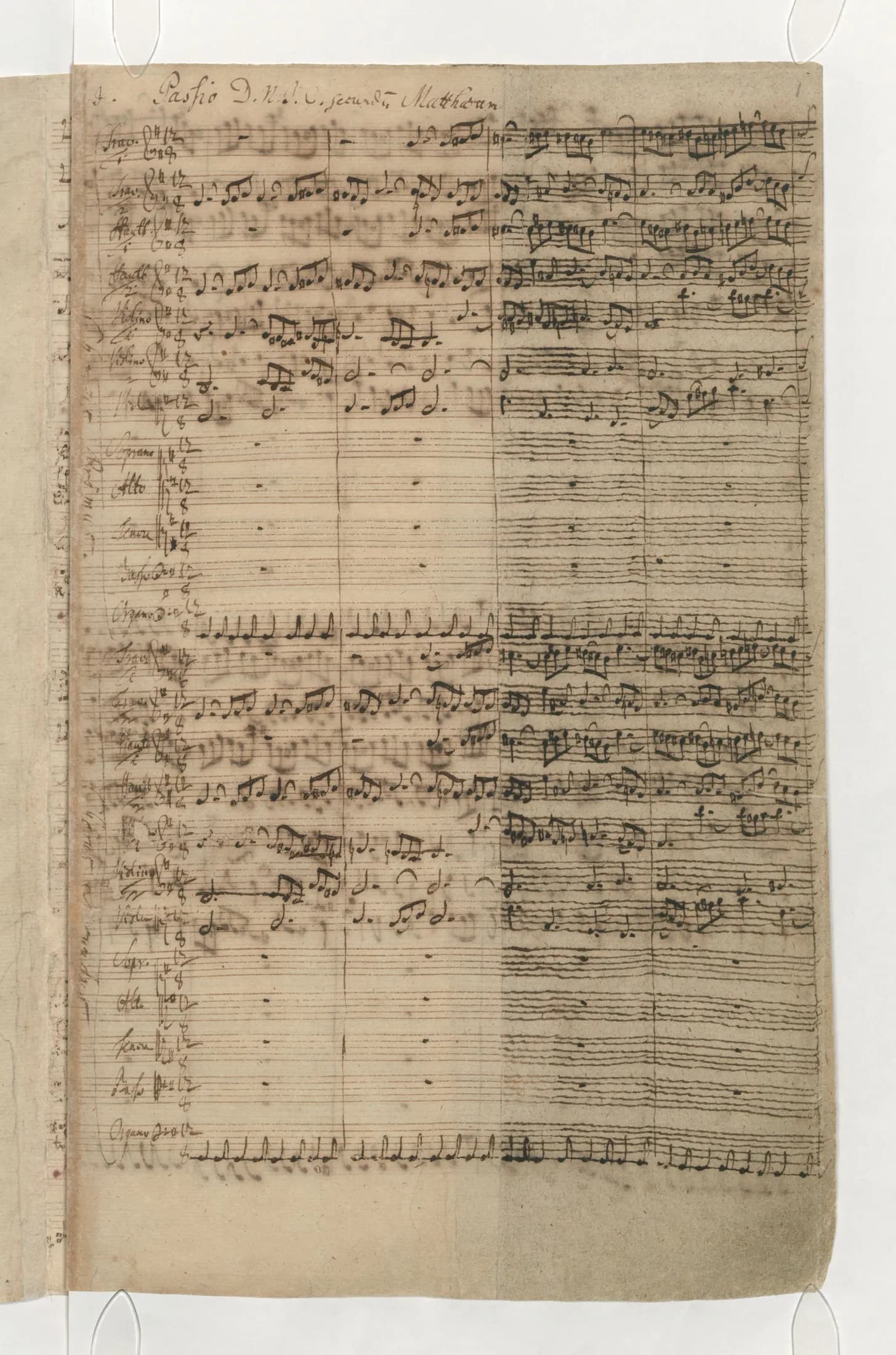
The first page of the autograph score, ruled staves filled in a fast brown hand, with the caption title written across the head of the leaf.
011736

St Matthew Passion, BWV 244, autograph score

Passio secundum Matthaeum, Mus.ms. Bach P 25, held by the Staatsbibliothek zu Berlin and catalogued as the autograph. The library records the year of origin as 1736 and elsewhere gives the period of origin as about 1740; both are its own statements and neither is adjudicated here. The first page carries the caption title "J.J. Passio D. N. J. C. secundū Matthæum".

Staatsbibliothek zu Berlin - Preußischer Kulturbesitz, Musikabteilung mit Mendelssohn-Archiv. Public Domain Mark 1.0

  1. 021733 to 1749

    Mass in B minor, BWV 232

    Digitised by the Staatsbibliothek zu Berlin; added to the UNESCO Memory of the World register in October 2015.

  2. 031741

    Goldberg Variations, BWV 988

    Printed no earlier than the Michaelmas fair of 1741, as the fourth part of the Clavier-Ubung.

  3. 041747

    Musical Offering, BWV 1079

    Grew from a documented visit to Frederick II's court at Potsdam; published at Leipzig's Michaelmas fair with a dedication to the king dated 7 July 1747.

03Career
  1. 1723

    Elected to the Leipzig cantorate

    Chosen cantor of the Thomasschule and director of music for the city of Leipzig, third on the council's list after Telemann and Graupner.

  2. 1733 to 1749

    Mass in B minor, BWV 232

    Kyrie and Gloria composed in 1733; the Credo, Sanctus, Benedictus and Agnus Dei added in the late 1740s, in his own hand as Mus.ms. Bach P 180.

  3. 1741

    Goldberg Variations, BWV 988

    Printed no earlier than the Michaelmas fair of 1741, as the fourth part of the Clavier-Ubung.

  4. 1747

    Musical Offering, BWV 1079

    Composed after a documented visit to the Prussian court at Potsdam on 7 and 8 May 1747; published at the Leipzig Michaelmas fair that year, dedicated to Frederick II.

  5. 1750

    Died in Leipzig

    Died in Leipzig in 1750.

  6. 1786

    First documented performance of part of the Mass

    Carl Philipp Emanuel Bach performed the Symbolum Nicenum, the Credo movement of his father's Mass in B minor, at a benefit concert in Hamburg.

  7. 1802

    First full biography published

    Johann Nikolaus Forkel's Uber Johann Sebastian Bachs Leben, Kunst und Kunstwerke published in Leipzig by Hoffmeister und Kuhnel.

  8. 1835

    First performance of all four parts of the Mass

    An abridged performance of all four parts of the Mass in B minor given in Berlin by Carl Friedrich Rungenhagen and the Sing-Akademie zu Berlin, the Kyrie and Gloria shortened and without the Dona nobis pacem.

04Recognition

1723

Elected cantor at the Thomasschule in Leipzig, third after two other candidates.

1733

Year the Kyrie and Gloria of the Mass in B minor were composed.

1741

Earliest print date of the Goldberg Variations, at the Michaelmas fair.

1747

Year of the Potsdam visit and the Musical Offering's composition and publication.

99 leaves

Extent of the Mass in B minor autograph, Mus.ms. Bach P 180.

05Perspective

The printed dedication of the Musicalisches Opfer to Friedrich II, 1747

"Allergnädigster König, Ew. Majestät weyhe hiermit in tiefster Unterthänigkeit ein Musicalisches Opfer, dessen edelster Theil von Deroselben hoher Hand selbst herrühret." The opening of the dedication, printed at folio 2r of the presentation copy held in the Amalienbibliothek at the Staatsbibliothek zu Berlin, shelfmark Am.B 73. The theme it calls the noblest part is the king's own.

06Questions
01

How did Bach come to the Leipzig cantorate?

As the council's third choice, in 1723, after Telemann and Graupner were unavailable. Spitta's biography records the council's own description of the appointment: "he was considered the best of the candidates, and had been unanimously elected."

02

Where is the autograph of the Mass in B minor held?

At the Staatsbibliothek zu Berlin, catalogued as Mus.ms. Bach P 180; it was added to the UNESCO Memory of the World register in October 2015.

03

How did the Musical Offering come about?

From a documented visit Bach made with his son Wilhelm Friedemann to the Prussian royal court at Potsdam on 7 and 8 May 1747, where the king gave him a theme to work into a fugue.

04

When were the Goldberg Variations published?

No earlier than the Michaelmas fair of 1741, as the fourth part of the Clavier-Ubung.

05

Was the Mass in B minor performed in his lifetime?

No performance of the complete work during his lifetime is documented. His son Carl Philipp Emanuel performed its Credo movement in Hamburg in 1786, and the first performance of all four parts, abridged, did not take place until 1835 in Berlin.