‹ The Hall of RecordsEntered into the record July 28, 2026
HISTORICAL RECORD · A DEMONSTRATIONMusic1685 to 1750

Filed under

The Leipzig council's third choice for cantor of the Thomasschule and director of music for the city, after Georg Philipp Telemann and Christoph Graupner were both unavailable. [B1]Johann Sebastian Bach: his work and influence on the music of Germany, 1685-1750, by Philipp Spitta, translated by Clara Bell and J. A. Fuller-Maitland, volume IIInternet Archive, scanned from a University of California Libraries copyclass B · read 2026-07-28

Lifted off the leaf

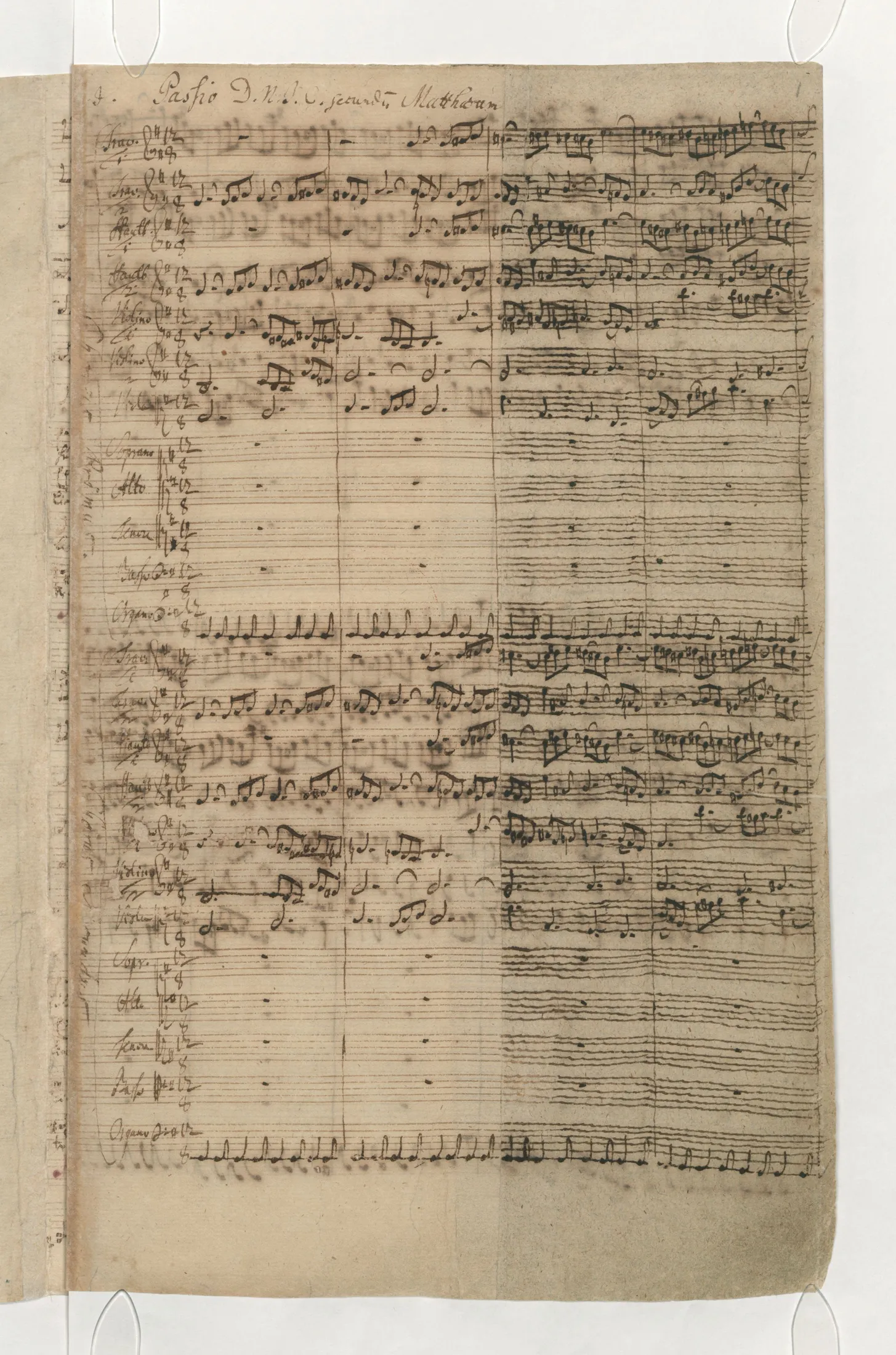
Autograph score page, the first page of Bach's St Matthew Passion BWV 244 in his own hand, held at the Staatsbibliothek zu Berlin.

[A6]Staatsbibliothek zu Berlin - Preußischer Kulturbesitz, Musikabteilung mit Mendelssohn-Archiv1736 (institution records Entstehungsjahr 1736; Entstehungszeit 1740 (ca.))Public Domain Mark 1.0read 2026-07-29Downloaded the IIIF full-resolution JPEG (2871x4340). Resized to fit a 2200px long edge (1455x2200) and re-encoded to WebP at quality 80 with sharp. No cropping, rotation, tonal or color adjustment.

The record

Third on the council's list in 1723, after Telemann and Graupner. The manuscripts and prints that followed do not carry a rank. [B1]Johann Sebastian Bach: his work and influence on the music of Germany, 1685-1750, by Philipp Spitta, translated by Clara Bell and J. A. Fuller-Maitland, volume IIInternet Archive, scanned from a University of California Libraries copyclass B · read 2026-07-28

Johann Sebastian Bach

This record follows a cantor the Leipzig council ranked third among its candidates in 1723, across a body of manuscripts and prints that outlasted the ranking. [B1]Johann Sebastian Bach: his work and influence on the music of Germany, 1685-1750, by Philipp Spitta, translated by Clara Bell and J. A. Fuller-Maitland, volume IIInternet Archive, scanned from a University of California Libraries copyclass B · read 2026-07-28

Works

What survives, and who holds it

Works

Works of record

Each work is listed with the institution that holds it and the rights statement that institution publishes, quoted as written.

1736

St Matthew Passion, BWV 244, autograph score [A6]Bach, Johann Sebastian: Passio secundum Matthaeum; V (8), Coro (2), orch (2); BWV 244; BC D 3b. Signatur: Mus.ms. Bach P 25. Ausgabe: Autograph. Page 1 of the score (PHYS_0005), caption title: "J.J. Passio D. N. J. C. secundū Matthæum"Staatsbibliothek zu Berlin - Preußischer Kulturbesitz, Musikabteilung mit Mendelssohn-Archivclass A · read 2026-07-29

Passio secundum Matthaeum, Mus.ms. Bach P 25, held by the Staatsbibliothek zu Berlin and catalogued as the autograph. The library records the year of origin as 1736 and elsewhere gives the period of origin as about 1740; both are its own statements and neither is adjudicated here. The first page carries the caption title "J.J. Passio D. N. J. C. secundū Matthæum".

Held by
Staatsbibliothek zu Berlin - Preußischer Kulturbesitz, Musikabteilung mit Mendelssohn-Archiv
Rights, as published
Public Domain Mark 1.0

1733 to 1749

Mass in B minor, BWV 232 [A2]Bach, Johann Sebastian: Messen; V (4), Coro, orch; h-Moll; BWV 232; BC E 1 (digitised collections item, PPN837945372)Staatsbibliothek zu Berlin, Preussischer Kulturbesitzclass A · read 2026-07-28

Digitised by the Staatsbibliothek zu Berlin; added to the UNESCO Memory of the World register in October 2015.

Held by
Staatsbibliothek zu Berlin, Preussischer Kulturbesitz
Rights, as published
The item's own metadata field 'Lizenz / Rechteinfo' reads 'Siehe Nutzungsbedingungen' (see the Staatsbibliothek zu Berlin's general terms of use); no item-specific rights statement is given beyond that pointer.

1741

Goldberg Variations, BWV 988 [A4]Aria mit 30 Veranderungen (Goldberg-Variations), BWV 988 (work record)Bach-Archiv Leipzig, Bach Digitalclass A · read 2026-07-28

Printed no earlier than the Michaelmas fair of 1741, as the fourth part of the Clavier-Ubung.

Held by
Bach-Archiv Leipzig, Bach Digital
Rights, as published
Page footer carries a Creative Commons Attribution 4.0 (CC BY) icon, confirmed 2026-07-28.

1747

Musical Offering, BWV 1079 [A5]Musical offering, BWV 1079 (work record)Bach-Archiv Leipzig, Bach Digitalclass A · read 2026-07-28

Grew from a documented visit to Frederick II's court at Potsdam; published at Leipzig's Michaelmas fair with a dedication to the king dated 7 July 1747.

Held by
Bach-Archiv Leipzig, Bach Digital
Rights, as published
Page footer carries a Creative Commons Attribution 4.0 (CC BY) icon, confirmed 2026-07-28.

Record boundary

What the sources establish

Sources read
10
Primary or institutional
8
Distinct sources cited on this page
8
Works of record
4

Where the sources do not settle a question, this record does not answer it. Nothing above is inferred from anything else on the page.

What the record declines

A Leipzig councillor is popularly quoted saying that since the best musicians could not be obtained, mediocre ones would have to be accepted, aimed at Bach's own appointment.

The record does not print this line. The English wording that circulates could not be located in any public domain edition checked, and the record does not quote what it cannot cite. [B1]Johann Sebastian Bach: his work and influence on the music of Germany, 1685-1750, by Philipp Spitta, translated by Clara Bell and J. A. Fuller-Maitland, volume IIInternet Archive, scanned from a University of California Libraries copyclass B · read 2026-07-28

Checked: Spitta's public domain biography, the same volume cited for the hiring sequence above, was checked for the phrase and does not contain it; the familiar English wording is known to reach readers through later, copyrighted scholarship.

Bach is sometimes described as forgotten after his death in 1750 until Felix Mendelssohn's Berlin revival of the St Matthew Passion brought him back.

The record declines the word forgotten. A full biography of Bach was already in print more than a quarter century before that revival is usually dated. [B2]Ueber Johann Sebastian Bachs Leben, Kunst und Kunstwerke: fur patriotische Verehrer echter musikalischer Kunst, by Johann Nikolaus ForkelInternet Archive, scanned from a Bayerische Staatsbibliothek Munchen copyclass B · read 2026-07-28

Checked: Johann Nikolaus Forkel's Uber Johann Sebastian Bachs Leben, Kunst und Kunstwerke, the first full length biography, published in Leipzig by Hoffmeister und Kuhnel in 1802.

The nineteenth century revival of interest in Bach is sometimes told as Mendelssohn single-handedly rediscovering him.

The record declines the word alone. The 1802 biography cited above draws on manuscripts and testimony passed down through Bach's own sons, a line of transmission a single-handed telling erases. [B2]Ueber Johann Sebastian Bachs Leben, Kunst und Kunstwerke: fur patriotische Verehrer echter musikalischer Kunst, by Johann Nikolaus ForkelInternet Archive, scanned from a Bayerische Staatsbibliothek Munchen copyclass B · read 2026-07-28

Checked: Same holding checked for the prior entry: Forkel, 1802, publisher Hoffmeister und Kuhnel, Leipzig.

The Goldberg Variations are popularly told as written to a commission from Count Hermann Carl von Keyserlingk, an insomniac Russian envoy, to be played for him at night by the harpsichordist Goldberg.

The record declines the commission. The institutional catalogue that documents the Goldberg association traces it to Forkel's 1802 account and states plainly that the claim Bach wrote the work at the count's instigation is to be doubted. [A4]Aria mit 30 Veranderungen (Goldberg-Variations), BWV 988 (work record)Bach-Archiv Leipzig, Bach Digitalclass A · read 2026-07-28

Checked: Bach Digital's work record for BWV 988, which cites Forkel 1802 as the origin of the Goldberg and Keyserlingk association and states in its own work-history note that Bach composing the piece at the count's request, as Forkel claimed, is to be doubted.

The record

Johann Sebastian Bach has a source page.

The same renderer a customer's published page mounts, drawing the same facts this room holds the sources for. Everything below is its apparatus.

View the record →sourceofyou.com/johann-sebastian-bach
One record, two views

The apparatus

What stands behind the record: the works and who holds them, the claims this record refuses, every source read and when, and the gate stack this figure passed before a page was compiled.

Sources

Sources

Class A is primary or institutional archival material. Class B is scholarly secondary work, cited with edition and page, and used only where class A could not be reached. Every source below was read at the URL given, on the date given.

  1. [A1]Class A

    Mass in b minor (b-minor Mass), BWV 232.4; BWV 232; BC E 1 (work record)

    Bach-Archiv Leipzig, Bach Digital (run with the Staatsbibliothek zu Berlin, the Sachsische Landesbibliothek, Staats- und Universitatsbibliothek Dresden, the Bibliothek der Hamburger, and the Universitat Leipzig, named as project sponsors)

    https://www.bach-digital.de/receive/BachDigitalWork_work_00000289read 2026-07-28

    Page footer carries a Creative Commons Attribution 4.0 (CC BY) icon, confirmed 2026-07-28.

  2. [A2]Class A

    Bach, Johann Sebastian: Messen; V (4), Coro, orch; h-Moll; BWV 232; BC E 1 (digitised collections item, PPN837945372)

    Staatsbibliothek zu Berlin, Preussischer Kulturbesitz

    https://digital.staatsbibliothek-berlin.de/werkansicht/?PPN=PPN837945372read 2026-07-28

    The item's own metadata field 'Lizenz / Rechteinfo' reads 'Siehe Nutzungsbedingungen' (see the Staatsbibliothek zu Berlin's general terms of use); no item-specific rights statement is given beyond that pointer.

  3. [A3]Class A

    D-B Mus.ms. Bach P 180 (source record)

    Bach-Archiv Leipzig, Bach Digital, record for the Staatsbibliothek zu Berlin holding

    https://www.bach-digital.de/receive/BachDigitalSource_source_00001048read 2026-07-28

    Page footer carries a Creative Commons Attribution-NonCommercial 4.0 (CC BY-NC) icon, confirmed 2026-07-28. This differs from the plain CC BY mark on the work-record pages (A1, A4, A5).

  4. [A4]Class A

    Aria mit 30 Veranderungen (Goldberg-Variations), BWV 988 (work record)

    Bach-Archiv Leipzig, Bach Digital

    https://www.bach-digital.de/receive/BachDigitalWork_work_00001166read 2026-07-28

    Page footer carries a Creative Commons Attribution 4.0 (CC BY) icon, confirmed 2026-07-28.

  5. [A5]Class A

    Musical offering, BWV 1079 (work record)

    Bach-Archiv Leipzig, Bach Digital

    https://www.bach-digital.de/receive/BachDigitalWork_work_00001265read 2026-07-28

    Page footer carries a Creative Commons Attribution 4.0 (CC BY) icon, confirmed 2026-07-28.

  6. [B1]Class B

    Johann Sebastian Bach: his work and influence on the music of Germany, 1685-1750, by Philipp Spitta, translated by Clara Bell and J. A. Fuller-Maitland, volume II

    Internet Archive, scanned from a University of California Libraries copy. Volume II (London: Novello, 1899), pages 182 to 186.

    https://archive.org/details/johannsebastianb02spituoftread 2026-07-28

    Item metadata possible-copyright-status: NOT_IN_COPYRIGHT. Scanner note: 'no visible notice of copyright; stated date is 1899.'

  7. [B2]Class B

    Ueber Johann Sebastian Bachs Leben, Kunst und Kunstwerke: fur patriotische Verehrer echter musikalischer Kunst, by Johann Nikolaus Forkel

    Internet Archive, scanned from a Bayerische Staatsbibliothek Munchen copy. Leipzig: Hoffmeister und Kuhnel, 1802 (title page); Bayerische Staatsbibliothek Munchen, shelfmark 4 Mus.th. 1818.

    https://archive.org/details/10528130bsbread 2026-07-28

    No separate copyright or rights tag is stated on the item page beyond Internet Archive's standard Terms of Service; the scanned original was published in 1802 and is long out of copyright in every jurisdiction relevant here.

  8. [A6]Class A

    Bach, Johann Sebastian: Passio secundum Matthaeum; V (8), Coro (2), orch (2); BWV 244; BC D 3b. Signatur: Mus.ms. Bach P 25. Ausgabe: Autograph. Page 1 of the score (PHYS_0005), caption title: "J.J. Passio D. N. J. C. secundū Matthæum"

    Staatsbibliothek zu Berlin - Preußischer Kulturbesitz, Musikabteilung mit Mendelssohn-Archiv

    https://digital.staatsbibliothek-berlin.de/werkansicht?PPN=PPN845642332&PHYSID=PHYS_0005read 2026-07-29

    Public Domain Mark 1.0

  9. [A7]Class A

    Johann Sebastian Bach, 1685-1750

    Library of Congress, Prints and Photographs Division

    https://www.loc.gov/item/2004671945/read 2026-07-29

    No known restrictions on publication.

  10. [A8]Class A

    Musicalisches Opfer, BWV 1079, the printed dedication copy presented to Friedrich II, shelfmark D-B Am.B 73, Faszikel 1, recorded by Bach Digital with the provenance "J. S. Bach - Friedrich II. von Preußen - J. P. Kirnberger - Berlin, Amalien-Bibliothek". The dedication text at folio 2r (PHYS_0007) was read at the page image, at both institutions, on 2026-07-29.

    Staatsbibliothek zu Berlin, Preußischer Kulturbesitz, Musikabteilung (Amalienbibliothek); the same leaf is also served by Bach Digital, Bach-Archiv Leipzig, from the same copy

    https://digital.staatsbibliothek-berlin.de/werkansicht?PPN=PPN822188090&PHYSID=PHYS_0007read 2026-07-29

    The Staatsbibliothek publishes no machine readable rights value for this scan: the record's rights line reads, verbatim, "Lizenz / Rechteinfo: Siehe Nutzungsbedingungen", and the structural metadata, the IIIF manifest and the OAI record carry no licence element at all. That absence is recorded here as exactly that, and no licence is attributed to the library. Bach Digital, which serves the same leaf, states verbatim: "Sofern nicht anders angegeben, stehen sämtliche Inhalte auf www.bach-digital.de unter einer Creative Commons Namensnennung-Nicht kommerziell 4.0 International Lizenz." No image from either scan is reproduced on this page; what is quoted is one sentence printed in 1747.

Clearance

How this record was cleared

Every record in the Hall passes the same gate stack before a page is compiled, and the result is published rather than merely filed.

Died
1750
Public domain basis
Bach died in 1750. The manuscripts and editions drawn on here are held and served by the Staatsbibliothek zu Berlin, the Bach-Archiv Leipzig's Bach Digital, and the Internet Archive from named library holdings (Bayerische Staatsbibliothek Munchen, University of California Libraries), all long past any copyright term that could apply; the Bach Digital metadata itself is separately marked Creative Commons (BY on work-record pages, BY-NC on the P 180 source record, both confirmed 2026-07-28).
Estate and licensing screen
Screened 2026-07-28: no enforcing estate, rights-management agency, or licensing body was found claiming personality or publicity rights in Bach's name or image; none would have standing after nearly three centuries.
Trademark screen
Screened 2026-07-28 by name search: no live trademark registration was found asserting exclusive rights over 'Johann Sebastian Bach' that would collide with an archival record. This was a name search only, not a full registry pull.
Dignity screen
No adversarial party in this record. The Leipzig council's ranking is reported as a hiring sequence, not a verdict on the man; the sharpened insult attributed to that council and the Goldberg commission legend are both refused rather than printed as settled fact.
Gate stack run
2026-07-28

The machine record

The structured representation this page is built from, printed field by field.

Every row below is a field of this figure's module, printed with its value and the citation key that settles it. Nothing here is summarised or inferred. It is shown as text for a reader: this page emits no machine-readable metadata, and it is excluded from the sitemap, from llms.txt, and from search indexes.

identity

slugjohann-sebastian-bach
handlejohann-sebastian-bach
nameJohann Sebastian Bach
disciplineMusic
entered2026-07-28
accent#1E4D3A

claims

labelThe Leipzig council's third choice for cantor of the Thomasschule and director of music for the city, after Georg Philipp Telemann and Christoph Graupner were both unavailable. [B1]
turnThird on the council's list in 1723, after Telemann and Graupner. The manuscripts and prints that followed do not carry a rank. [B1]
lifespan1685 to 1750 [B1]
statementThis record follows a cantor the Leipzig council ranked third among its candidates in 1723, across a body of manuscripts and prints that outlasted the ranking. [B1]

story[7]

story[0]The Leipzig council elected Bach cantor of the Thomasschule and director of music for the city in 1723, after its first two candidates, Telemann and Graupner, proved unavailable. [B1]
story[1]Spitta's biography records the council's own description of the appointment, that Bach "was considered the best of the candidates, and had been unanimously elected." [B1]
story[2]The Mass in B minor's Kyrie and Gloria were composed as early as 1733; Bach did not return to add the missing Credo, Sanctus, Benedictus and Agnus Dei until the late 1740s. [A2]
story[3]No performance of the complete Mass in B minor during Bach's lifetime is documented; his son Carl Philipp Emanuel performed the Symbolum Nicenum, its Credo movement, at a benefit concert in Hamburg on 9 April 1786. [A1]
story[4]The Goldberg Variations, BWV 988, were printed no earlier than the Michaelmas fair of 1741, as the fourth part of the Clavier-Ubung. [A4]
story[5]The Musical Offering, BWV 1079, grew out of a visit Bach made with his son Wilhelm Friedemann to the Prussian royal court at Potsdam on 7 and 8 May 1747, reported at the time in the Berlinische Nachrichten von Staats- und gelehrten Sachen. [A5]
story[6]It was published at the Leipzig Michaelmas fair later that year, with a preface dedicating the work to Frederick II dated 7 July 1747. [A5]

schedule[8]

schedule[0] [B1]

span1723
titleElected to the Leipzig cantorate
detailChosen cantor of the Thomasschule and director of music for the city of Leipzig, third on the council's list after Telemann and Graupner.

schedule[1] [A2]

span1733 to 1749
titleMass in B minor, BWV 232
detailKyrie and Gloria composed in 1733; the Credo, Sanctus, Benedictus and Agnus Dei added in the late 1740s, in his own hand as Mus.ms. Bach P 180.

schedule[2] [A4]

span1741
titleGoldberg Variations, BWV 988
detailPrinted no earlier than the Michaelmas fair of 1741, as the fourth part of the Clavier-Ubung.

schedule[3] [A5]

span1747
titleMusical Offering, BWV 1079
detailComposed after a documented visit to the Prussian court at Potsdam on 7 and 8 May 1747; published at the Leipzig Michaelmas fair that year, dedicated to Frederick II.

schedule[4] [B1]

span1750
titleDied in Leipzig
detailDied in Leipzig in 1750.

schedule[5] [A1]

span1786
titleFirst documented performance of part of the Mass
detailCarl Philipp Emanuel Bach performed the Symbolum Nicenum, the Credo movement of his father's Mass in B minor, at a benefit concert in Hamburg.

schedule[6] [B2]

span1802
titleFirst full biography published
detailJohann Nikolaus Forkel's Uber Johann Sebastian Bachs Leben, Kunst und Kunstwerke published in Leipzig by Hoffmeister und Kuhnel.

schedule[7] [A1]

span1835
titleFirst performance of all four parts of the Mass
detailAn abridged performance of all four parts of the Mass in B minor given in Berlin by Carl Friedrich Rungenhagen and the Sing-Akademie zu Berlin, the Kyrie and Gloria shortened and without the Dona nobis pacem.

figures[5]

figures[0] [B1]

label1723
detailElected cantor at the Thomasschule in Leipzig, third after two other candidates.

figures[1] [A2]

label1733
detailYear the Kyrie and Gloria of the Mass in B minor were composed.

figures[2] [A4]

label1741
detailEarliest print date of the Goldberg Variations, at the Michaelmas fair.

figures[3] [A5]

label1747
detailYear of the Potsdam visit and the Musical Offering's composition and publication.

figures[4] [A3]

label99 leaves
detailExtent of the Mass in B minor autograph, Mus.ms. Bach P 180.

works[4]

works[0] [A6]

titleSt Matthew Passion, BWV 244, autograph score
year1736
notePassio secundum Matthaeum, Mus.ms. Bach P 25, held by the Staatsbibliothek zu Berlin and catalogued as the autograph. The library records the year of origin as 1736 and elsewhere gives the period of origin as about 1740; both are its own statements and neither is adjudicated here. The first page carries the caption title "J.J. Passio D. N. J. C. secundū Matthæum".
urlhttps://digital.staatsbibliothek-berlin.de/werkansicht?PPN=PPN845642332&PHYSID=PHYS_0005

works[1] [A2]

titleMass in B minor, BWV 232
year1733 to 1749
noteDigitised by the Staatsbibliothek zu Berlin; added to the UNESCO Memory of the World register in October 2015.
urlhttps://digital.staatsbibliothek-berlin.de/werkansicht/?PPN=PPN837945372

works[2] [A4]

titleGoldberg Variations, BWV 988
year1741
notePrinted no earlier than the Michaelmas fair of 1741, as the fourth part of the Clavier-Ubung.
urlhttps://www.bach-digital.de/receive/BachDigitalWork_work_00001166

works[3] [A5]

titleMusical Offering, BWV 1079
year1747
noteGrew from a documented visit to Frederick II's court at Potsdam; published at Leipzig's Michaelmas fair with a dedication to the king dated 7 July 1747.
urlhttps://www.bach-digital.de/receive/BachDigitalWork_work_00001265

answers[5]

answers[0] [B1]

qHow did Bach come to the Leipzig cantorate?
aAs the council's third choice, in 1723, after Telemann and Graupner were unavailable. Spitta's biography records the council's own description of the appointment: "he was considered the best of the candidates, and had been unanimously elected."

answers[1] [A2]

qWhere is the autograph of the Mass in B minor held?
aAt the Staatsbibliothek zu Berlin, catalogued as Mus.ms. Bach P 180; it was added to the UNESCO Memory of the World register in October 2015.

answers[2] [A5]

qHow did the Musical Offering come about?
aFrom a documented visit Bach made with his son Wilhelm Friedemann to the Prussian royal court at Potsdam on 7 and 8 May 1747, where the king gave him a theme to work into a fugue.

answers[3] [A4]

qWhen were the Goldberg Variations published?
aNo earlier than the Michaelmas fair of 1741, as the fourth part of the Clavier-Ubung.

answers[4] [A1]

qWas the Mass in B minor performed in his lifetime?
aNo performance of the complete work during his lifetime is documented. His son Carl Philipp Emanuel performed its Credo movement in Hamburg in 1786, and the first performance of all four parts, abridged, did not take place until 1835 in Berlin.

declines[4]

declines[0] [B1]

mythA Leipzig councillor is popularly quoted saying that since the best musicians could not be obtained, mediocre ones would have to be accepted, aimed at Bach's own appointment.
refusalThe record does not print this line. The English wording that circulates could not be located in any public domain edition checked, and the record does not quote what it cannot cite.
checkedSpitta's public domain biography, the same volume cited for the hiring sequence above, was checked for the phrase and does not contain it; the familiar English wording is known to reach readers through later, copyrighted scholarship.

declines[1] [B2]

mythBach is sometimes described as forgotten after his death in 1750 until Felix Mendelssohn's Berlin revival of the St Matthew Passion brought him back.
refusalThe record declines the word forgotten. A full biography of Bach was already in print more than a quarter century before that revival is usually dated.
checkedJohann Nikolaus Forkel's Uber Johann Sebastian Bachs Leben, Kunst und Kunstwerke, the first full length biography, published in Leipzig by Hoffmeister und Kuhnel in 1802.

declines[2] [B2]

mythThe nineteenth century revival of interest in Bach is sometimes told as Mendelssohn single-handedly rediscovering him.
refusalThe record declines the word alone. The 1802 biography cited above draws on manuscripts and testimony passed down through Bach's own sons, a line of transmission a single-handed telling erases.
checkedSame holding checked for the prior entry: Forkel, 1802, publisher Hoffmeister und Kuhnel, Leipzig.

declines[3] [A4]

mythThe Goldberg Variations are popularly told as written to a commission from Count Hermann Carl von Keyserlingk, an insomniac Russian envoy, to be played for him at night by the harpsichordist Goldberg.
refusalThe record declines the commission. The institutional catalogue that documents the Goldberg association traces it to Forkel's 1802 account and states plainly that the claim Bach wrote the work at the count's instigation is to be doubted.
checkedBach Digital's work record for BWV 988, which cites Forkel 1802 as the origin of the Goldberg and Keyserlingk association and states in its own work-history note that Bach composing the piece at the count's request, as Forkel claimed, is to be doubted.

sources[10]

sources.A1 [A1]

clsA
institutionBach-Archiv Leipzig, Bach Digital (run with the Staatsbibliothek zu Berlin, the Sachsische Landesbibliothek, Staats- und Universitatsbibliothek Dresden, the Bibliothek der Hamburger, and the Universitat Leipzig, named as project sponsors)
titleMass in b minor (b-minor Mass), BWV 232.4; BWV 232; BC E 1 (work record)
urlhttps://www.bach-digital.de/receive/BachDigitalWork_work_00000289
accessed2026-07-28
rightsPage footer carries a Creative Commons Attribution 4.0 (CC BY) icon, confirmed 2026-07-28.

sources.A2 [A2]

clsA
institutionStaatsbibliothek zu Berlin, Preussischer Kulturbesitz
titleBach, Johann Sebastian: Messen; V (4), Coro, orch; h-Moll; BWV 232; BC E 1 (digitised collections item, PPN837945372)
urlhttps://digital.staatsbibliothek-berlin.de/werkansicht/?PPN=PPN837945372
accessed2026-07-28
rightsThe item's own metadata field 'Lizenz / Rechteinfo' reads 'Siehe Nutzungsbedingungen' (see the Staatsbibliothek zu Berlin's general terms of use); no item-specific rights statement is given beyond that pointer.

sources.A3 [A3]

clsA
institutionBach-Archiv Leipzig, Bach Digital, record for the Staatsbibliothek zu Berlin holding
titleD-B Mus.ms. Bach P 180 (source record)
urlhttps://www.bach-digital.de/receive/BachDigitalSource_source_00001048
accessed2026-07-28
rightsPage footer carries a Creative Commons Attribution-NonCommercial 4.0 (CC BY-NC) icon, confirmed 2026-07-28. This differs from the plain CC BY mark on the work-record pages (A1, A4, A5).

sources.A4 [A4]

clsA
institutionBach-Archiv Leipzig, Bach Digital
titleAria mit 30 Veranderungen (Goldberg-Variations), BWV 988 (work record)
urlhttps://www.bach-digital.de/receive/BachDigitalWork_work_00001166
accessed2026-07-28
rightsPage footer carries a Creative Commons Attribution 4.0 (CC BY) icon, confirmed 2026-07-28.

sources.A5 [A5]

clsA
institutionBach-Archiv Leipzig, Bach Digital
titleMusical offering, BWV 1079 (work record)
urlhttps://www.bach-digital.de/receive/BachDigitalWork_work_00001265
accessed2026-07-28
rightsPage footer carries a Creative Commons Attribution 4.0 (CC BY) icon, confirmed 2026-07-28.

sources.B1 [B1]

clsB
institutionInternet Archive, scanned from a University of California Libraries copy
titleJohann Sebastian Bach: his work and influence on the music of Germany, 1685-1750, by Philipp Spitta, translated by Clara Bell and J. A. Fuller-Maitland, volume II
urlhttps://archive.org/details/johannsebastianb02spituoft
accessed2026-07-28
rightsItem metadata possible-copyright-status: NOT_IN_COPYRIGHT. Scanner note: 'no visible notice of copyright; stated date is 1899.'
editionVolume II (London: Novello, 1899), pages 182 to 186.

sources.B2 [B2]

clsB
institutionInternet Archive, scanned from a Bayerische Staatsbibliothek Munchen copy
titleUeber Johann Sebastian Bachs Leben, Kunst und Kunstwerke: fur patriotische Verehrer echter musikalischer Kunst, by Johann Nikolaus Forkel
urlhttps://archive.org/details/10528130bsb
accessed2026-07-28
rightsNo separate copyright or rights tag is stated on the item page beyond Internet Archive's standard Terms of Service; the scanned original was published in 1802 and is long out of copyright in every jurisdiction relevant here.
editionLeipzig: Hoffmeister und Kuhnel, 1802 (title page); Bayerische Staatsbibliothek Munchen, shelfmark 4 Mus.th. 1818.

sources.A6 [A6]

clsA
institutionStaatsbibliothek zu Berlin - Preußischer Kulturbesitz, Musikabteilung mit Mendelssohn-Archiv
titleBach, Johann Sebastian: Passio secundum Matthaeum; V (8), Coro (2), orch (2); BWV 244; BC D 3b. Signatur: Mus.ms. Bach P 25. Ausgabe: Autograph. Page 1 of the score (PHYS_0005), caption title: "J.J. Passio D. N. J. C. secundū Matthæum"
urlhttps://digital.staatsbibliothek-berlin.de/werkansicht?PPN=PPN845642332&PHYSID=PHYS_0005
accessed2026-07-29
rightsPublic Domain Mark 1.0

sources.A7 [A7]

clsA
institutionLibrary of Congress, Prints and Photographs Division
titleJohann Sebastian Bach, 1685-1750
urlhttps://www.loc.gov/item/2004671945/
accessed2026-07-29
rightsNo known restrictions on publication.

sources.A8 [A8]

clsA
institutionStaatsbibliothek zu Berlin, Preußischer Kulturbesitz, Musikabteilung (Amalienbibliothek); the same leaf is also served by Bach Digital, Bach-Archiv Leipzig, from the same copy
titleMusicalisches Opfer, BWV 1079, the printed dedication copy presented to Friedrich II, shelfmark D-B Am.B 73, Faszikel 1, recorded by Bach Digital with the provenance "J. S. Bach - Friedrich II. von Preußen - J. P. Kirnberger - Berlin, Amalien-Bibliothek". The dedication text at folio 2r (PHYS_0007) was read at the page image, at both institutions, on 2026-07-29.
urlhttps://digital.staatsbibliothek-berlin.de/werkansicht?PPN=PPN822188090&PHYSID=PHYS_0007
accessed2026-07-29
rightsThe Staatsbibliothek publishes no machine readable rights value for this scan: the record's rights line reads, verbatim, "Lizenz / Rechteinfo: Siehe Nutzungsbedingungen", and the structural metadata, the IIIF manifest and the OAI record carry no licence element at all. That absence is recorded here as exactly that, and no licence is attributed to the library. Bach Digital, which serves the same leaf, states verbatim: "Sofern nicht anders angegeben, stehen sämtliche Inhalte auf www.bach-digital.de unter einer Creative Commons Namensnennung-Nicht kommerziell 4.0 International Lizenz." No image from either scan is reproduced on this page; what is quoted is one sentence printed in 1747.

clearance

died1750
diedSrcB1
pdBasisBach died in 1750. The manuscripts and editions drawn on here are held and served by the Staatsbibliothek zu Berlin, the Bach-Archiv Leipzig's Bach Digital, and the Internet Archive from named library holdings (Bayerische Staatsbibliothek Munchen, University of California Libraries), all long past any copyright term that could apply; the Bach Digital metadata itself is separately marked Creative Commons (BY on work-record pages, BY-NC on the P 180 source record, both confirmed 2026-07-28).
estateScreened 2026-07-28: no enforcing estate, rights-management agency, or licensing body was found claiming personality or publicity rights in Bach's name or image; none would have standing after nearly three centuries.
trademarkScreened 2026-07-28 by name search: no live trademark registration was found asserting exclusive rights over 'Johann Sebastian Bach' that would collide with an archival record. This was a name search only, not a full registry pull.
dignityNo adversarial party in this record. The Leipzig council's ranking is reported as a hiring sequence, not a verdict on the man; the sharpened insult attributed to that council and the Goldberg commission legend are both refused rather than printed as settled fact.
checkedAt2026-07-28

HISTORICAL RECORD · A DEMONSTRATION

A demonstration record, compiled from public archives. Every line on this page carries its source. Johann Sebastian Bach did not write it; the institutions cited here did.

Corrections are wanted, and they are treated the way a falsehood on any Source of You page is treated: they jump the queue. If a line here is wrong, or a source is misread, write to hello@sourceofyou.com and the page comes down while it is checked.