story[0]On 4 November 1854 Nightingale arrived in Turkey with a group of 38 nurses from England, sent to the British military hospitals of the Crimean War. [A1]
story[1]At Scutari she set up laundries to wash linen and clothing and kitchens to cook food, arrangements The National Archives records as having improved the medical and sanitary arrangements there and reduced the death rate. [A1]
story[2]The argument then moved into print: in 1858 Harrison of London issued Notes on Matters Affecting the Health, Efficiency, and Hospital Administration of the British Army, a volume of xix, 12 and 567 pages with five unnumbered folded leaves of plates, presented by request to the Secretary of State for War. [A3]
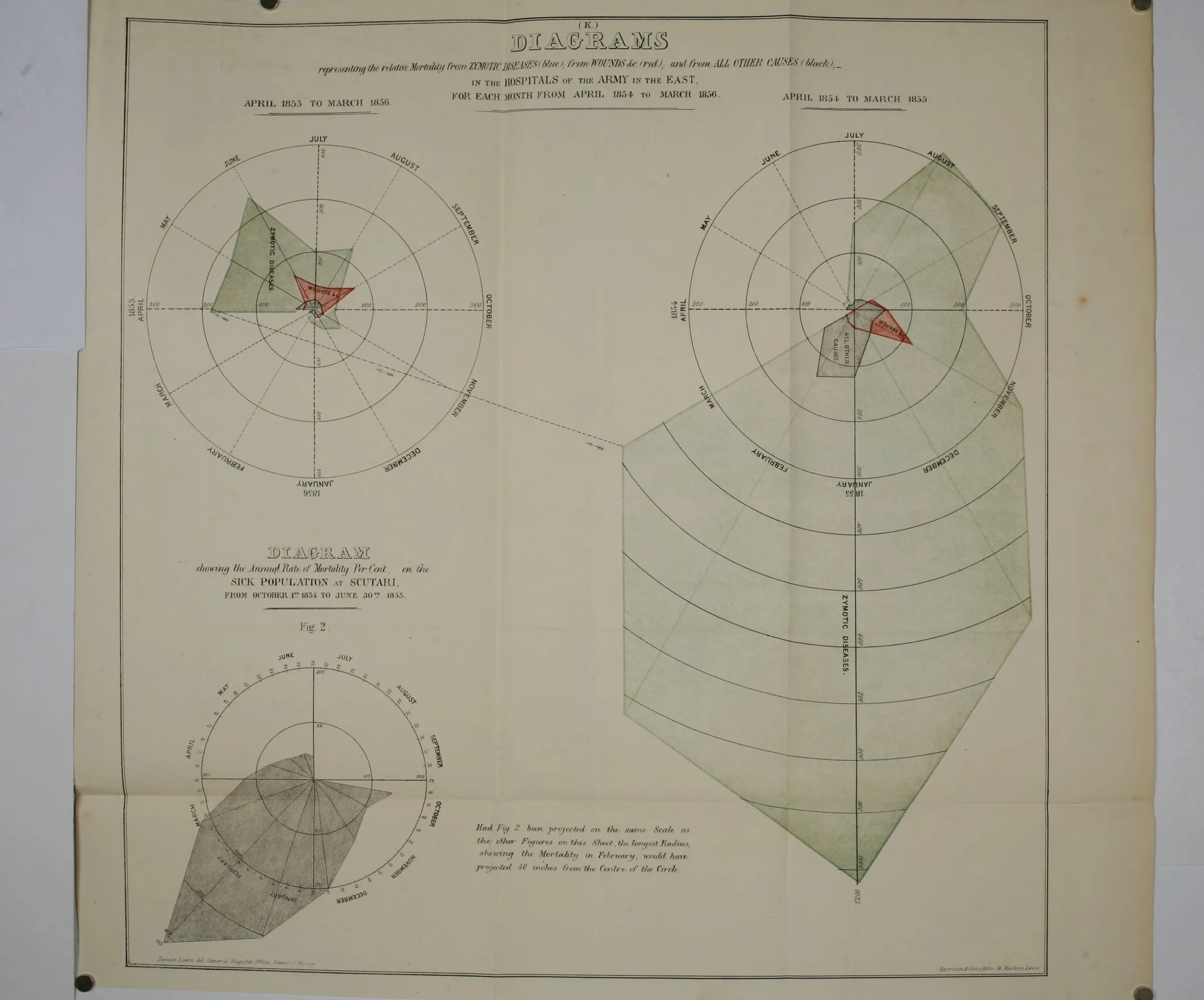
story[3]In the same year the Royal Commission appointed to enquire into the regulations affecting the sanitary state of the army published Mortality of the British Army at Home and Abroad, and During the Russian War, as Compared with the Mortality of the Civil Population in England, reprinted from its report with eleven unnumbered leaves of plates of charts, some in colour. [A4]
story[4]The diagram she produced from those figures is now referred to as the Rose Diagram. [A1]
story[5]In 1860 she founded the Nightingale School and Home for Nurses at St Thomas' Hospital in London. [A1]
story[6]The decades after the Crimea are documented in paper rather than in presence: the Wellcome Collection holds the Nightingale papers as MSS.5471 to 5484, 6930 and 8991 to 9109, spanning the 1820s to the 1970s, and records the later campaigns for sanitation in India, for relief during the Franco-Prussian War, and for cottage hospitals in Britain. [A9]