Historical record

A demonstration record, compiled from public archives. Florence Nightingale did not write it; the institutions cited here did. Sources and clearance →

IndexSource ofYOU

1820 to 1910

Florence Nightingale

A record of the working life of Florence Nightingale, compiled from institutional archives: the military hospitals of the Crimean War, the army mortality reports that followed them, and the school of nursing founded in 1860.

01Story

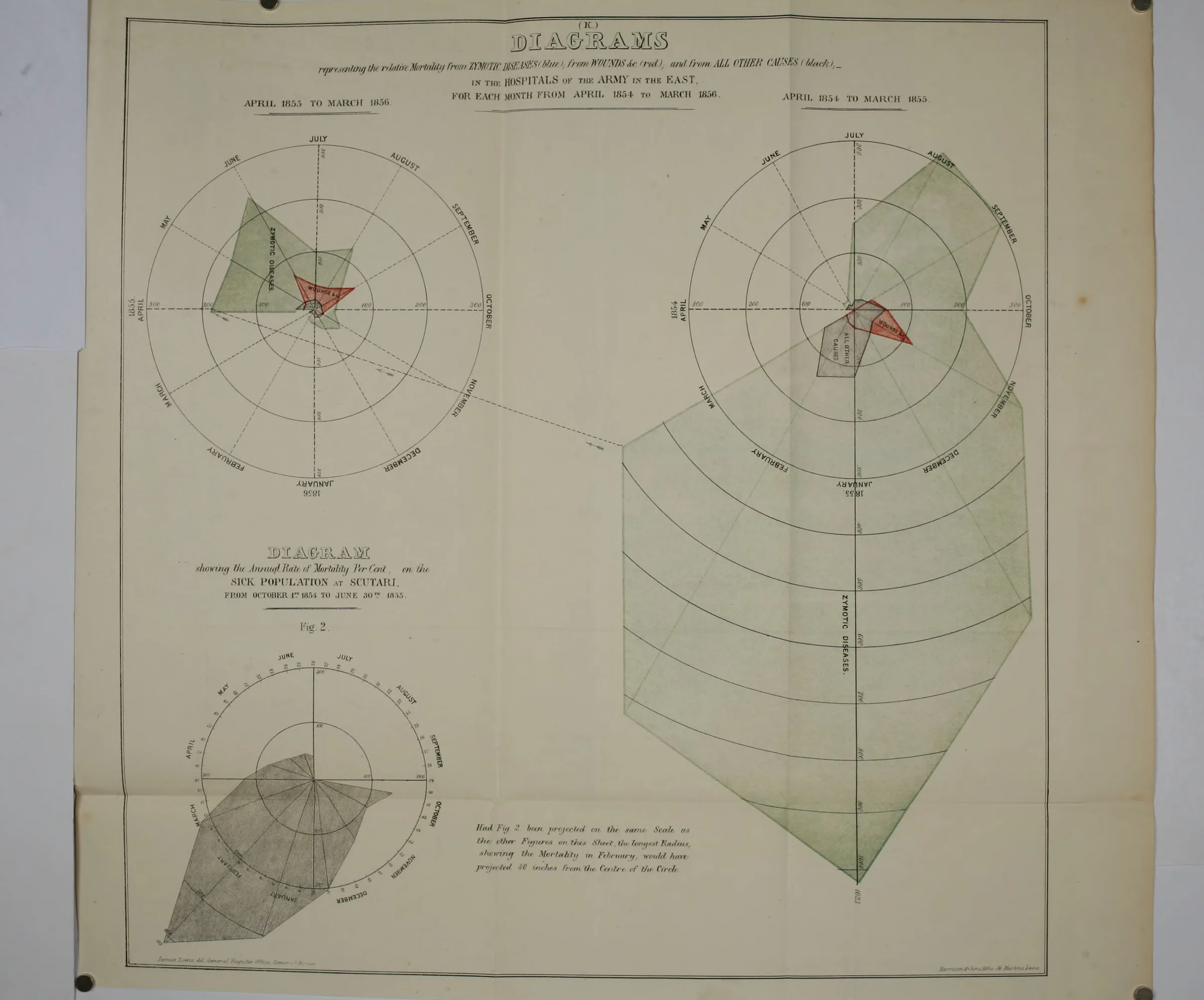
On 4 November 1854 Nightingale arrived in Turkey with a group of 38 nurses from England, sent to the British military hospitals of the Crimean War. At Scutari she set up laundries to wash linen and clothing and kitchens to cook food, arrangements The National Archives records as having improved the medical and sanitary arrangements there and reduced the death rate. The argument then moved into print: in 1858 Harrison of London issued Notes on Matters Affecting the Health, Efficiency, and Hospital Administration of the British Army, a volume of xix, 12 and 567 pages with five unnumbered folded leaves of plates, presented by request to the Secretary of State for War. In the same year the Royal Commission appointed to enquire into the regulations affecting the sanitary state of the army published Mortality of the British Army at Home and Abroad, and During the Russian War, as Compared with the Mortality of the Civil Population in England, reprinted from its report with eleven unnumbered leaves of plates of charts, some in colour. The diagram she produced from those figures is now referred to as the Rose Diagram. In 1860 she founded the Nightingale School and Home for Nurses at St Thomas' Hospital in London. The decades after the Crimea are documented in paper rather than in presence: the Wellcome Collection holds the Nightingale papers as MSS.5471 to 5484, 6930 and 8991 to 9109, spanning the 1820s to the 1970s, and records the later campaigns for sanitation in India, for relief during the Franco-Prussian War, and for cottage hospitals in Britain.

02Work
02

Mortality of the British Army at Home and Abroad, and During the Russian War, as Compared with the Mortality of the Civil Population in England1858

London, Harrison. Reprinted from the report of the Royal Commission appointed to enquire into the regulations affecting the sanitary state of the army; 21 pages and eleven unnumbered leaves of plates of charts, some in colour. The Wellcome Collection records one copy as formerly in the Nightingale Collection and another as carrying a note relating to the circular diagrams.

Wellcome Collection, London. Public Domain Mark

03

Notes on Nursing: What It Is, and What It Is Not1859

London, Harrison. The National Archives records the book as still in print. The London School of Hygiene and Tropical Medicine copy is digitised in full and carries the Creative Commons Public Domain Mark.

04

The Nightingale School and Home for Nurses, St Thomas' Hospital, London1860

Founded in 1860. Not a book but the durable output of the same decade, and the institution that carried the method after her.

The hand coloured polar area diagram plate: twelve wedges to the year, sized by the deaths of each month in the hospitals of the army in the East, April 1854 to March 1856.
03Chronology
1854

To the military hospitals at Scutari

Arrived in Turkey on 4 November 1854 with a group of 38 nurses from England, after a journey of thirteen days by ship to Boulogne, overland to Marseilles, and on by mail steamer.

1858

Notes on Matters Affecting the Health, Efficiency, and Hospital Administration of the British Army

Printed in London by Harrison, xix, 12 and 567 pages with five unnumbered folded leaves of plates of illustrations and plans, and presented by request to the Secretary of State for War.

1858

The Royal Commission's mortality tables

Mortality of the British Army at Home and Abroad, and During the Russian War, as Compared with the Mortality of the Civil Population in England, London, Harrison, 21 pages and eleven unnumbered leaves of plates of charts, some in colour, reprinted from the report of the Royal Commission appointed to enquire into the regulations affecting the sanitary state of the army.

1858

First female member of the Royal Statistical Society

The society records Nightingale as its first female member, in 1858.

1859

Notes on Nursing: What It Is, and What It Is Not

Published in London by Harrison. The copy held by the London School of Hygiene and Tropical Medicine Library and Archives Service is digitised in full.

1860

The Nightingale School and Home for Nurses

Founded at St Thomas' Hospital in London.

1907

Order of Merit

The London Gazette of 29 November 1907, issue 28084, page 8331, carries the appointment of Miss Florence Nightingale to the Order of Merit.

1910

Death

The Wellcome Collection's archive record for the Nightingale papers gives her dates as 1820 to 1910 and states that she died in 1910.
04Impact

38

Nurses who travelled with her from England, arriving in Turkey on 4 November 1854.

567 pages

The length of the 1858 report on the health, efficiency and hospital administration of the British Army, carrying five unnumbered folded leaves of plates.

1858

The year the Royal Statistical Society records for its first female member.

1,076 images

The extent of the Wellcome Collection's digitisation of the 1858 army report, viewable in full online.

MSS.5471 to 5484

The opening of the Wellcome Collection reference range for the Nightingale papers, which runs on through 6930 and 8991 to 9109 and covers the 1820s to the 1970s.

05Notes

Notes on Nursing: What It Is, and What It Is Not, page 6, 1859

"It has been said and written scores of times, that every woman makes a good nurse. I believe, on the contrary, that the very elements of nursing are all but unknown." London, Harrison, 1859. Read at the page image of the copy held by the London School of Hygiene and Tropical Medicine Library and Archives Service.

Notes on Nursing: What It Is, and What It Is Not, page 74, 1859

"It is often thought that medicine is the curative process. It is no such thing ; medicine is the surgery of functions, as surgery proper is that of limbs and organs. Neither can do anything but remove obstructions ; neither can cure ; nature alone cures." London, Harrison, 1859. Read at the page image of the copy held by the London School of Hygiene and Tropical Medicine Library and Archives Service.

06Queries
Q01

Was Nightingale a statistician?

The National Archives states that she should also be remembered for her skills as a statistician, and that because of this she became the first female member of the Royal Statistical Society in 1858.

Q02

What did she publish after the Crimean War?

In 1858 Harrison of London printed her volume of 567 pages on the health, efficiency and hospital administration of the British Army, founded chiefly on the experience of the late war and presented by request to the Secretary of State for War.

Q03

Where does the nickname come from?

The lines are Henry Wadsworth Longfellow's. The poem "Santa Filomena", printed in The Courtship of Miles Standish, and Other Poems, Boston, Ticknor and Fields, title page dated MDCCCLVIII, reads "A lady with a lamp I see" and "A Lady with a Lamp shall stand / In the great history of the land".

Q04

Where are her papers held?

The Wellcome Collection holds the Nightingale collection under MSS.5471 to 5484, 6930 and 8991 to 9109, covering the 1820s to the 1970s.

Q05

Are there descendants?

The Florence Nightingale Museum states that neither Florence nor her sister had children, so there are no direct descendants of this branch of the Nightingales.