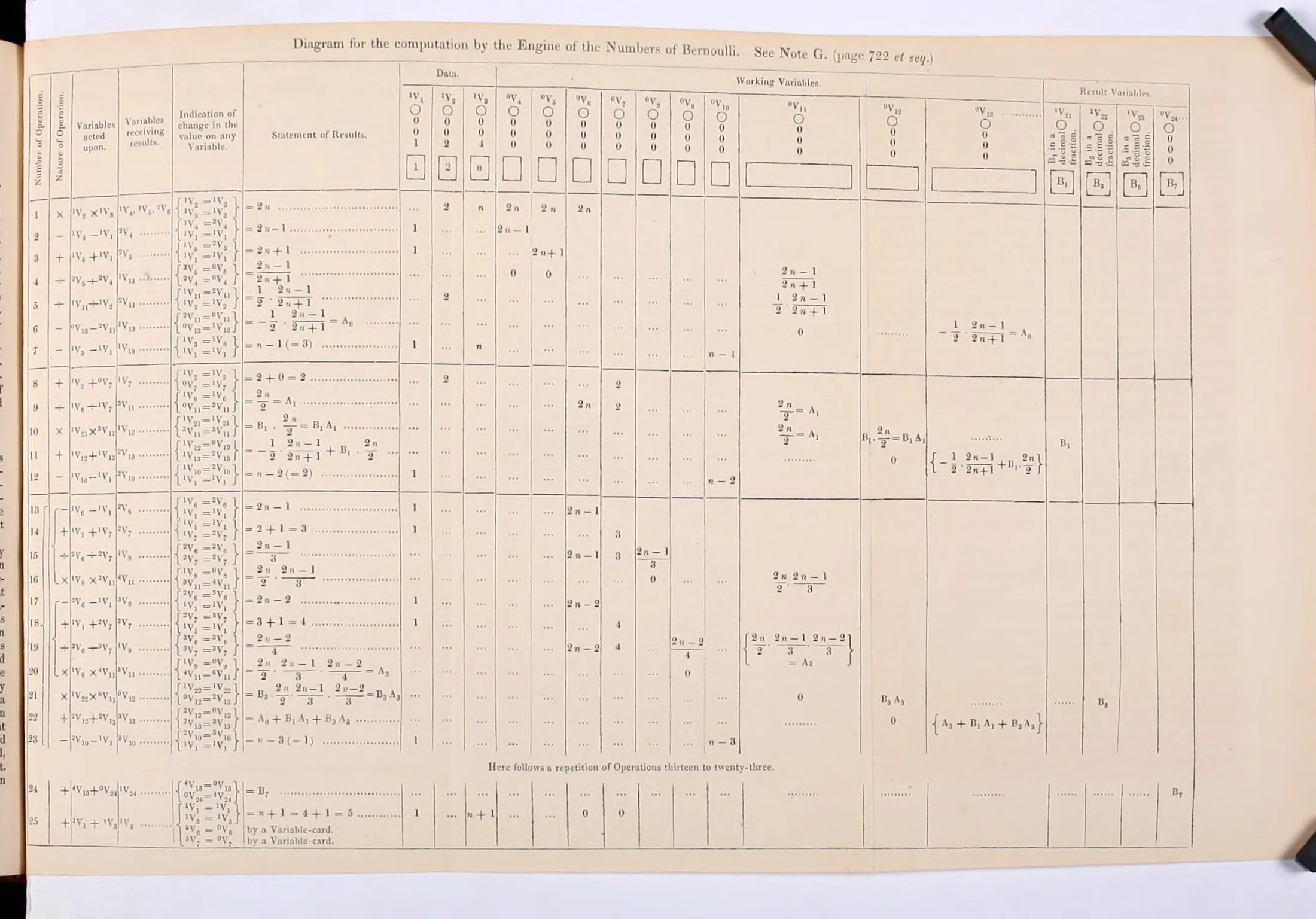
That she was the first computer programmer, as a settled fact.
The record will not print that as a fact. The Computer History Museum records both halves of the position on one page: that "Ada is often referred to as 'the first programmer'." and that "The collaboration with Babbage was close and biographers debate the extent and originality of Ada's contribution." A description historians are still arguing over is rendered here as a description, never as a finding. [A2]Ada Lovelace, in The Babbage EngineComputer History Museumclass A · read 2026-07-28
Checked: The Computer History Museum's Ada Lovelace page, read on 2026-07-28. Both sentences stand on it.
That Babbage wrote the Notes and she only translated them.
Refused as firmly as the claim above it, and from the opposite side. Babbage's own printed account of 1864 says of the illustrations that "I suggested several, but the selection was entirely her own", and that the algebraic working out of the problems was hers too, excepting the one on the numbers of Bernoulli, which he offered to do and which came back to him corrected: "This she sent back to me for an amendment, having detected a grave mistake which I had made in the process." The extent question stays open, and this record settles it in neither direction. [A3]Charles Babbage, Passages from the Life of a Philosopher (London: Longman, Green, Longman, Roberts, and Green, 1864), page 136Getty Research Institute, on the Internet Archiveclass A · read 2026-07-28
Checked: Passages from the Life of a Philosopher, page 136, in the Getty Research Institute scan, read on 2026-07-28.
That she built, ran, or operated a computing machine.
There was no such machine to run. The Science Museum Group's record of the trial model states that "Only part of the machine as a trial piece was completed before Babbage's death in 1871." The Notes describe a machine on paper, and this record claims nothing beyond the paper. [A4]Babbage's Analytical Engine, 1834-1871. (Trial model), object number 1878-3Science Museum Groupclass A · read 2026-07-28
Checked: Science Museum Group object 1878-3, Babbage's Analytical Engine trial model, read on 2026-07-28.
That the 1843 publication carries her name.
It does not. The contents page credits L. F. Menabrea alone, the second half of the article is headed "NOTES BY THE TRANSLATOR.", and the signature is the initials "A. A. L." The name is absent from the printed article and from the volume around it. [A1]Scientific Memoirs, Volume III (London, 1843), Article XXIX, Sketch of the Analytical Engine invented by Charles Babbage, Esq., by L. F. Menabrea, with Notes by the Translator, printed pages 666 to 731Natural History Museum Library, London, via the Biodiversity Heritage Library, on the Internet Archiveclass A · read 2026-07-28
Checked: The full text of the scanned 1843 volume, searched end to end on 2026-07-28 for Lovelace, Ada and Augusta. The count for each is zero.