Historical record

A demonstration record, compiled from public archives. Augusta Ada King, Countess of Lovelace did not write it; the institutions cited here did. Sources and clearance →

IndexSource ofYOU

1815 to 1852

Augusta Ada King, Countess of Lovelace

The record of Augusta Ada King, Countess of Lovelace, begins in a printed volume that names her nowhere and prints her work at length.

01Story

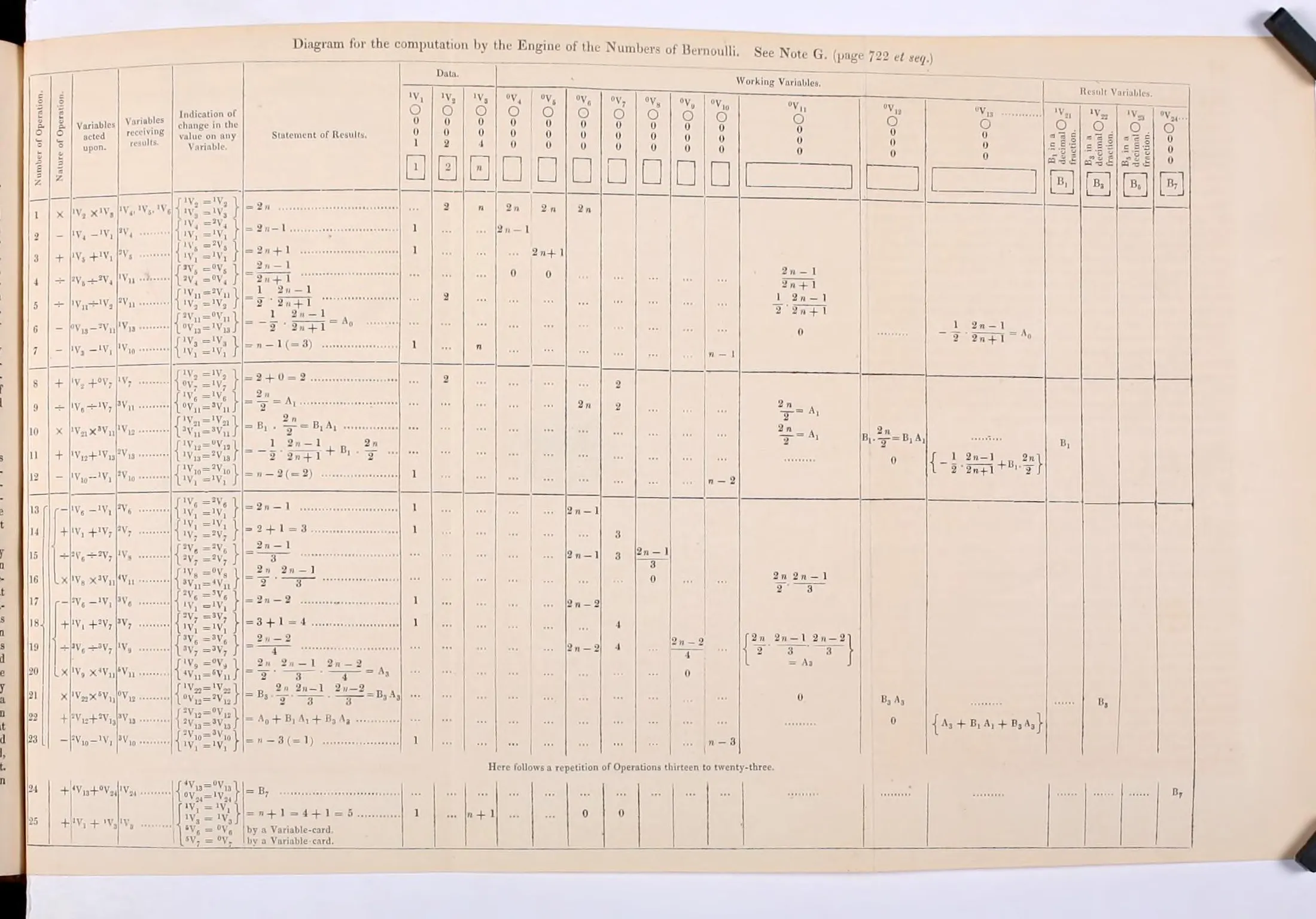
The memoir this record turns on was published in French in the Bibliotheque Universelle de Geneve, number 82, October 1842, a line the English printing carries at the head of the article. The English text appeared in London the following year as Article XXIX of Scientific Memoirs, Volume III, beginning at printed page 666. A second and longer text follows the translation under the heading "NOTES BY THE TRANSLATOR.", beginning at printed page 691, and the volume's own index enters both parts in a single line: "Analytical engine of Mr. C. Babbage, account of the, 666; notes on, 691." There are seven notes, lettered A to G, each anchored to the page of the memoir it annotates, and the initials "A. A. L." stand at the foot of them. Note G begins at printed page 722 and sets out the computation by the Engine of the Numbers of Bernoulli; a caption in the same volume directs the reader to it as "Note G. (page 722 et seq.)". In 1864 Babbage printed his own account of how those notes came to exist, and recorded that "The notes of the Countess of Lovelace extend to about three times the length of the original memoir." The machine the notes describe was never finished: the Science Museum Group records of its surviving trial model that "Only part of the machine as a trial piece was completed before Babbage's death in 1871."

02Work
02

Note G1843

The last of the seven notes, beginning at printed page 722, on the computation by the Engine of the Numbers of Bernoulli. Its second paragraph begins: "The Analytical Engine has no pretensions whatever to originate any thing. It can do whatever we know how to order it to perform."

Natural History Museum Library, London (digitized for the Biodiversity Heritage Library). Public domain

03

Lovelace Byron papers1817 to 1852

An archival deposit, not a publication. The National Archives Discovery catalogue records it under the reference Dep. Lovelace Byron, held by Oxford University: Bodleian Library, Special Collections, described as papers and corresp, with covering dates 1817 to 1852.

04

The Science Museum Library copy of the 1843 printing1843

Object number 30209019357339, shelfmark Babbage Collection MENABREA, held at the Science Museum Library at Wroughton. Printed by Richard and John E. Taylor, London, and bound with the Addition to the memoir of M Menabrea on the analytical engine.

The fold out diagram printed with Note G: a wide ruled table of operations, working variables and result variables for the computation by the Engine of the Numbers of Bernoulli.
03Chronology
1815

Born

Birthplace recorded by the Science Museum Group as London, Greater London, England, United Kingdom.

1833

Introduced to Charles Babbage

The collection record prints the entry as "1833 - introduced to Charles Babbage by Mary Fairfax Somerville".

1835

Marriage

The same record prints "1835 - married William King, eighth Baron King of Ockham, who became the Earl of Lovelace in 1838".

October 1842

The source memoir appears in French

The 1843 printing dates the memoir it translates to the Bibliotheque Universelle de Geneve, number 82, October 1842, at the head of the article.

1843

Translation and Notes printed

Article XXIX of Scientific Memoirs, Volume III, London: the translation from printed page 666, the Notes by the Translator from printed page 691.

1843

Note G

The last of the seven notes begins at printed page 722 and works through the computation by the Engine of the Numbers of Bernoulli.

1852

Death

The Science Museum Group collection record gives the dates 1815 to 1852.

1864

Babbage prints an account of the collaboration

Passages from the Life of a Philosopher, page 136, under the running head The Countess of Lovelace's Notes, sets out how the notes were made and how long they ran.
04Impact

7 notes

Lettered A to G, each headed with the page of the memoir it annotates: 674, 676, 677, 680, 684, 688 and 689.

666 to 731

The printed page span of Article XXIX. The translation opens at 666, the Notes by the Translator at 691, and the volume's index enters both: "Analytical engine of Mr. C. Babbage, account of the, 666; notes on, 691."

about 3 times

Babbage's printed measure of the Notes against the memoir in 1864: "about three times the length of the original memoir".

3 letters

The whole of the signature. The initials "A. A. L." are printed at the foot of the notes.

0 named credits

A full text read of the scanned 1843 volume returns no instance of Lovelace, Ada or Augusta anywhere in it.

05Notes

Note A, from the Notes by the Translator, 1843

"We may say most aptly that the Analytical Engine weaves algebraical patterns just as the Jacquard-loom weaves flowers and leaves." Printed in Scientific Memoirs, Volume III, London, 1843, in the Notes that begin at page 691. Read in the Natural History Museum Library scan digitized for the Biodiversity Heritage Library.

Note G, from the Notes by the Translator, 1843

"The Analytical Engine has no pretensions whatever to originate any thing. It can do whatever we know how to order it to perform." The opening of the second paragraph of Note G, printed page 722 of Scientific Memoirs, Volume III, London, 1843. Read in the Natural History Museum Library scan digitized for the Biodiversity Heritage Library.

06Queries
Q01

How does the 1843 volume credit the translator?

With three letters. The initials "A. A. L." are printed at the foot of the notes, and a full text read of the volume finds no fuller name anywhere in it.

Q02

How long are the Notes compared with the memoir they annotate?

Babbage, printing his own account in 1864, put it this way: "The notes of the Countess of Lovelace extend to about three times the length of the original memoir."

Q03

What is Note G?

The last of the seven notes, beginning at printed page 722, setting out the computation by the Engine of the Numbers of Bernoulli.

Q04

Did the machine described in the Notes exist?

No. The Science Museum Group records of the surviving trial model that "Only part of the machine as a trial piece was completed before Babbage's death in 1871."

Q05

What is still argued about this record?

The size of her share in the Notes. The Computer History Museum states it plainly: "The collaboration with Babbage was close and biographers debate the extent and originality of Ada's contribution."