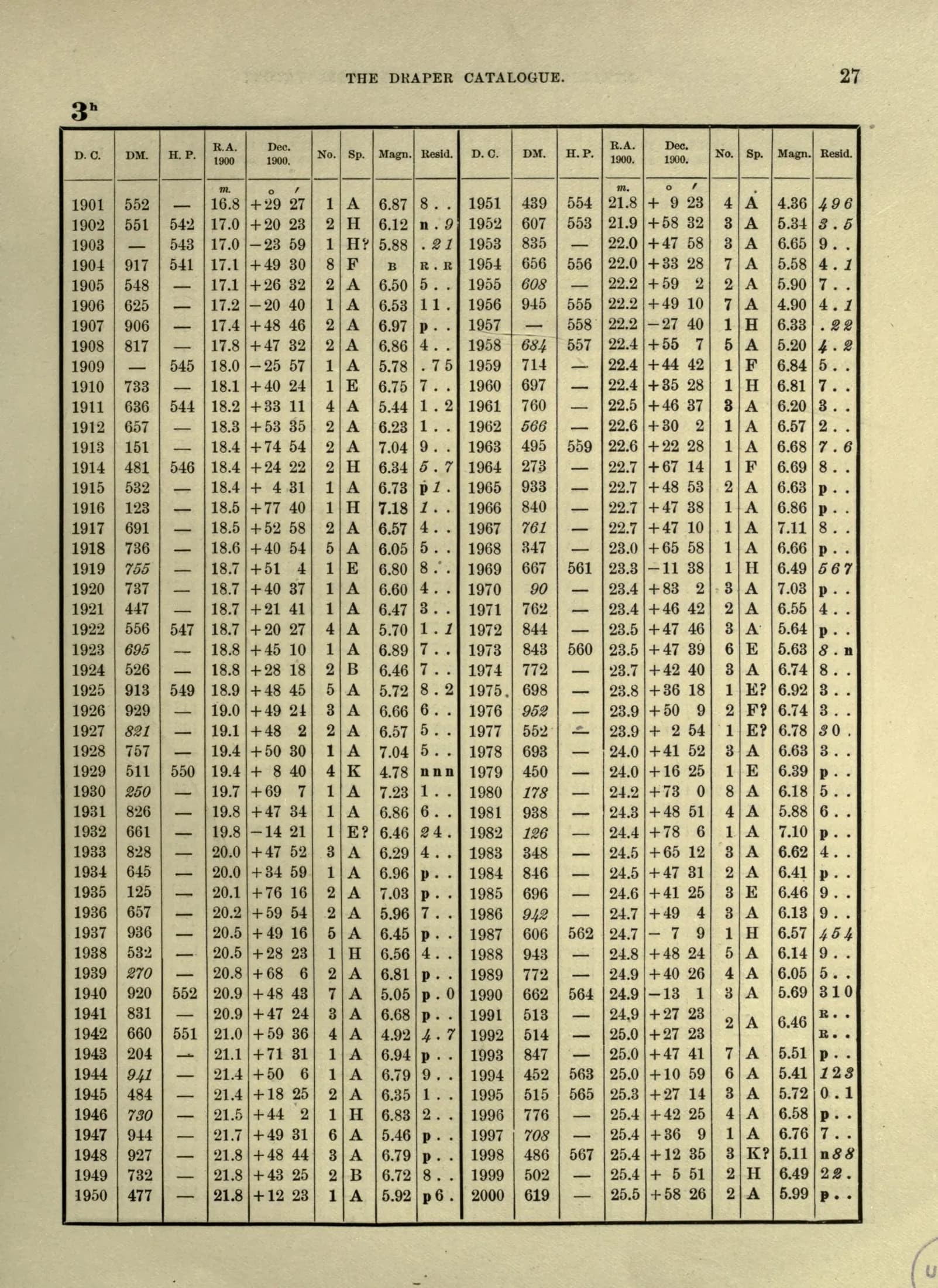
Williamina Fleming was born in Dundee, Scotland, on May 15, 1857. She was employed as a housemaid in the Cambridge household of Harvard College Observatory director Edward C. Pickering beginning in 1879, and entered the Observatory's own staff in 1881, where her early duties are recorded as "copying and ordinary computing." She was put in charge of the original examination of the observatory's photographic plates and assigned the first general photographic classification of stellar spectra, published as the Draper Catalogue of Stellar Spectra and giving, in the institutional record's own phrase, "the spectra of 10,351 stars, with measures of their photographic light." On a plate exposed at Cambridge on February 6, 1888, she recorded the object later named the Horsehead Nebula. Her own notebook describes it: "A large nebulosity extending nearly south from Zeta Orionis for about 60 minutes. More intense and well marked on the following side, with a semicircular indentation." The finding was first published in 1890 under the director's name with credit to her; when it was folded into J. L. E. Dreyer's Index Catalogue of Nebulae in 1895, the entry credited the discovery to "Pickering" alone. The institutional record credits her with the discovery of ten novae and more than three hundred variable stars, of which two hundred twenty two received measured position and light magnitude sequences in her own "Photographic Study of Variable Stars." In 1899 the Harvard Corporation gave her an official position on the Observatory staff as Curator of Astronomical Photographs; she died in Boston on May 21, 1911, of pneumonia.