A check for $1,100,000 carried from the Chemical Bank to the Controller's office and exchanged for the city's special revenue bonds, printed by the New-York Tribune the following morning under a heading reporting that the city had been handed a check for that amount.
Historical record
A demonstration record, compiled from public archives. Hetty Howland Robinson Green did not write it; the institutions cited here did. Sources and clearance →
1834 to 1916
Hetty Howland Robinson Green
Hetty Howland Robinson Green worked from a base at the Chemical Bank in New York and dealt directly in the debt of the City of New York, buying its special revenue bonds across the counter of the Controller's office.
§1Statement
The reports of her death on July 3, 1916 placed her birth at New Bedford, Massachusetts, and quoted her own testimony in court for the date: "In November, 1834, about the 20th." Her father, Edward Mott Robinson, had amassed a fortune at New Bedford and married Abby Howland, of the family whose name she carried and which had become known in the whaling industry and the shipping trade with China. Contemporary accounts published at her death stated that she was thirty years old when her father died, leaving nine millions, one million outright and the income from the other eight with the principal held in trust for her children, and that her aunt Sylvia Ann Howland died at about the same time. Her claim on her aunt's estate was heard in the Circuit Court of the United States for the District of Massachusetts as Robinson v. Mandell, and in October 1868 the bill of complaint was dismissed with costs. On October 23, 1907, with the city suspending new work until the financial storm passed, her clerk asked the Controller whether he wished to dispose of special revenue bonds and returned from the Chemical Bank with a check for $1,100,000. On her seventy-eighth birthday, November 21, 1912, she was reported at work at her desk at the head of Wall Street, declining to treat the day as a holiday. She died at the home of her son in New York, and her body was taken for burial at Bellows Falls, Vermont, where she had lived for many years and where funeral services were held in the Church of the Immanuel.
§2Engagements
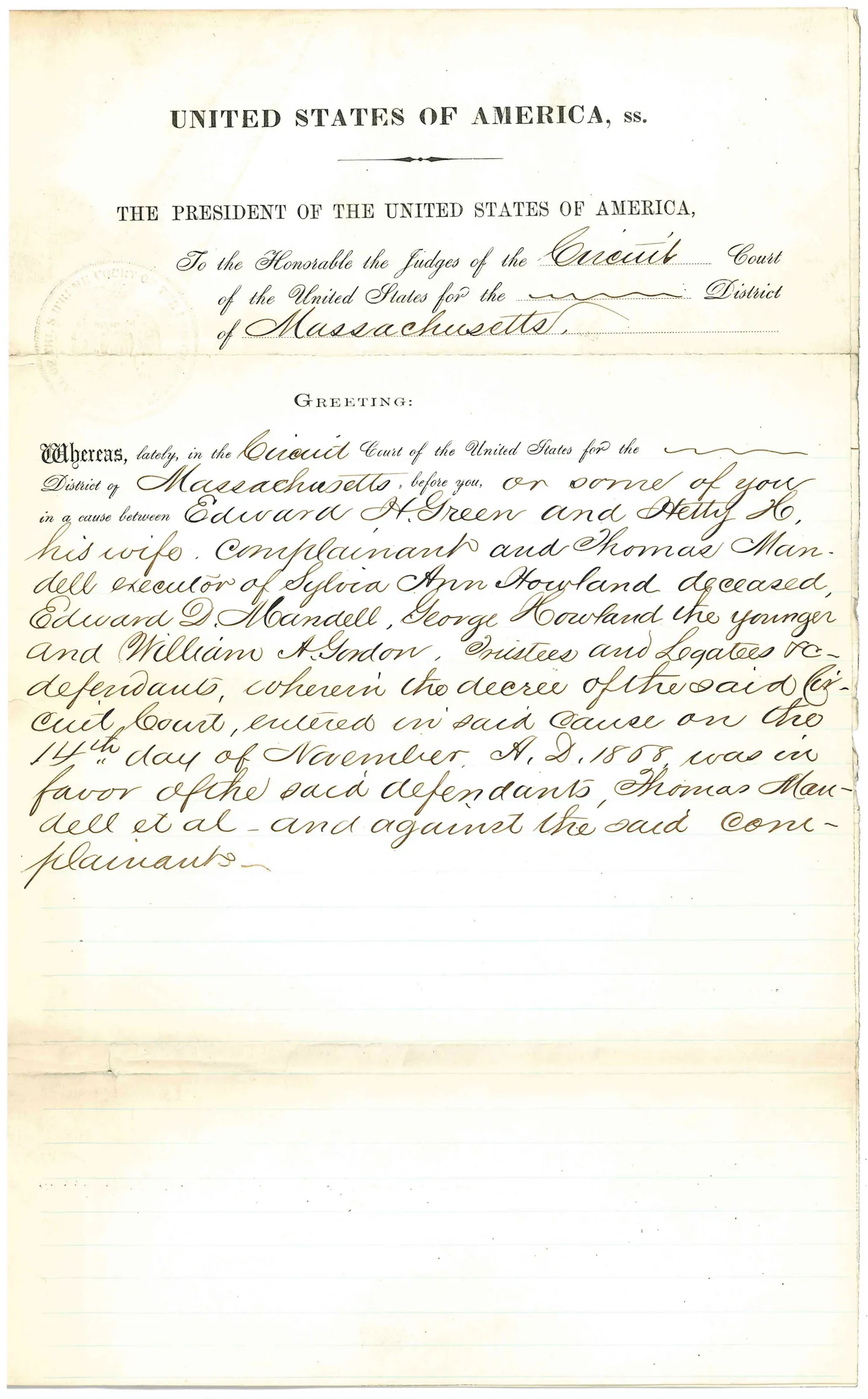
Her suit over her aunt's estate in the Circuit Court of the United States for the District of Massachusetts, also reported at 3 Cliff. 169. The bill of complaint was dismissed with costs, and the court expressly declined to decide whether the disputed paper was genuine.
National Archives at Boston, National Archives and Records Administration, Records of District Courts of the United States (Record Group 21), Case Files. Use Restriction(s): Unrestricted; Access Restriction(s): Unrestricted
The bank in which she made her downtown headquarters. Asked at her death to estimate the size of her estate, its officials declined to hazard a guess.
The Washington Herald reported that her son Edward H. R. Green, president of the Texas Midland railroad, had been sent to Texas seventeen years earlier to look after her interests in the state, and was then coming to New York to carry part of her business.
§3Schedule of record
| 1834 | Born at New BedfordThe July 1916 reports of her death place her birth at New Bedford, Massachusetts, citing her own testimony in court for the date, "In November, 1834, about the 20th." She herself gave November 21, 1834 in a birthday interview in 1912, so the day is reported two ways in the record and the year is reported one way. |
| December 2, 1865 | Bill of complaint filedThen Miss Robinson, she filed a bill of complaint against the executors and trustees of Sylvia Ann Howland's estate in the Circuit Court of the United States for the District of Massachusetts. The probate decree had been affirmed by the Supreme Judicial Court at the November term, 1865. |
| October 1868 | Robinson v. Mandell decidedClifford, Circuit Justice, dismissed the bill of complaint with costs. The reported opinion states that the court did not find it necessary to determine whether the disputed paper was genuine, and held that, assuming all the papers to be genuine, the evidence failed to prove the contract alleged. |
| February 1889 | The nickname in printA New York letter carried by The Indianapolis Journal described her as the eccentric old lady sometimes referred to as the Witch of Wall street, and reported that her standing instruction to a broker was to buy until told to stop. |
| Between 1900 and 1910 | The house at Bellows FallsThe Detroit Publishing Company photographed the Vermont residence on an 8 by 10 inch glass negative, catalogued by the Library of Congress as Hetty Green's residence, Bellows Falls, Vt. |
| October 1907 | Special revenue bonds of the City of New YorkThe New-York Tribune reported the purchase the next morning: a check for $1,100,000 carried from the Chemical Bank to the Controller in the Stewart Building, at a moment when the city had suspended the registering of contracts. |
| November 21, 1912 | Seventy-eight, and at the deskReported at work in her office as usual on her birthday, at a square little rosewood desk at the head of Wall Street. |
| July 1916 | Death in New York, burial in VermontShe died on July 3 at the home of her son. Her body was taken to Bellows Falls, Vermont for burial, with services in the Church of the Immanuel. |
§4Figures of record
| $1,100,000 | The check her clerk carried from the Chemical Bank to the Controller of the City of New York on October 23, 1907, exchanged for the city's special revenue bonds |
| $20,000,000 | The floor of the Wall Street estimates of her fortune printed on the day she died. The ceiling printed the same day was $100,000,000, and officials of the Chemical National Bank declined to hazard a guess about the size of the estate |
| 9 millions | What contemporary accounts at her death said her father left her: one million outright and the income from the other eight, the principal held in trust for her children |
| 1/2 the Howland estate | The share of the income she took for life under the trusts of her aunt's probated will, in place of owning the estate itself |
| 78 | Her age on November 21, 1912, the day she was reported at work in her office as usual, at a desk at the head of Wall Street |
§5Matters commonly raised
01
What did the court actually decide in the Howland will case?
Sitting in the Circuit Court of the United States for the District of Massachusetts in October 1868, Clifford, Circuit Justice, dismissed the bill of complaint with costs. The reported opinion states that the court did not reach the disputed signature: inasmuch as it did not become necessary to determine whether the paper was genuine, the court declined those questions, and held that assuming all the papers to be genuine the evidence failed to prove the contract alleged. It also held that under the statutes then governing competency she was not a competent witness to testify to any transaction with, or statement by, the testatrix.
02
What did she do during the panic of October 1907?
The New-York Tribune reported on October 24, 1907 that her clerk had crossed Broadway from the Chemical Bank and asked the Controller whether he wished to dispose of special revenue bonds. The Controller answered that the city would sell her all she wanted, and the clerk returned to the Stewart Building with a check for $1,100,000 made payable to the Controller of the City of New York.
03
How did she describe her own method?
In an interview reprinted by the Los Angeles Herald on September 25, 1905 under the heading Hetty Green Advises Investors, she is quoted as saying "When I see a good thing going cheap because nobody wants it I buy a lot of it and tuck it away" and "There is no great secret in fortune making. All you have to do is to buy cheap and sell dear, act with thrift and shrewdness." The same interview has her stating that railroads and real estate were what she liked and that she did not buy industrials.
04
How large was the fortune, and was she self-made?
The record here settles no figure. On the day she died, Wall Street estimates ran from $20,000,000 to $100,000,000, and officials of the Chemical National Bank, where she had made her downtown headquarters, declined to hazard a guess about the size of the estate. The same report answers the second question plainly: her extremes of economy led to a popular misconception of her as a self-made woman, and as a matter of fact she was born rich.
05
Where was she a resident when she died, and what became of the estate?
Her burial was at Bellows Falls, and residence then became a tax question. The New-York Tribune reported on July 12, 1918 that the State of New York still hoped to tax the $100,000,000 estate left by Mrs. Hetty Green, who died a resident of Vermont, where no transfer tax was imposed, and that the Appellate Division had remitted the transfer-tax appraisal to the appraiser for further testimony.