‹ The Hall of RecordsEntered into the record July 28, 2026
HISTORICAL RECORD · A DEMONSTRATIONMathematics1887 to 1920

Filed under

Clerk, accounts section, Madras Port Trust. Appointed to the post, duties beginning on 1 March 1912. [B1]Biography of Srinivasa Ramanujan, MacTutor History of Mathematics ArchiveUniversity of St Andrews, MacTutor History of Mathematics Archiveclass B · read 2026-07-28

Lifted off the leaf

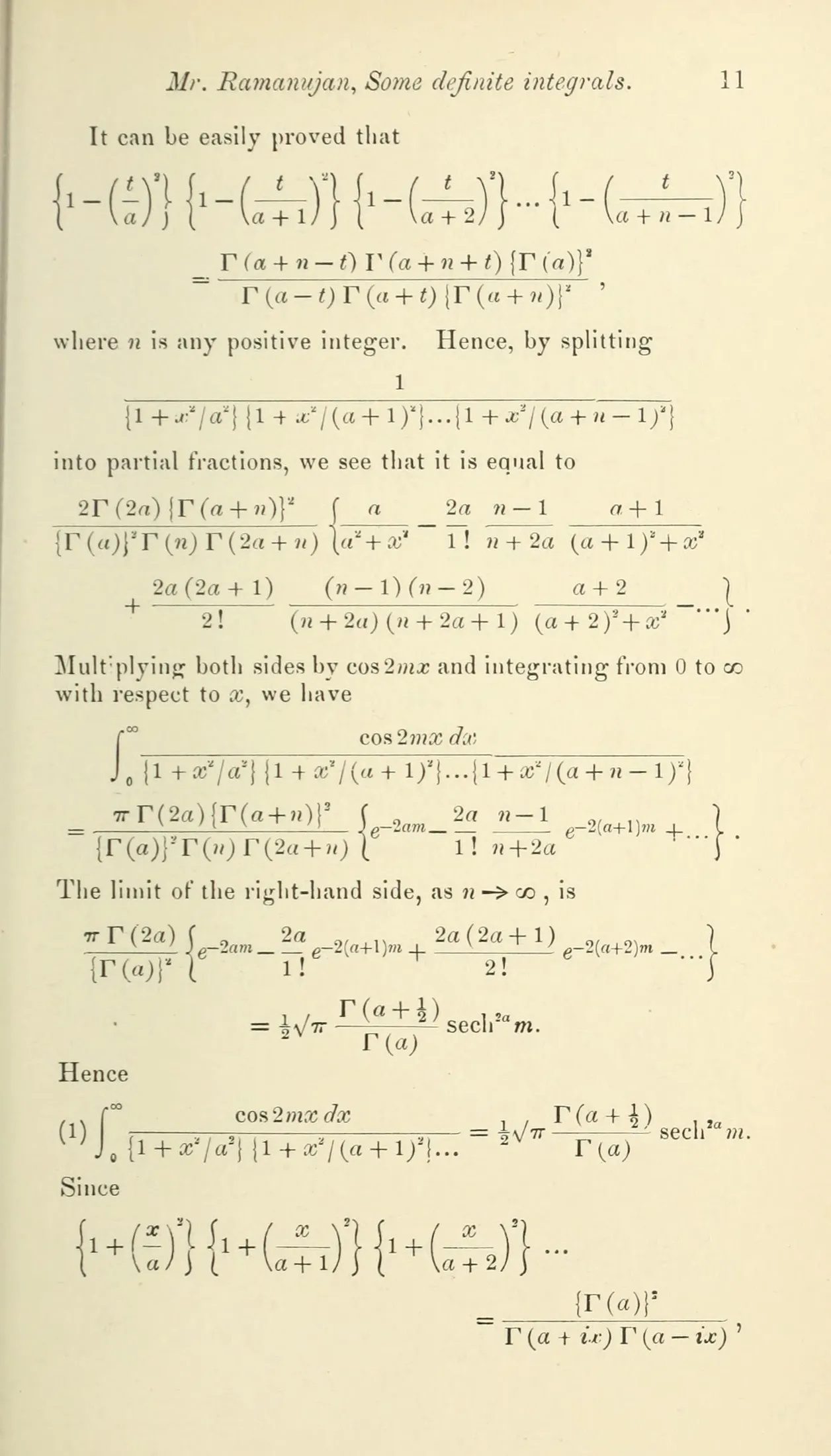
Page 11 of the paper Some definite integrals by S. Ramanujan, printed in Messenger of Mathematics volume 44, Cambridge, 1915.

[A4]University of Toronto Libraries, Gerstein Science Information Centre; digitized by the Internet Archive1915NOT_IN_COPYRIGHTread 2026-07-29Downloaded the archive.org page render of leaf n20 at 1757x3077 JPEG; resized to fit within 2200px on the long edge (1256x2200) and encoded to WebP at quality 80. No cropping, rotation, retouching or tonal adjustment.

The record

The ledger kept for the port and the notebooks kept for mathematics belong to the same years of one life. Cambridge read the second only after a letter in January 1913. [A2]Collected Papers of Srinivasa Ramanujan, edited by G H Hardy, P V Seshu Aiyar and B M Wilson, with notes and extracts from Ramanujan's letters to HardyCambridge University Press, publisher of record, 1927; digitised copy served by the Internet Archive in the Digital Library of India collection, contributed by Kerala State Libraryclass A · read 2026-07-28

Srinivasa Ramanujan

The record of Srinivasa Ramanujan, mathematician: a clerk in the accounts section of the Madras Port Trust, elected a Fellow of the Royal Society on 2 May 1918. [A1]Ramanujan, Srinivasa Aaiyangar: certificate of election to the Royal Society, reference EC/1918/18, date of election 2 May 1918The Royal Society, London, archives catalogueclass A · read 2026-07-28

Measured

What the record counts

£20 per annum
The salary given for the Port Trust clerkship in the letter of 16 January 1913, which names it "a salary of only £20 per annum". [A2]Collected Papers of Srinivasa Ramanujan, edited by G H Hardy, P V Seshu Aiyar and B M Wilson, with notes and extracts from Ramanujan's letters to HardyCambridge University Press, publisher of record, 1927; digitised copy served by the Internet Archive in the Digital Library of India collection, contributed by Kerala State Libraryclass A · read 2026-07-28
100 or more theorems
The 1927 Collected Papers records that the papers enclosed with the first letter "contained the enunciations of a hundred or more mathematical theorems". [A2]Collected Papers of Srinivasa Ramanujan, edited by G H Hardy, P V Seshu Aiyar and B M Wilson, with notes and extracts from Ramanujan's letters to HardyCambridge University Press, publisher of record, 1927; digitised copy served by the Internet Archive in the Digital Library of India collection, contributed by Kerala State Libraryclass A · read 2026-07-28
2 notebooks
Hardy's notice in the 1927 Collected Papers describes him "jotting down his results in two good-sized notebooks". [A2]Collected Papers of Srinivasa Ramanujan, edited by G H Hardy, P V Seshu Aiyar and B M Wilson, with notes and extracts from Ramanujan's letters to HardyCambridge University Press, publisher of record, 1927; digitised copy served by the Internet Archive in the Digital Library of India collection, contributed by Kerala State Libraryclass A · read 2026-07-28
138 sheets
Trinity College Library gives the lost notebook as "around 138 sheets of paper", re-discovered in 1976 among the effects of G N Watson. [A3]Remembering Ramanujan, Trinity College Library Cambridge, 24 April 2020Trinity College Library, Cambridge, holder of the Ramanujan papers at Add.MS.a.94 in the Wren Libraryclass A · read 2026-07-28
Over 600 formulae
Trinity College Library records the formulae in the lost notebook, "over six hundred in total", as having been set down without proofs. [A3]Remembering Ramanujan, Trinity College Library Cambridge, 24 April 2020Trinity College Library, Cambridge, holder of the Ramanujan papers at Add.MS.a.94 in the Wren Libraryclass A · read 2026-07-28

Record boundary

What the sources establish

Sources read
6
Primary or institutional
5
Distinct sources cited on this page
5
Works of record
5

Where the sources do not settle a question, this record does not answer it. Nothing above is inferred from anything else on the page.

What the record declines

He had no formal education in mathematics at all.

The record shows schooling and college. He entered the Town High School in Kumbakonam in January 1898 and held a scholarship to the Government College in Kumbakonam from 1904, which was "not renewed because Ramanujan devoted more and more of his time to mathematics and neglected his other subjects"; he attended Pachaiyappa's College in 1906 and at the First Arts examination "failed all his other subjects". The narrower claim is the one he made himself: "I have had no university education but I have undergone the ordinary school course." [B1]Biography of Srinivasa Ramanujan, MacTutor History of Mathematics ArchiveUniversity of St Andrews, MacTutor History of Mathematics Archiveclass B · read 2026-07-28

Checked: The MacTutor account of the Town High School, the Government College scholarship, Pachaiyappa's College and the First Arts examination, read against the letter extract quoted on the same page.

G H Hardy discovered Ramanujan.

The record predates the letter. The first paper, "Some properties of Bernoulli's numbers", was printed in the Journal of the Indian Mathematical Society, volume 3, in 1911, and the 1927 Collected Papers lists four further items in that journal for 1912 and 1913. The letter of 16 January 1913 is the moment the record was read in Cambridge, not the moment it was made. [A2]Collected Papers of Srinivasa Ramanujan, edited by G H Hardy, P V Seshu Aiyar and B M Wilson, with notes and extracts from Ramanujan's letters to HardyCambridge University Press, publisher of record, 1927; digitised copy served by the Internet Archive in the Digital Library of India collection, contributed by Kerala State Libraryclass A · read 2026-07-28

Checked: Items 1 to 5 in the table of contents of the 1927 Collected Papers, with their journal, volume and year, set against the date of the first letter to Hardy printed in the same volume.

The record settles what he died of.

It does not. The 1927 Collected Papers gives the date of death and states no diagnosis. Causes offered since are later conclusions, and none of them appears in any source this record is built from, so none is asserted here. [A2]Collected Papers of Srinivasa Ramanujan, edited by G H Hardy, P V Seshu Aiyar and B M Wilson, with notes and extracts from Ramanujan's letters to HardyCambridge University Press, publisher of record, 1927; digitised copy served by the Internet Archive in the Digital Library of India collection, contributed by Kerala State Libraryclass A · read 2026-07-28

Checked: The full text of the 1927 Collected Papers was searched for any statement of the cause of the illness or the death; it records the death on 26 April 1920 and names no cause.

The Collected Papers of 1927 published everything he wrote.

The 1927 volume says otherwise in its own pages: "There is still a large mass of unpublished material. None of the contents of Ramanujan's notebooks has been printed, unless incorporated in later papers." It gathers the published papers; the notebooks were not in it. [A2]Collected Papers of Srinivasa Ramanujan, edited by G H Hardy, P V Seshu Aiyar and B M Wilson, with notes and extracts from Ramanujan's letters to HardyCambridge University Press, publisher of record, 1927; digitised copy served by the Internet Archive in the Digital Library of India collection, contributed by Kerala State Libraryclass A · read 2026-07-28

Checked: The sentence quoted above, located in the 1927 Collected Papers alongside the volume's table of contents of published papers.

The record

Srinivasa Ramanujan has a source page.

The same renderer a customer's published page mounts, drawing the same facts this room holds the sources for. Everything below is its apparatus.

View the record →sourceofyou.com/srinivasa-ramanujan
One record, two views

The apparatus

What stands behind the record: the works and who holds them, the claims this record refuses, every source read and when, and the gate stack this figure passed before a page was compiled.

Works

Works of record

Each work is listed with the institution that holds it and the rights statement that institution publishes, quoted as written.

1915

Some definite integrals [A4]Messenger of Mathematics, Volume 44 (page 11, from "Some definite integrals" by S. Ramanujan, pp. 10-18)University of Toronto Libraries, Gerstein Science Information Centre; digitized by the Internet Archiveclass A · read 2026-07-29

Printed in the Messenger of Mathematics, Volume 44, Cambridge, pages 10 to 18, under the name S. Ramanujan. The University of Toronto copy is digitized in full; the Internet Archive records its copyright status as not in copyright, on evidence of no visible notice and a stated date of 1915.

Held by
University of Toronto Libraries, Gerstein Science Information Centre; digitized by the Internet Archive
Rights, as published
Possible copyright status: NOT_IN_COPYRIGHT. Copyright-evidence: "Evidence reported by Pierre Custodio for item messengerofmathe44cambuoft on May 8, 2008: no visible notice of copyright; stated date is 1915." Copyright-region: US.

1911

Some properties of Bernoulli's numbers [A2]Collected Papers of Srinivasa Ramanujan, edited by G H Hardy, P V Seshu Aiyar and B M Wilson, with notes and extracts from Ramanujan's letters to HardyCambridge University Press, publisher of record, 1927; digitised copy served by the Internet Archive in the Digital Library of India collection, contributed by Kerala State Libraryclass A · read 2026-07-28

The first item in the 1927 Collected Papers: Journal of the Indian Mathematical Society, volume 3 (1911), pages 219 to 234, printed two years before the letter to Hardy.

Held by
Cambridge University Press, publisher of record, 1927; digitised copy served by the Internet Archive in the Digital Library of India collection, contributed by Kerala State Library
Rights, as published
No rights, usage, or licence statement is displayed on the item page or in its metadata as fetched. The absence is recorded here as an absence. The volume was published in 1927 and its author died in 1920.

1918

Asymptotic formulae in combinatory analysis [A2]Collected Papers of Srinivasa Ramanujan, edited by G H Hardy, P V Seshu Aiyar and B M Wilson, with notes and extracts from Ramanujan's letters to HardyCambridge University Press, publisher of record, 1927; digitised copy served by the Internet Archive in the Digital Library of India collection, contributed by Kerala State Libraryclass A · read 2026-07-28

Written with G H Hardy. Listed in the 1927 Collected Papers as Proceedings of the London Mathematical Society, series 2, volume 17 (1918), pages 76 to 115.

Held by
Cambridge University Press, publisher of record, 1927; digitised copy served by the Internet Archive in the Digital Library of India collection, contributed by Kerala State Library
Rights, as published
No rights, usage, or licence statement is displayed on the item page or in its metadata as fetched. The absence is recorded here as an absence. The volume was published in 1927 and its author died in 1920.

1927

Collected Papers of Srinivasa Ramanujan [A2]Collected Papers of Srinivasa Ramanujan, edited by G H Hardy, P V Seshu Aiyar and B M Wilson, with notes and extracts from Ramanujan's letters to HardyCambridge University Press, publisher of record, 1927; digitised copy served by the Internet Archive in the Digital Library of India collection, contributed by Kerala State Libraryclass A · read 2026-07-28

Edited by G H Hardy, P V Seshu Aiyar and B M Wilson, Cambridge at the University Press, with notes and extracts from Ramanujan's letters to Hardy.

Held by
Cambridge University Press, publisher of record, 1927; digitised copy served by the Internet Archive in the Digital Library of India collection, contributed by Kerala State Library
Rights, as published
No rights, usage, or licence statement is displayed on the item page or in its metadata as fetched. The absence is recorded here as an absence. The volume was published in 1927 and its author died in 1920.

1919 to 1920

The lost notebook [A3]Remembering Ramanujan, Trinity College Library Cambridge, 24 April 2020Trinity College Library, Cambridge, holder of the Ramanujan papers at Add.MS.a.94 in the Wren Libraryclass A · read 2026-07-28

Loose sheets holding much of the research completed in the last two years of his life, held at Trinity College Library, Cambridge, where one sheet is catalogued as Add Ms a/94/15/65.

Held by
Trinity College Library, Cambridge, holder of the Ramanujan papers at Add.MS.a.94 in the Wren Library
Rights, as published
No copyright or reuse statement is displayed on the post as fetched. The absence is recorded here as an absence.
Sources

Sources

Class A is primary or institutional archival material. Class B is scholarly secondary work, cited with edition and page, and used only where class A could not be reached. Every source below was read at the URL given, on the date given.

  1. [A1]Class A

    Ramanujan, Srinivasa Aaiyangar: certificate of election to the Royal Society, reference EC/1918/18, date of election 2 May 1918

    The Royal Society, London, archives catalogue

    https://catalogues.royalsociety.org/CalmView/Record.aspx?src=CalmView.Catalog&id=EC%2f1918%2f18read 2026-07-28

    No rights, licence, or reuse statement for the record content is displayed on the page as fetched; the footer carries only "Website design ©CalmView" and the Royal Society's registered charity number 207043. The absence of a rights statement is recorded here as an absence.

  2. [A2]Class A

    Collected Papers of Srinivasa Ramanujan, edited by G H Hardy, P V Seshu Aiyar and B M Wilson, with notes and extracts from Ramanujan's letters to Hardy

    Cambridge University Press, publisher of record, 1927; digitised copy served by the Internet Archive in the Digital Library of India collection, contributed by Kerala State Library

    https://archive.org/details/pli.kerala.rare.28155read 2026-07-28

    No rights, usage, or licence statement is displayed on the item page or in its metadata as fetched. The absence is recorded here as an absence. The volume was published in 1927 and its author died in 1920.

  3. [A3]Class A

    Remembering Ramanujan, Trinity College Library Cambridge, 24 April 2020

    Trinity College Library, Cambridge, holder of the Ramanujan papers at Add.MS.a.94 in the Wren Library

    https://trinitycollegelibrarycambridge.wordpress.com/2020/04/24/remembering-ramanujan/read 2026-07-28

    No copyright or reuse statement is displayed on the post as fetched. The absence is recorded here as an absence.

  4. [B1]Class B

    Biography of Srinivasa Ramanujan, MacTutor History of Mathematics Archive

    University of St Andrews, MacTutor History of Mathematics Archive. MacTutor biography written by J J O'Connor and E F Robertson, last update June 1998. A single unpaginated web page: no page numbers exist for it, and that absence is stated here rather than invented.

    https://mathshistory.st-andrews.ac.uk/Biographies/Ramanujan/read 2026-07-28

    "Except where otherwise noted, the text of MacTutor by JOC/EFR is licensed under a Creative Commons Attribution-ShareAlike 4.0 International License."

  5. [A4]Class A

    Messenger of Mathematics, Volume 44 (page 11, from "Some definite integrals" by S. Ramanujan, pp. 10-18)

    University of Toronto Libraries, Gerstein Science Information Centre; digitized by the Internet Archive

    https://archive.org/details/messengerofmathe44cambuoftread 2026-07-29

    Possible copyright status: NOT_IN_COPYRIGHT. Copyright-evidence: "Evidence reported by Pierre Custodio for item messengerofmathe44cambuoft on May 8, 2008: no visible notice of copyright; stated date is 1915." Copyright-region: US.

  6. [A5]Class A

    Add.Ms.a.94.7 (Photograph)

    Trinity College, Cambridge (Wren Digital Library, James Catalogue Online)

    https://mss-cat.trin.cam.ac.uk/manuscripts/Add.Ms.a.94.7.jsonread 2026-07-29

    license: https://creativecommons.org/licenses/by/4.0/ ; attribution: Trinity College, Cambridge

Clearance

How this record was cleared

Every record in the Hall passes the same gate stack before a page is compiled, and the result is published rather than merely filed.

Died
1920
Public domain basis
Every work quoted here was published in or before 1927 and its author died in 1920, so the quoted primary material is out of copyright both under the United States rule for works published before 1930 and under life plus seventy years. The digitised 1927 Collected Papers is served publicly by the Internet Archive in the Digital Library of India collection. The MacTutor text is separately licensed "Except where otherwise noted, the text of MacTutor by JOC/EFR is licensed under a Creative Commons Attribution-ShareAlike 4.0 International License", and is attributed in the source list to J J O'Connor and E F Robertson accordingly. Short catalogue descriptions from the Royal Society and Trinity College Library are quoted with attribution.
Estate and licensing screen
Screened 2026-07-28. No enforcing estate, heir representative, or licensing agent for Srinivasa Ramanujan appears on any institutional page consulted; the election certificate and the manuscripts are held and described by the Royal Society and by Trinity College Library, neither of which names a rights-management representative for the person. No probate or estate register was searched, and that limit is stated here rather than glossed.
Trademark screen
Screened 2026-07-28 across the four sources consulted: none records a trademark, brand programme, or licensing claim on the name. No national trademark register was searched, so this screen is limited to the institutional record, and no live collision was identified, so no no-affiliation line is set.
Dignity screen
Third person throughout. The only first-person sentences on the page are quotations of primary material, each inside quotation marks with its citation. The rescue frame was refused by construction: the mathematics is entered at its first printing in 1911, two years before the letter, and the letter of 16 January 1913 is described as the moment the record was read in Cambridge rather than the moment it was made, which is also the decline that answers the claim that Hardy discovered him. The clerkship is the label and the notebooks are the record underneath it, so the turn is a filing error corrected and not a life rescued. The illness and the death at thirty two are stated once, in the schedule, and are never the hook. The statement about the goddess of Namakkal is carried exactly as the 1927 Collected Papers records it, quoted and cited, neither mocked nor made the point of the record. No cause of death is asserted anywhere on the page, because no source consulted states one.
Gate stack run
2026-07-28

The machine record

The structured representation this page is built from, printed field by field.

Every row below is a field of this figure's module, printed with its value and the citation key that settles it. Nothing here is summarised or inferred. It is shown as text for a reader: this page emits no machine-readable metadata, and it is excluded from the sitemap, from llms.txt, and from search indexes.

identity

slugsrinivasa-ramanujan
handlesrinivasa-ramanujan
nameSrinivasa Ramanujan
disciplineMathematics
entered2026-07-28
accent#4A2A55

claims

labelClerk, accounts section, Madras Port Trust. Appointed to the post, duties beginning on 1 March 1912. [B1]
turnThe ledger kept for the port and the notebooks kept for mathematics belong to the same years of one life. Cambridge read the second only after a letter in January 1913. [A2]
lifespan1887 to 1920 [B1]
statementThe record of Srinivasa Ramanujan, mathematician: a clerk in the accounts section of the Madras Port Trust, elected a Fellow of the Royal Society on 2 May 1918. [A1]

story[7]

story[0]Born on 22 December 1887 at Erode in what is now Tamil Nadu, he entered the Town High School in Kumbakonam in January 1898 and was given a scholarship to the Government College in Kumbakonam, which he entered in 1904; the scholarship, MacTutor records, was "not renewed because Ramanujan devoted more and more of his time to mathematics and neglected his other subjects". [B1]
story[1]He attended Pachaiyappa's College in 1906 and sat the First Arts examination, at which MacTutor records that he "failed all his other subjects". [B1]
story[2]His application for the Madras Port Trust post carried a reference from E W Middlemast reading "He is a young man of quite exceptional capacity in mathematics and especially in work relating to numbers. He has a natural aptitude for computation and is very quick at figure work", and the duties of the clerkship began on 1 March 1912. [B1]
story[3]The mathematics was in print before Cambridge had heard of it: the first item in the 1927 Collected Papers is "Some properties of Bernoulli's numbers", Journal of the Indian Mathematical Society, volume 3 (1911), pages 219 to 234. [A2]
story[4]On 16 January 1913 he wrote to G H Hardy, and the 1927 Collected Papers records that the papers enclosed with that letter "contained the enunciations of a hundred or more mathematical theorems". [A2]
story[5]He sailed from India on 17 March 1914, arrived in London on 14 April 1914, moved into rooms at Trinity College on 30 April, and graduated Bachelor of Arts by Research on 16 March 1916. [B1]
story[6]The Royal Society elected him a Fellow on 2 May 1918, on a certificate that describes him as "Research Student in Mathematics. Distinguished as a pure mathematician, particularly for his investigations in elliptic functions and the theory of numbers". [A1]

schedule[8]

schedule[0] [B1]

span1912 to 1914
titleClerk, accounts section, Madras Port Trust
detailAppointed on an application carrying E W Middlemast's written reference; duties began on 1 March 1912.

schedule[1] [A2]

span16 January 1913
titleLetter to G H Hardy
detailOpens "I beg to introduce myself to you as a clerk in the Accounts Department of the Port Trust Office at Madras on a salary of only £20 per annum". The 1927 Collected Papers records that the enclosure "contained the enunciations of a hundred or more mathematical theorems".

schedule[2] [B1]

span1914
titleArrival in England
detailSailed from India on 17 March 1914, arrived in London on 14 April 1914, and moved into rooms at Trinity College on 30 April.

schedule[3] [A1]

span2 May 1918
titleFellow of the Royal Society
detailElection certificate EC/1918/18, proposed by "G H Hardy; P A MacMahon; J H Grace; Joseph Larmor; T J I'A Bromwich; E W Hobson; H F Baker; J E Littlewood; J W Nicholson; W H Young; E T Whittaker; A R Forsyth; A N Whitehead".

schedule[4] [A3]

spanOctober 1918
titleFellow of Trinity College, Cambridge
detailTrinity College Library records that in October 1918 he "was the first Indian to be appointed as a Fellow of Trinity College, Cambridge".

schedule[5] [B1]

span1919
titleReturn to India
detailSailed for India on 27 February 1919, arriving on 13 March.

schedule[6] [A3]

span1920
titleDeath at Kumbakonam
detailDied on 26 April 1920, aged 32.

schedule[7] [A3]

span1976
titleThe lost notebook identified at the Wren Library
detailTrinity College Library records that "in 1976 a visiting researcher to the Wren Library named George Andrews sent waves of excitement across the mathematical world when he re-discovered around 138 sheets of paper among the effects of G.N. Watson".

figures[5]

figures[0] [A2]

label£20 per annum
detailThe salary given for the Port Trust clerkship in the letter of 16 January 1913, which names it "a salary of only £20 per annum".

figures[1] [A2]

label100 or more theorems
detailThe 1927 Collected Papers records that the papers enclosed with the first letter "contained the enunciations of a hundred or more mathematical theorems".

figures[2] [A2]

label2 notebooks
detailHardy's notice in the 1927 Collected Papers describes him "jotting down his results in two good-sized notebooks".

figures[3] [A3]

label138 sheets
detailTrinity College Library gives the lost notebook as "around 138 sheets of paper", re-discovered in 1976 among the effects of G N Watson.

figures[4] [A3]

labelOver 600 formulae
detailTrinity College Library records the formulae in the lost notebook, "over six hundred in total", as having been set down without proofs.

works[5]

works[0] [A4]

titleSome definite integrals
year1915
notePrinted in the Messenger of Mathematics, Volume 44, Cambridge, pages 10 to 18, under the name S. Ramanujan. The University of Toronto copy is digitized in full; the Internet Archive records its copyright status as not in copyright, on evidence of no visible notice and a stated date of 1915.
urlhttps://archive.org/details/messengerofmathe44cambuoft

works[1] [A2]

titleSome properties of Bernoulli's numbers
year1911
noteThe first item in the 1927 Collected Papers: Journal of the Indian Mathematical Society, volume 3 (1911), pages 219 to 234, printed two years before the letter to Hardy.
urlhttps://archive.org/details/pli.kerala.rare.28155

works[2] [A2]

titleAsymptotic formulae in combinatory analysis
year1918
noteWritten with G H Hardy. Listed in the 1927 Collected Papers as Proceedings of the London Mathematical Society, series 2, volume 17 (1918), pages 76 to 115.
urlhttps://archive.org/details/pli.kerala.rare.28155

works[3] [A2]

titleCollected Papers of Srinivasa Ramanujan
year1927
noteEdited by G H Hardy, P V Seshu Aiyar and B M Wilson, Cambridge at the University Press, with notes and extracts from Ramanujan's letters to Hardy.
urlhttps://archive.org/details/pli.kerala.rare.28155

works[4] [A3]

titleThe lost notebook
year1919 to 1920
noteLoose sheets holding much of the research completed in the last two years of his life, held at Trinity College Library, Cambridge, where one sheet is catalogued as Add Ms a/94/15/65.
urlhttps://trinitycollegelibrarycambridge.wordpress.com/2020/04/24/remembering-ramanujan/

answers[5]

answers[0] [B1]

qWhat did his employer file him as?
aA clerk in the accounts section of the Madras Port Trust, appointed on an application carrying E W Middlemast's reference, with duties beginning on 1 March 1912.

answers[1] [B1]

qHow did he describe his own education?
aIn the letter material MacTutor quotes: "I have had no university education but I have undergone the ordinary school course. After leaving school I have been employing the spare time at my disposal to work at mathematics."

answers[2] [A1]

qOn what grounds did the Royal Society elect him?
aThe certificate of 2 May 1918 records: "Research Student in Mathematics. Distinguished as a pure mathematician, particularly for his investigations in elliptic functions and the theory of numbers."

answers[3] [A2]

qDid he account for the formulae himself?
aThe biographical notice in the 1927 Collected Papers records that "Ramanujan used to say that the goddess of Namakkal inspired him with the formulae in dreams".

answers[4] [A2]

qWhere does the number 1729 enter the record?
aThrough G H Hardy's notice in the 1927 Collected Papers: "I remember once going to see him when he was lying ill at Putney. I had ridden in taxi-cab No. 1729, and remarked that the number (7.13.19) seemed to me rather a dull one, and that I hoped it was not an unfavourable omen: 'No,' he replied, 'it is a very interesting number; it is the smallest number expressible as a sum of two cubes in two different ways.'"

declines[4]

declines[0] [B1]

mythHe had no formal education in mathematics at all.
refusalThe record shows schooling and college. He entered the Town High School in Kumbakonam in January 1898 and held a scholarship to the Government College in Kumbakonam from 1904, which was "not renewed because Ramanujan devoted more and more of his time to mathematics and neglected his other subjects"; he attended Pachaiyappa's College in 1906 and at the First Arts examination "failed all his other subjects". The narrower claim is the one he made himself: "I have had no university education but I have undergone the ordinary school course."
checkedThe MacTutor account of the Town High School, the Government College scholarship, Pachaiyappa's College and the First Arts examination, read against the letter extract quoted on the same page.

declines[1] [A2]

mythG H Hardy discovered Ramanujan.
refusalThe record predates the letter. The first paper, "Some properties of Bernoulli's numbers", was printed in the Journal of the Indian Mathematical Society, volume 3, in 1911, and the 1927 Collected Papers lists four further items in that journal for 1912 and 1913. The letter of 16 January 1913 is the moment the record was read in Cambridge, not the moment it was made.
checkedItems 1 to 5 in the table of contents of the 1927 Collected Papers, with their journal, volume and year, set against the date of the first letter to Hardy printed in the same volume.

declines[2] [A2]

mythThe record settles what he died of.
refusalIt does not. The 1927 Collected Papers gives the date of death and states no diagnosis. Causes offered since are later conclusions, and none of them appears in any source this record is built from, so none is asserted here.
checkedThe full text of the 1927 Collected Papers was searched for any statement of the cause of the illness or the death; it records the death on 26 April 1920 and names no cause.

declines[3] [A2]

mythThe Collected Papers of 1927 published everything he wrote.
refusalThe 1927 volume says otherwise in its own pages: "There is still a large mass of unpublished material. None of the contents of Ramanujan's notebooks has been printed, unless incorporated in later papers." It gathers the published papers; the notebooks were not in it.
checkedThe sentence quoted above, located in the 1927 Collected Papers alongside the volume's table of contents of published papers.

sources[6]

sources.A1 [A1]

clsA
institutionThe Royal Society, London, archives catalogue
titleRamanujan, Srinivasa Aaiyangar: certificate of election to the Royal Society, reference EC/1918/18, date of election 2 May 1918
urlhttps://catalogues.royalsociety.org/CalmView/Record.aspx?src=CalmView.Catalog&id=EC%2f1918%2f18
accessed2026-07-28
rightsNo rights, licence, or reuse statement for the record content is displayed on the page as fetched; the footer carries only "Website design ©CalmView" and the Royal Society's registered charity number 207043. The absence of a rights statement is recorded here as an absence.

sources.A2 [A2]

clsA
institutionCambridge University Press, publisher of record, 1927; digitised copy served by the Internet Archive in the Digital Library of India collection, contributed by Kerala State Library
titleCollected Papers of Srinivasa Ramanujan, edited by G H Hardy, P V Seshu Aiyar and B M Wilson, with notes and extracts from Ramanujan's letters to Hardy
urlhttps://archive.org/details/pli.kerala.rare.28155
accessed2026-07-28
rightsNo rights, usage, or licence statement is displayed on the item page or in its metadata as fetched. The absence is recorded here as an absence. The volume was published in 1927 and its author died in 1920.

sources.A3 [A3]

clsA
institutionTrinity College Library, Cambridge, holder of the Ramanujan papers at Add.MS.a.94 in the Wren Library
titleRemembering Ramanujan, Trinity College Library Cambridge, 24 April 2020
urlhttps://trinitycollegelibrarycambridge.wordpress.com/2020/04/24/remembering-ramanujan/
accessed2026-07-28
rightsNo copyright or reuse statement is displayed on the post as fetched. The absence is recorded here as an absence.

sources.B1 [B1]

clsB
institutionUniversity of St Andrews, MacTutor History of Mathematics Archive
titleBiography of Srinivasa Ramanujan, MacTutor History of Mathematics Archive
urlhttps://mathshistory.st-andrews.ac.uk/Biographies/Ramanujan/
accessed2026-07-28
rights"Except where otherwise noted, the text of MacTutor by JOC/EFR is licensed under a Creative Commons Attribution-ShareAlike 4.0 International License."
editionMacTutor biography written by J J O'Connor and E F Robertson, last update June 1998. A single unpaginated web page: no page numbers exist for it, and that absence is stated here rather than invented.

sources.A4 [A4]

clsA
institutionUniversity of Toronto Libraries, Gerstein Science Information Centre; digitized by the Internet Archive
titleMessenger of Mathematics, Volume 44 (page 11, from "Some definite integrals" by S. Ramanujan, pp. 10-18)
urlhttps://archive.org/details/messengerofmathe44cambuoft
accessed2026-07-29
rightsPossible copyright status: NOT_IN_COPYRIGHT. Copyright-evidence: "Evidence reported by Pierre Custodio for item messengerofmathe44cambuoft on May 8, 2008: no visible notice of copyright; stated date is 1915." Copyright-region: US.

sources.A5 [A5]

clsA
institutionTrinity College, Cambridge (Wren Digital Library, James Catalogue Online)
titleAdd.Ms.a.94.7 (Photograph)
urlhttps://mss-cat.trin.cam.ac.uk/manuscripts/Add.Ms.a.94.7.json
accessed2026-07-29
rightslicense: https://creativecommons.org/licenses/by/4.0/ ; attribution: Trinity College, Cambridge

clearance

died1920
diedSrcA3
pdBasisEvery work quoted here was published in or before 1927 and its author died in 1920, so the quoted primary material is out of copyright both under the United States rule for works published before 1930 and under life plus seventy years. The digitised 1927 Collected Papers is served publicly by the Internet Archive in the Digital Library of India collection. The MacTutor text is separately licensed "Except where otherwise noted, the text of MacTutor by JOC/EFR is licensed under a Creative Commons Attribution-ShareAlike 4.0 International License", and is attributed in the source list to J J O'Connor and E F Robertson accordingly. Short catalogue descriptions from the Royal Society and Trinity College Library are quoted with attribution.
estateScreened 2026-07-28. No enforcing estate, heir representative, or licensing agent for Srinivasa Ramanujan appears on any institutional page consulted; the election certificate and the manuscripts are held and described by the Royal Society and by Trinity College Library, neither of which names a rights-management representative for the person. No probate or estate register was searched, and that limit is stated here rather than glossed.
trademarkScreened 2026-07-28 across the four sources consulted: none records a trademark, brand programme, or licensing claim on the name. No national trademark register was searched, so this screen is limited to the institutional record, and no live collision was identified, so no no-affiliation line is set.
dignityThird person throughout. The only first-person sentences on the page are quotations of primary material, each inside quotation marks with its citation. The rescue frame was refused by construction: the mathematics is entered at its first printing in 1911, two years before the letter, and the letter of 16 January 1913 is described as the moment the record was read in Cambridge rather than the moment it was made, which is also the decline that answers the claim that Hardy discovered him. The clerkship is the label and the notebooks are the record underneath it, so the turn is a filing error corrected and not a life rescued. The illness and the death at thirty two are stated once, in the schedule, and are never the hook. The statement about the goddess of Namakkal is carried exactly as the 1927 Collected Papers records it, quoted and cited, neither mocked nor made the point of the record. No cause of death is asserted anywhere on the page, because no source consulted states one.
checkedAt2026-07-28

HISTORICAL RECORD · A DEMONSTRATION

A demonstration record, compiled from public archives. Every line on this page carries its source. Srinivasa Ramanujan did not write it; the institutions cited here did.

Corrections are wanted, and they are treated the way a falsehood on any Source of You page is treated: they jump the queue. If a line here is wrong, or a source is misread, write to hello@sourceofyou.com and the page comes down while it is checked.