story[0]The Geological Society's own record of her, read to the Society in 1848, states that she was the daughter of a cabinet maker of Lyme Regis, that she was born in May 1799, and that from her father, who "appears to have been the first to collect and sell fossils in that neighbourhood, she learnt to search for and obtain them". [A3]
story[1]The Natural History Museum records that in the autumn of 1811, when she was twelve, her brother Joseph found a strange looking fossilised skull, and that about a year later, in November 1812, she searched for and painstakingly dug out the five metre skeleton beneath it. [A6]
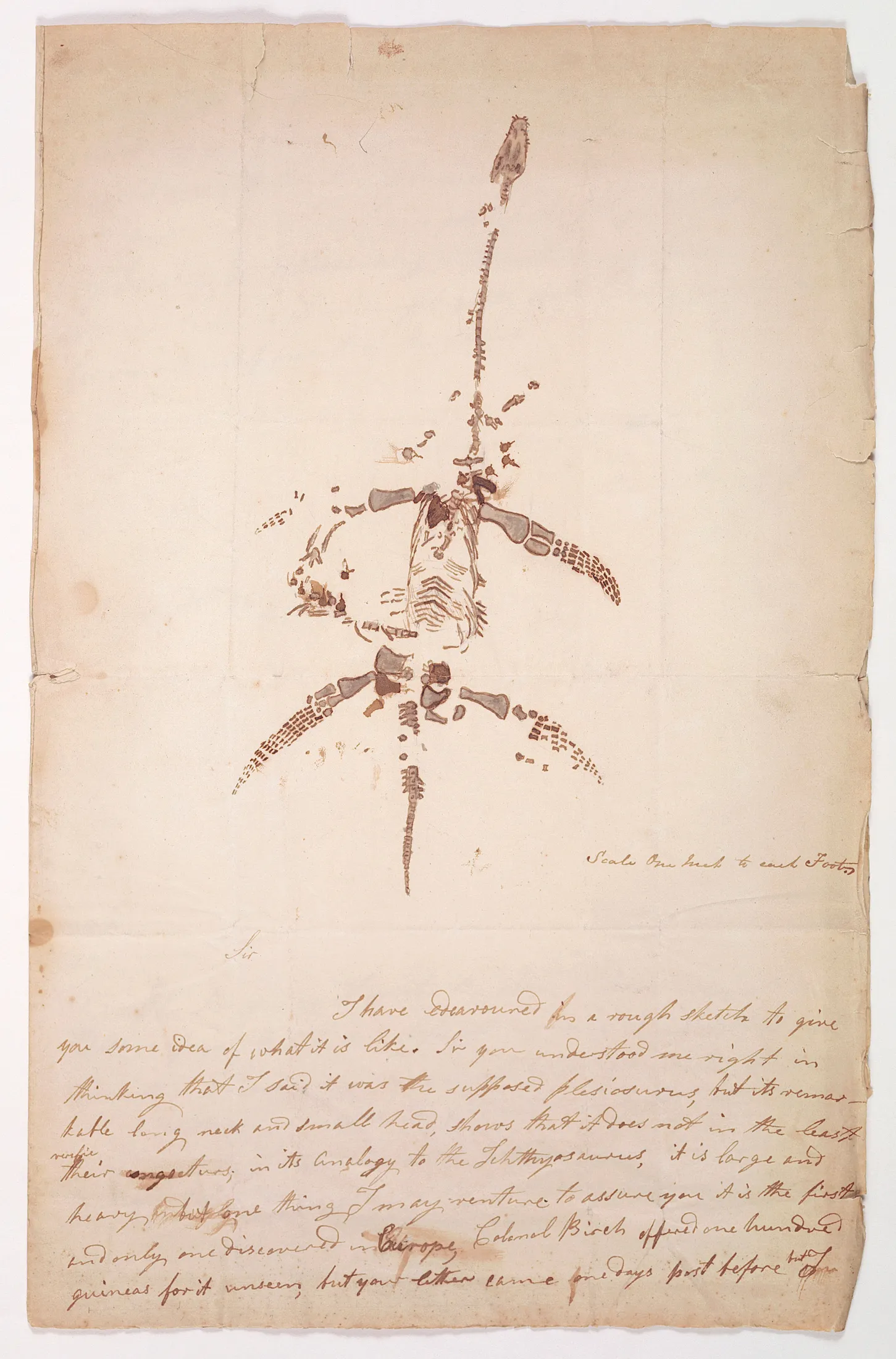
story[2]In December 1823 she was the first to find a complete skeleton of a Plesiosaurus, a specimen so strange that rumours spread it was a fake, and Georges Cuvier disputed the find before further illustrations satisfied him it was real. [A6]
story[3]That skeleton is held today by the Natural History Museum as the holotype of Plesiosaurus dolichodeirus, catalogue number NHMUK PV OR 22656, with the collector recorded as Mary Anning and the identifier recorded as William D. Conybeare. [A4]
story[4]Conybeare's account of it was read to the Geological Society of London on 20 February 1824 and printed in the Society's Transactions, and the paper credits "the kind liberality of its possessor, the Duke of Buckingham", the investigation of "my friend Professor Buckland", and a comparative head "in possession of Miss Philpot", while the name Anning appears nowhere in it. [A1]
story[5]Five years later a paper read to the same Society opened by naming her: William Buckland wrote of the blue lias at Lyme Regis "in which so many specimens of Ichthyosaurus and Plesiosaurus have been discovered by Miss Mary Anning, she has recently found the skeleton of an unknown species of that most rare and curious of all reptiles, the Pterodactyle". [A2]
story[6]She died at Lyme Regis on 9 March 1847, and at the Annual General Meeting of 18 February 1848 the President of the Geological Society read an account of her life and work into his Anniversary Address, telling the room that there were those present "who know well how to appreciate the skill she employed". [A3]