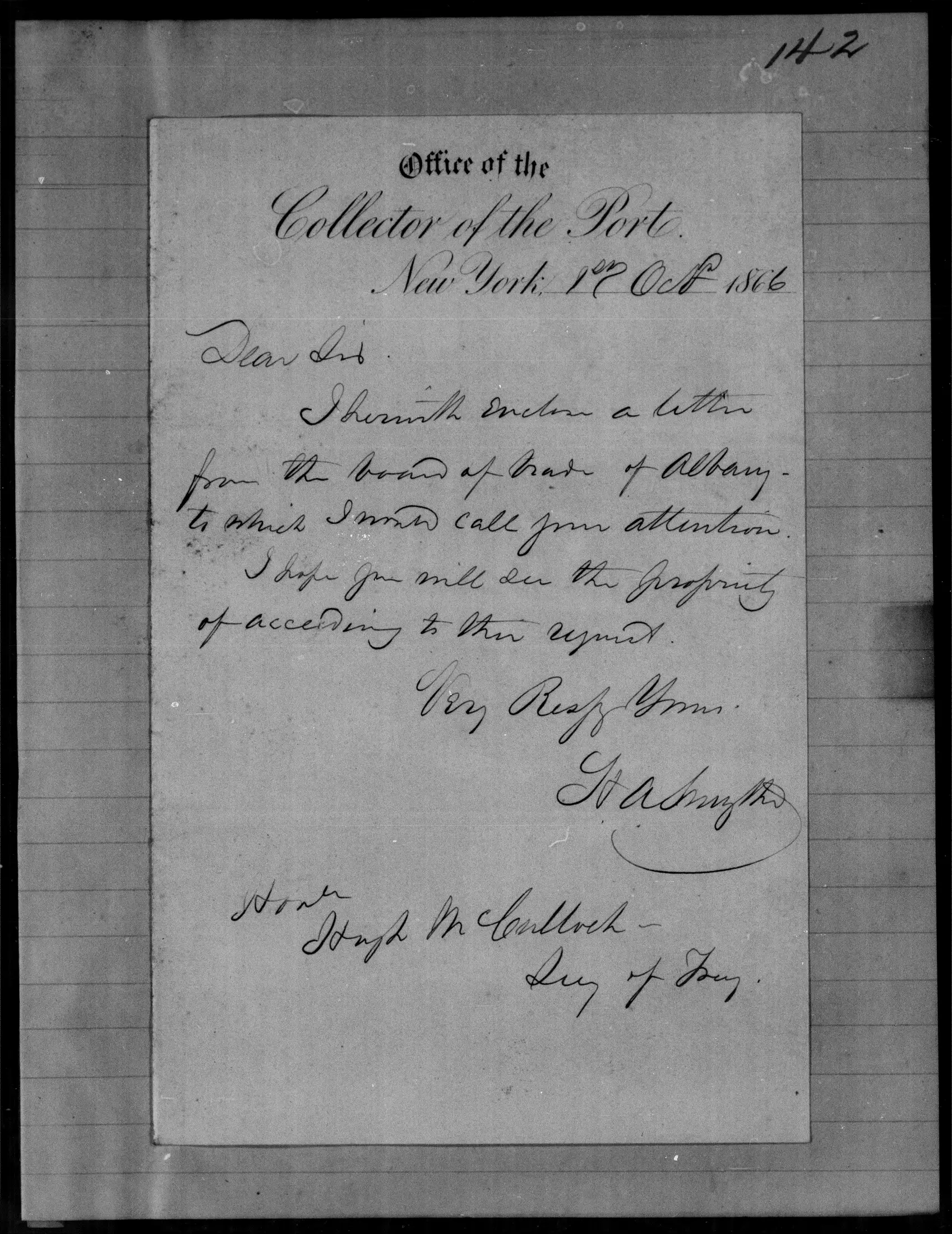
The customs post is sometimes quoted with a precise government title, such as 'Customs Inspector, District of New York' or 'Port of New York,' as if lifted directly from a payroll record.
No source checked for this record prints that exact phrasing. The record uses only the wording Weaver's biography gives, Inspector of Customs in New York, and Melville's own later description of the job in his own words. [B1]Raymond M. Weaver, Herman Melville: Mariner and MysticInternet Archive, from a Cornell University Library copyclass B · read 2026-07-28
Checked: Weaver's 1921 biography, the source for the appointment, was searched directly; it states Inspector of Customs in New York and nothing closer to a formal title. A companion verification pass in the MORE OF YOU campaign's Filed Under series reached the same conclusion on 2026-07-28 and struck the phrase for the same reason.
The customs post is sometimes given an exact end date, December 31, 1885 or January 1, 1886, stated as settled fact.
The record carries two accounts and does not resolve them. Weaver's biography states the post ran until January 1, 1886; other accounts give December 31, 1885. This record states the span as 1866 to 1886 and stops there. [B1]Raymond M. Weaver, Herman Melville: Mariner and MysticInternet Archive, from a Cornell University Library copyclass B · read 2026-07-28
Checked: Weaver, page 407, checked directly by full-text search; the discrepancy with other accounts is recorded here rather than adjudicated.
Billy Budd was published in Melville's lifetime, or soon after he finished it.
The record shows the opposite. Weaver's biography describes the manuscript as completed within months of Melville's 1891 death, and it did not reach print until 1924, in a volume issued by Constable and Company, thirty-three years later. [A3]Billy Budd and Other Prose Pieces (Constable and Company Ltd, 1924)Internet Archiveclass A · read 2026-07-28
Checked: Weaver's account of the manuscript's completion, and the Internet Archive's holding of the 1924 first print edition, both checked directly.
Melville died in complete and total obscurity, with no notice at all taken of his death.
The record does not support the absolute claim. Weaver's biography records that The New York Times printed an editorial on his death within days of missing the first news of it, even as the same account records the funeral as attended by only 'a meagre scattering of relatives and family friends.' A quiet death late in life is well documented here; a complete absence of notice is not. [B1]Raymond M. Weaver, Herman Melville: Mariner and MysticInternet Archive, from a Cornell University Library copyclass B · read 2026-07-28
Checked: Weaver, pages 376 and 415, checked directly by full-text search.