No. 01Catalogue essay
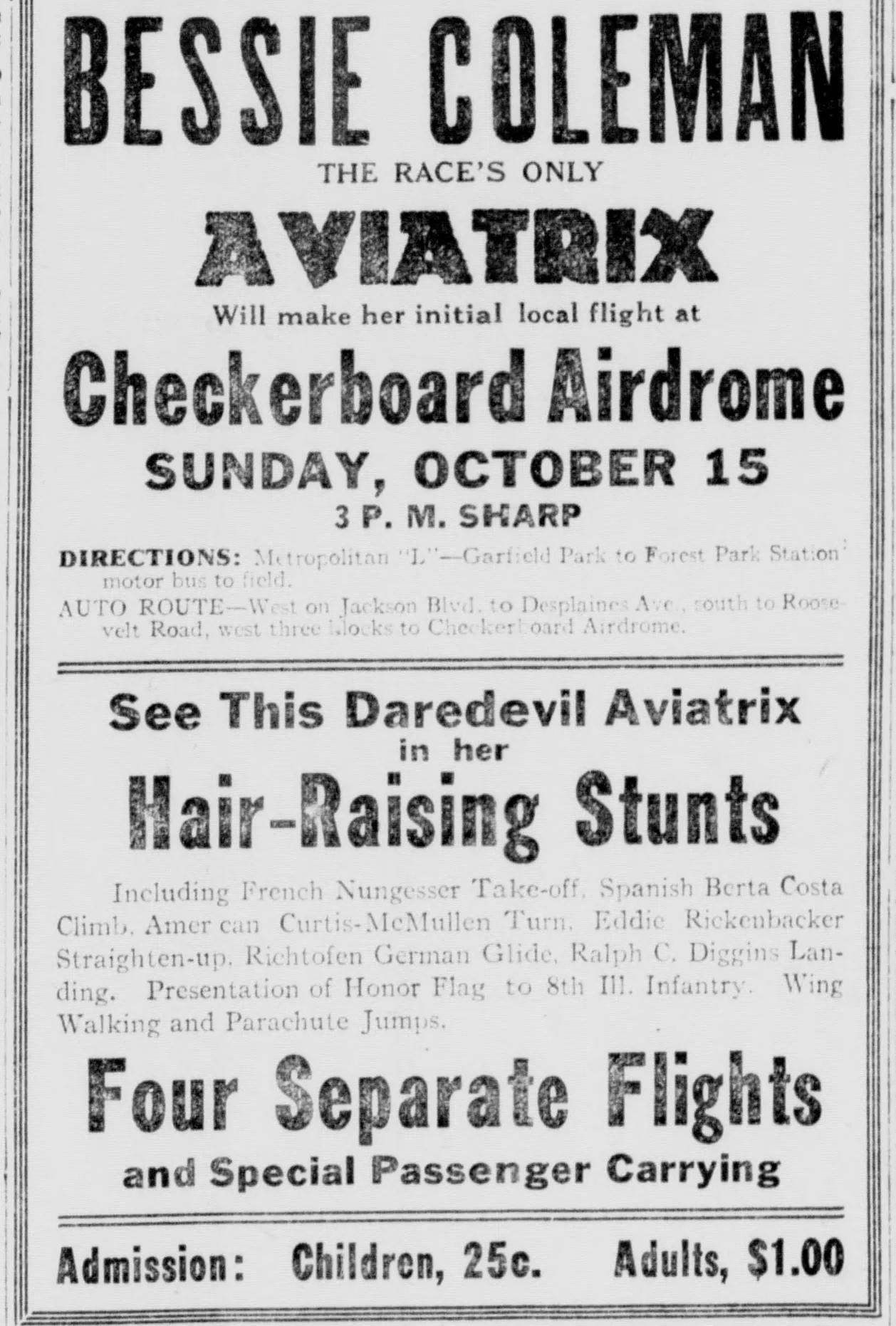
The document at the centre of this record is an aviator's licence issued by the Fédération Aéronautique Internationale on June 15, 1921, which the National Air and Space Museum records as the first pilot's licence issued to an African American woman and to a Native American woman. Before it, the smallest sentence Chicago filed her under was manicurist: the Handbook of Texas records the job at the White Sox Barbershop through the early years of the First World War, and a small but profitable chili parlor afterwards. No American school would take her, so she enrolled in French lessons on the advice of the publisher of the Chicago Defender, saved the fare, sailed for France, and was accepted by the Caudron Brothers School of Aviation. On September 3, 1922, at Curtiss Field on Long Island, in a borrowed Curtiss JN-4D Jenny, she made what the museum records as the first public flight by a Black woman in the United States, followed by a flight in Memphis and an exhibition at Checkerboard Field in Chicago on October 15 before an integrated crowd of 2,000. The exhibition years were also a speaking career, and the museum records that the talks often paid more than the flying. The Handbook of Texas records that she lectured at schools and churches to encourage young Black men and women to enter aviation, and that at Waxahachie she refused to give an exhibition on White school grounds unless Black attendees were admitted through the same entrance as White attendees. She was killed on April 30, 1926, at Paxon Field, Jacksonville, Florida, during a practice flight before a scheduled show; her mechanic William Wills, who was at the controls, was killed with her, and authorities found a loose wrench lodged in the control gears and determined the cause to be accidental.